41
WARNING
Never use a unit with visible damage to the spark
plug protector and ignition cable. There is a risk
of sparking, which can cause a re.
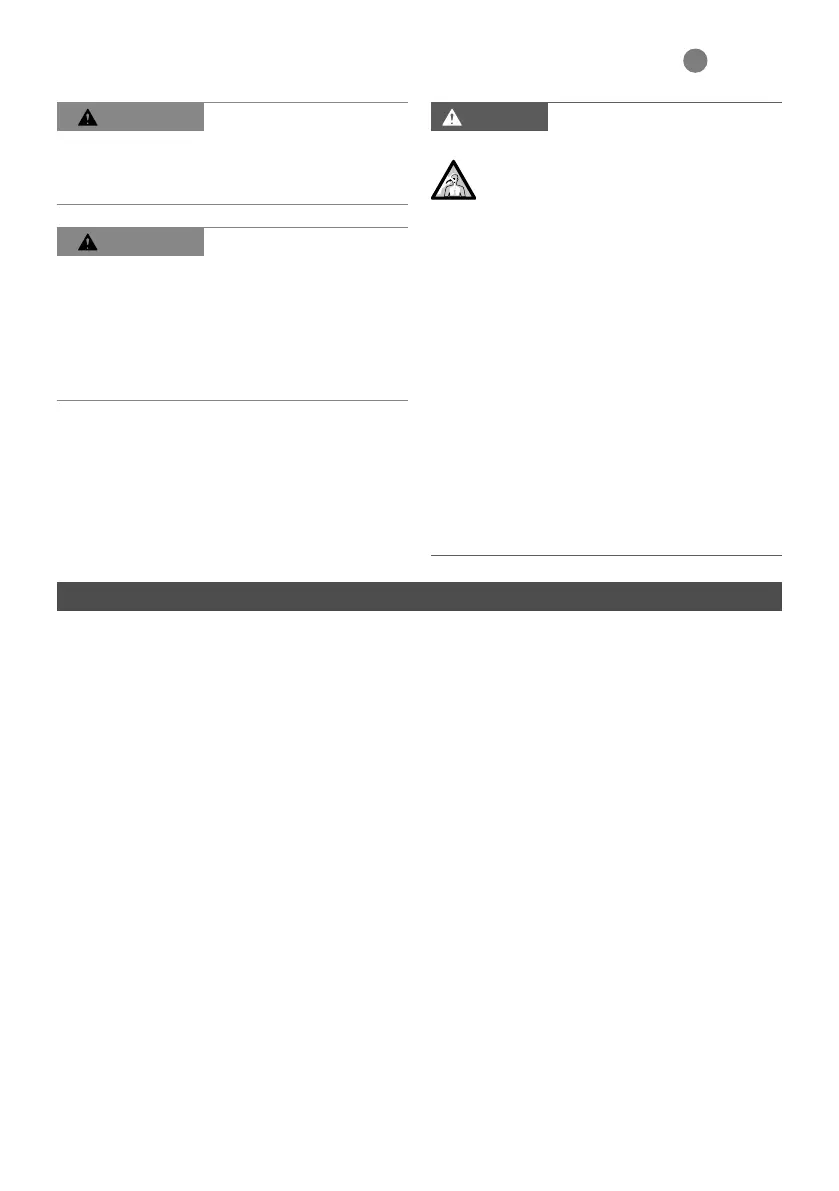
WARNING
Warning! This device generates an electroma-
gnetic eld during operation. This eld may
aect active or passive medical implants under
certain circumstances. To reduce the risk of seri-
ous or fatal injury, we recommend that persons
with medical implants consult their doctor and
the manufacturer of the medical implant before
operating the machine.
DANGER
Risk of poisoning!
As soon as the engine is running, this product gene
-
rates toxic exhaust fumes containing chemicals, such as
unburned hydrocarbons (including benzene) and carbon
monoxide, that are known to cause respiratory problems,
cancer, birth defects, or other reproductive harm. Some
of the gases (e.g. carbon monoxide) may be colourless
and odourless. To reduce the risk of serious or fatal injury/
illness from inhaling toxic fumes, never run the machine
indoors or in poorly ventilated locations. If exhaust fumes
become concentrated due to insucient ventilation, clear
obstructions from work area to permit proper ventilation
before proceeding and/or take frequent breaks to allow
fumes to dissipate before they become concentrated. In
-
halation of certain dust, especially organic duxts can cause
susceptible persons to have an allergic reaction. Sub-
stantial or repeated inhalation of dust and other airborne
contaminants, in particular those with a smaller particle
size, may cause respiratory or other illnesses. Control dust
at the source where possible.
SAFETY INSTRUCTIONS FOR CHAIN SAWS
• Keep all parts of the body away from the saw chain
when the chain saw is operating. Before you start the
chain saw, make sure the saw chain is not contacting
anything. A moment of inattention while operating
chain saws may cause entanglement of your clothing or
body with the saw chain.
• Always hold the chain saw with your right hand
on the rear handle and your left hand on the front
handle. Holding the chain saw with a reversed hand
conguration increases the risk of personal injury and
should never be done.
• The tool must only be held by the insulated grip
surfaces because the saw chain may touch concealed
wires. Saw chains that touch a live wire make metal
parts of the tool live and could give the operator an
electric shock.
• Wear eye protection. Further protective equipment
for hearing, head, hands, legs and feet is recom
-
mended.Adequate protective equipment will reduce
personal injury from ying debris or accidental contact
with the saw chain.
• Do not work on trees with the chainsaw. There is a risk
of injury when working on a tree.
• Always keep proper footing and operate the chain saw
only when standing on xed, secure and level surface.
Slippery or unstable surfaces may cause a loss of balance
or control of the chain saw.
• When cutting a limb that is under tension, be alert
for spring back. When the tension in the wood bres is
released the spring loaded limb may strike the operator
and /or throw the chain saw out of control.
• Use extreme caution when cutting brush and sapli
-
ngs. The slender material may catch the saw chain and
be whipped toward you or pull you o balance.
• Carry the chain saw by the front handle with the
chain saw switched o and away from your body.
When transporting or storing the chain saw, always
t the guide bar cover. Proper handling of the chain saw
will reduce the likelihood of accidental contact with the
moving saw chain.
• Follow instructions for lubricating, chain tensioning
and changing the bar and chain. Improperly tensi
-
oned or lubricated chain may either break or increase
the chance for kickback.
• Keep handles dry, clean, and free from oil and grease.
Greasy, oily handles are slippery causing loss of control.
• Cut wood only. Do not use chain saw for purposes
not intended. For example: do not use chain saw for
cutting metal, plastic, masonry or non-wood building
materials. Use of the chain saw for operations dierent
than intended could result in a hazardous situation.
Causes and operator prevention of
kickback:
Kickback may occur when the nose or tip of the guide
bar touches an object, or when the wood closes in and
pinches the saw chain in the cut.
Tip contact in some cases may cause a sudden reverse
reaction, kicking the guide bar up and back towards the
GB
ENGLISH


 To Next Page
 Loading...