43
saw to bounce towards you or bind up with enough force
to cause a kickback. The best tool for that kind of work is a
hand saw, pruning shears, an axe or other hand tools.
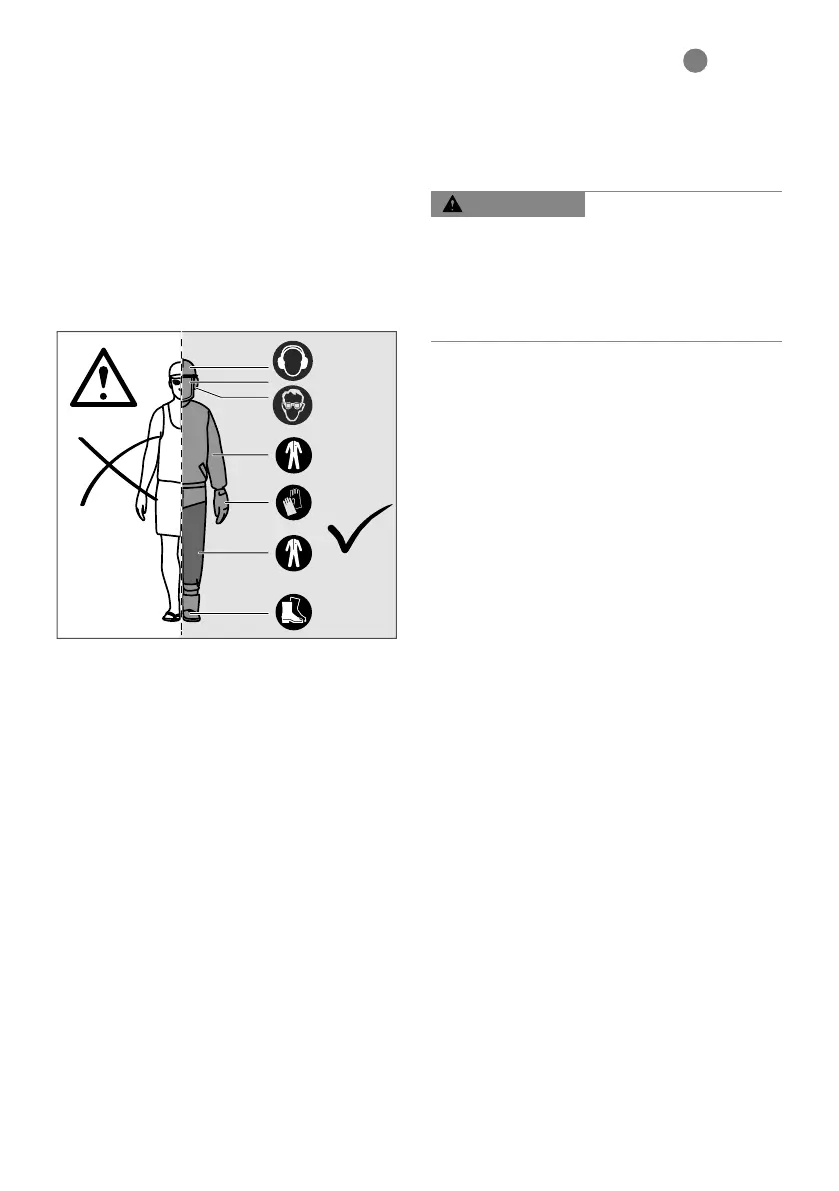
Personal protective equipment
Wear a helmet at all times when operating the machine.
A helmet, equipped with mesh visor, can help reduce the
risk of injury to the face and the head if kickback occurs.
Wear ear protectors. Exposure to noise can cause hearing
loss.
Good quality personal protective equipment, as used
by professionals, will help reduce the risk of injury to
the operator. The following items should be used when
operating the machine:
Safety helmet
should comply with EN 397 and be CE marked
Hearing protection
should comply with EN 352-1 and be CE marked
Eye and face protection
should be CE marked and comply with EN 166 (for safety
glasses) or EN 1731 (for mesh visors)
Gloves
should comply with EN381-7 and be CE marked
Leg protection (chaps)
should comply with EN 381-5, be CE marked and provide
allround protection
Chain saw safety boots
should comply with EN ISO 20345:2004 and be marked
with a shield depicting a chain saw to show compliance
with EN 381-3. (Occasional users may use steel toe-cap
safety boots with protective gaiters which conform to
EN 381-9 if the ground is even and there is little risk of
tripping or catching on undergrowth)
Chain saw jackets for upper body
protection
should comply with EN 381-11 and be CE marked
WARNING
Consequences of improper maintenance, removal
or modication of safety features like the chain
brake, ignition switch, hand guard (front and back),
spiked bumper, chain catcher, guide bar, low kick-
back saw chain may cause the safety features to not
function correctly, thus increasing the potential for
serious injury.
Low kick-back saw chain
A low-kick-back saw chain helps to reduce the possibility
of a kickback event.The rakers (depth gauges) ahead of
each cutter can minimize the force of a kick-back reaction
by preventing the cutters from digging in too deeply.
Only use replacement guide bar and chain combinations
recommended by the manufacturer.As saw chains are
sharpened, they lose some of the low kickback qualities
and extra caution is required. For your safety, replace saw
chains when cutting performance decreases.
Spiked Bumper
The integral bumper spike may be used as a pivot when
making a cut. It helps to keep the body of the chain saw
steady while cutting. When cutting, push the machine
forward until the spikes dig into the edge of the wood,
then by moving the rear handle up or down in the
direction of the cutting line it can help ease the physical
strain of cutting.
Guide Bar
Generally, guide bars with small radius tips have
somewhat lower potential for kick-back. You should use a
guide bar and matching chain which is just long enough
for the job. Longer bars increase the risk of loss of control
during sawing. Regularly check the chain tension. When
cutting smaller branches (less than the full length of the
guide bar) the chain is more likely to be thrown o if the
tension is not correct.
Chain Brake
Chain brakes are designed to quickly stop the chain
from rotating. When the chain brake lever/hand guard
is pushed towards the bar, the chain should stop
immediately. A chain brake does not prevent kickback.
It only lowers the risk of injury should the chain bar
contact the operator’s body during a kickback event. The
chain brake should be tested before each use for correct
operation in both the run and brake positions.
Chain Catcher
A chain catcher prevents the saw chain from being
thrown back towards the operator if the saw chain comes
loose or breaks.
GB
ENGLISH


 To Next Page
 Loading...