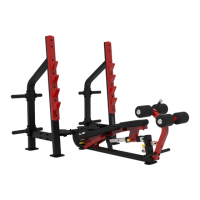
The IF2011 FID Bench is a versatile piece of fitness equipment designed for weight training. The acronym "FID" typically stands for Flat, Incline, and Decline, indicating that the bench's backrest can be adjusted to these various positions to accommodate a wide range of exercises. This adjustability allows users to target different muscle groups and perform a comprehensive workout. The bench is intended for use in a home or commercial setting, providing a stable and secure platform for lifting weights.
Function Description:
The primary function of the IF2011 FID Bench is to support users during various weight training exercises. Its adjustable design allows for:
- Flat Bench Press: For exercises like dumbbell or barbell chest presses, targeting the overall pectoral muscles.
- Incline Bench Press: To emphasize the upper chest and front deltoids.
- Decline Bench Press: To focus on the lower chest.
- Seated Exercises: With the backrest in an upright or inclined position, it can be used for shoulder presses, bicep curls, and tricep extensions.
- Abdominal Exercises: In a decline position, it can facilitate various core exercises like decline crunches.
The bench's construction emphasizes stability and durability, ensuring user safety during intense workouts. The inclusion of a head pad, back pad, and seat pad provides comfort and support.
Important Technical Specifications:
- Model Number: IF2011
- Product Type: FID Bench
- Class: H (likely indicating home use, though the manual also mentions commercial maintenance)
- Maximum Weight Capacity: 200 kg (440 lbs) – This refers to the total weight the bench can support, including the user and any weights being lifted.
- Maximum User Weight: 150 kg (330 lbs) – This specifies the maximum weight of the individual using the bench.
- Product Dimensions (LWH): 1383 mm * 568 mm * 497 mm
- Product Total Surface: 1383 mm * 568 mm
- Product Total Mass: 30 kg (66 lbs)
- Training Area and Free Area: The manual specifies a required free area of 600 mm around the product, indicating a total footprint of 1383 mm + 2600 mm (length) by 568 mm + 2600 mm (width) for safe operation.
- Assembly Time: Approximately 2 hours for professional installers.
- Fasteners: The manual provides a "Measurement Guide" for various bolt types (Button Head Cap Screw, Socket Head Cap Screw, Flat Head Cap Screw, Hex Head Bolt, Cross Recessed Pan Head Screw) and their corresponding tightening torques (N.m) for different diameters (M6, M8, M10, M12, M16). This detail is crucial for proper assembly and safety.
Usage Features:
- Adjustable Back Pad Support: The bench features an adjustable back pad support, allowing users to change the angle of the backrest for flat, incline, and decline positions. This is a core feature enabling its FID functionality.
- Comfortable Padding: Equipped with a head pad, back pad, and seat pad, designed to provide comfort and support during exercises.
- Sturdy Construction: The "Main Frame ASSY," "Rear Base ASSY," and "Shaped Base ASSY" indicate a robust structural design for stability.
- Foot Caps and Non-Skid Pads: The inclusion of various foot caps and non-skid pads (e.g., Foot Cap 50.876.2, Foot Cap 2 50.8, Plug 50.876.2, Non Skid Pid, Rubber Pad) suggests attention to floor protection and preventing slippage during use.
- Wheels: The presence of wheels (DP86703101B) indicates that the bench is designed for easier portability and movement within a training space.
- Pop Pin: A pop pin (IT9322G0500P201C) is likely used for quick and secure adjustments of the bench's components, such as the backrest angle.
Maintenance Features:
The manual provides a detailed "Maintenance Schedule" and "General Maintenance Information" to ensure the longevity and safe operation of the equipment. It differentiates between "Commercial Maintenance" and "Home Maintenance."
Routine Maintenance (Home Use):
- Daily/Weekly:
- Inspect: Links, Pull Pins, Snap Locks, Swivels, Weight Stack Pins (for wear/damage, tension, alignment).
- Clean: Upholstery (with a damp cloth, periodically with mild soap/vinyl cleaner).
- Inspect: Cables or Belts and their tension.
- Weekly/3 Months:
- Inspect: Accessory Bars and Handles.
- Inspect: All Decals (for safety warnings/user info).
- Inspect: All Nuts and Bolts (tighten if needed, periodically re-tighten all hardware).
- Inspect: Anti-Skid Surface (replace if worn/slippery).
- Monthly/3 Months:
- Clean & Lubricate: Guide Rods (with Teflon-based lubricant like Superlube).
- Lubricate: Seat Sleeves, Turcite Bushings, Linear Bearing (with Silicon or Teflon-based lubricant spray).
- 6 Months/Yearly:
- Clean and Wax: All Glossy Finishes.
- Repack with Grease: Linear Bearings (disassemble, apply light grease like lithium/super lube to ball-bearings and tracks).
- Yearly/3 Years:
- Replace: Cables, Belts, and Connecting Parts (at first signs of damage/wear).
General Maintenance Information Highlights:
- Upholstery: Wipe down after every workout, use mild soap/vinyl cleaner periodically, avoid abrasive cleaners, replace ripped/worn upholstery immediately, keep sharp objects away.
- Decals: Inspect and familiarize yourself with safety warnings.
- Nuts and Bolts: Inspect for loosening and tighten as needed; perform a re-tightening sequence periodically.
- Anti-Skid Surfaces: Replace if worn or slippery.
- Belts and Cables: Visually inspect for fraying, cracking, peeling, or discoloration. Feel for thinning or bulging areas. Replace immediately at the first signs of damage or wear. Do not use equipment until replaced.
- Belt and Cable Tension: Check bolt attachments and re-adjust tension if needed, referring to the owner's manual.
- Seat Sleeves, Guide Rods: Wipe down adjusting tubes with a dust-free rag before lubricating with a Silicon or Teflon-based lubricant spray.
- Linear Bearings: Disassemble, apply light grease (lithium, super lube) to ball-bearings and tracks until full, then reassemble and wipe off excess.
The manual also includes a "Tools Required" section, listing a Ratchet Wrench and Socket, Adjustable Wrench, Rubber Mallet, Hex Key Wrench Set, and Phillips Screwdriver, indicating the necessary tools for assembly and some maintenance tasks. The emphasis on reading all instructions and precautions before use underscores the importance of safety and proper operation.

 Need help?
 General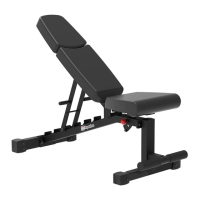

 To Next Page