EasyManua.ls Logo

Infopia EASYGLUCO Auto-coding - User Manual

Infopia EASYGLUCO Auto-coding
25 pages
Print Icon
To Next Page IconTo Next Page
Loading...
Blood Glucose Monitoring System
New bio-sensor technology :
Fast & Accurate results in 9 seconds
Blood Glucose Monitoring System for selftesting.
IMC00630 Rev.2014-05-03
Rm 1112, Ace Tower 9th Bldg., 130, Digital-ro,
Geumcheon-gu, Seoul, Korea
infopia Co.,Ltd.
132, Anyangcheondong-ro, Dongan-gu,
Anyang-si, Gyeonggi-do, Korea (431-836)
http://www.infopia21.com
Obelis S.A.
Bd. General Wahis 53 1030 Brussels, Belgium
Tel:+(32) 2.732.59.54 Fax:+(32) 2.732.60.03
E-mail:mail@obelis.net
INFM16B
Lancet : infopia Co.,Ltd.
Lancing Device : GMMC
Parc Industrial Ciutat de Carlet Mestral 20, 46240
Carlet, Valencia, Spain
Tel : +34 963 691 484
Fax : +34 963 691 484
E-mail : aricco@gmmc-inc.com
Global Medical Market Corporation S.L.
Question and Answer IconNeed help?

Do you have a question about the Infopia EASYGLUCO Auto-coding and is the answer not in the manual?

Summary

EASYGLUCO Auto-coding System Introduction and Overview

Introduction to the EASYGLUCO System

Welcome and overview of the EASYGLUCO Auto-coding blood glucose monitoring system.

Quick Reference for Initial Use

A brief guide for quick setup and initial blood glucose testing steps.

Safety, Components, and Meter Setup

General Safety and Handling Guidelines

Essential safety notes for using the EASYGLUCO Auto-coding blood glucose monitoring system.

EASYGLUCO System Components and Meter Overview

Identifies kit contents and key parts of the EASYGLUCO Auto-coding Blood Glucose Meter.

LCD Display Symbols and Test Strip Basics

Understanding meter symbols and basic test strip storage/handling.

Setting Up and Configuring the EASYGLUCO Meter

Covers meter setup options, limitations, and initial configuration.

Performing Blood Glucose Tests with EASYGLUCO

Automatic Code Recognition and Control Testing

Using auto-recognition and control solution for accurate testing.

Preparing for Blood Glucose Testing

Essential items and steps required before performing a blood glucose test.

Collecting Blood Samples and Test Procedure

Guide to collecting blood samples and the main test procedure.

Test Strip Ejector Function

Instructions on how to safely remove used test strips from the meter.

Managing Results, Advanced Features, and System Care

Reviewing and Deleting Test Results

How to view, manage, and delete recorded blood glucose test data.

Alternate Site Testing and Data Transfer

Guidelines for alternate site testing and transferring data to a computer.

Meter Maintenance and Cleaning

Instructions for cleaning and maintaining the EASYGLUCO Auto-coding meter.

Troubleshooting and Technical Information

Troubleshooting Common Meter Error Messages

Explains common error messages and provides solutions.

Test Principle and Performance Characteristics

Details the scientific principle and performance characteristics of the system.

Technical Specifications and Conversion Table

Provides device specifications and a mmol/L to mg/dL conversion chart.

EASYGLUCO Warranty and Symbols Reference

Three-Year Product Warranty Policy

Outlines the warranty terms and conditions for the EASYGLUCO meter.

Explanation of Reference Symbols

Explains the meaning of various symbols used on the product and its packaging.

Overview

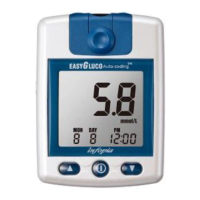
The EASYGLUCO Auto-coding™ Blood Glucose Monitoring System is a device designed for self-testing blood glucose levels, providing fast and accurate results. It utilizes new bio-sensor technology to deliver readings in just 9 seconds. The system is intended for in vitro diagnostic use only and should not be used for the diagnosis of diabetes.

Function Description:

The primary function of the EASYGLUCO system is to measure blood glucose levels from fresh capillary whole blood samples. It operates on a principle where glucose in the blood sample reacts with electrodes in the test strip, generating an electrical current that stimulates a chemical reaction. This reaction is then measured by the meter and displayed as your blood glucose result. The system is plasma-calibrated, allowing for easy comparison of results with laboratory methods.

Usage Features:

The EASYGLUCO meter boasts several user-friendly features to enhance the testing experience:

  • Auto-coding™: This is a key feature that automatically recognizes the code number from the test strip. This eliminates the inconvenience of manually setting the code number every time, preventing potential errors due to incorrect coding. When a test strip is inserted, the code number is automatically displayed, and users are advised to compare it with the code number printed on the test strip vial. If they don't match, the strip should be discarded.
  • Fast Results: The system provides blood glucose readings in a quick 9 seconds, making the testing process efficient.
  • User Activity Function: This feature allows users to designate activities related to their test results, providing context for their glucose readings.
  • 100 User ID Function: The meter supports up to 100 unique User IDs, which is useful for managing data for multiple users or for tracking individual results separately. When activated, test results are stored under the selected User ID.
  • Strip Ejector Function: After a test is complete, the strip ejector button allows for hygienic and safe disposal of the used test strip without direct contact.
  • Memory Storage: The meter can save up to 365 test results in its built-in memory. It also records the average glucose level for a user-preset number of days (7, 14, or 21 days). The newest result replaces the oldest once the memory is full.
  • Alarms: Users can set up to 5 alarms for planned testing times, helping to maintain a regular testing schedule.
  • Alternate Site Testing (AST): The system allows for testing from alternate sites such as the dorsal hand, ventral palm, upper arm, forearm, calf, and thigh, in addition to fingertips. A transparent tip for the lancing device is provided for AST. However, it's important to note that fingertip samples may show changes more quickly, especially when blood glucose is changing rapidly (e.g., after a meal, insulin dose, or physical exercise). Fingertip testing is recommended for hypoglycemia or when glucose levels are changing rapidly.
  • Date and Time Setting: The meter allows users to set the year (from 2008 to 2099), date, and time, ensuring accurate recording of test results.
  • Test Unit Selection: Users can choose between mg/dL or mmol/L as their preferred test unit. It's crucial to select the correct unit to avoid inaccurate result displays.
  • Control Solution Testing: The EASYGLUCO Control Solution (available in low, normal, and high levels) can be used to check if the meter and test strips are working correctly. This is recommended when opening a new vial of strips, if there's suspicion of malfunction, inconsistent results, or if the meter has been dropped.
  • PC Communications Port: The meter can be connected to a computer using a dedicated USB cable to transfer test results for further analysis using the EASYGLUCO Blood Glucose Program, which can be downloaded from the manufacturer's website.

Maintenance Features:

Proper care and maintenance are essential for the safe, accurate, and long-lasting use of the EASYGLUCO meter:

  • Cleaning: The meter should be cleaned with a soft cloth or tissue after testing. If necessary, rubbing alcohol can be used to wipe away dirt on the outer surface, but direct pouring of alcohol onto the meter should be avoided. Chemical solutions like benzol or acetone should not be used as they can damage the meter surface. After cleaning, the meter should be dried completely in a cool place away from direct sunlight.
  • Storage: The meter and test strips should be stored in a cool, dry area (2-30°C for strips) away from direct sunlight, moisture, and out of reach of children. The meter should be kept in its carrying case to prevent loss or damage. Test strip vials should be tightly capped immediately after removing a strip.
  • Battery Replacement: The meter uses two 3V Lithium batteries (CR2032). A low battery warning symbol appears on the LCD screen when power is running low. When replacing batteries, users must match the polarity symbols (+ or -) printed on the battery deck.
  • Lancing Device Maintenance: The lancing device should be cleaned if blood or stains remain to prevent infectious diseases. Lancets are for single use only and should be disposed of properly in a biohazard container.
  • Disposal: The meter and used batteries must be disposed of according to local regulations for electrical and electronic equipment and waste batteries, respectively. The manufacturer provides specific instructions for the recovery of the meter.
  • Photo Sensor Cleaning: If the meter is not working properly, the photo sensor can be cleaned with an alcohol gauze after opening the ejector cover. However, opening the cover for other purposes is strongly discouraged as it may affect sensor performance.

Infopia EASYGLUCO Auto-coding Specifications

General IconGeneral
ModelEASYGLUCO Auto-coding
TypeBlood Glucose Meter
Auto-codingYes
Measurement Range20-600 mg/dL
Sample TypeWhole Blood
Test Time9 seconds
DisplayLCD
Power Source2 x AAA batteries
Operating Temperature10-40 °C (50-104 °F)
Operating Humidity10-90% RH
Hematocrit Range30-55%
Sample Volume1.5 μL
Battery Life1000 tests

Related product manuals