APRIL 2020 • REVISION 4.0 INSTRUCTION MANUAL
7
2.1 The ProXcide™ major components
The ProXcide™ is a bio-decontamination system that delivers vaporised ProXcin™ (containing
hydrogen peroxide ≤ 7.5%) to surfaces within an enclosed space. It is designed for use in
commercial and healthcare settings. The ProXcide™ automatically adjusts every decontamination
process to the specific environment, monitoring and adjusting for temperature, humidity
and absorbency as well as to the volume of the room in order to ensure the same successful
decontamination is achieved every time. The complete decontamination cycle includes the injection
phase, ‘dwell’ phase, and a deactivation phase. The ProXcide™ system has a fully-integrated
deactivation unit that very quickly deactivates hydrogen peroxide in the treatment space at the end
of the decontamination process. The deactivation unit comprises a highly-eicient air-circulation
system which passes the air through a catalyst to quickly reduce the concentration of atmospheric
hydrogen peroxide.
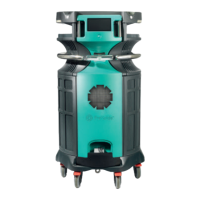
The ProXcide™ is made up of two major components:
1. The main vapour generating unit – is placed inside the sealed room where it carries out the
disinfection process. This consists of injection, deactivation and process control modules.
The main unit carries out a series of checks before enabling decontamination, and continually
monitors the humidy in the room to ensure the decontamination cycle is eective and
completed successfully. The main unit is powered from 230V mains.
2. The process monitor – is placed outside the room and is used to start the process. To ensure
correct set-up, the Operator is guided through an on-screen checklist. It also provides real-
time visual information about the decontamination stage and estimated time remaining, any
error messages and has an emergency stop button. The process monitor is powered by a 5V
5A CE marked power supply.
The process monitor and main unit communicate with each other using a built in wireless
system (which does not require access to hospital WiFi).
Section 2: The ProXcide
™


 To Next Page