Need help?
Do you have a question about the Inspur TS860M5 and is the answer not in the manual?
Provides critical safety guidelines and warnings for operating the server to prevent injury or damage.
Introduces the Inspur TS860M5 server, its high quality, reliability, and performance improvements.
Details the server's processor, chipset, memory, I/O, display, SAS, NIC, management, and PCIe configurations.
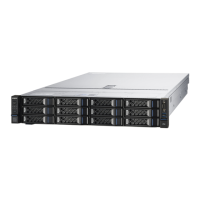
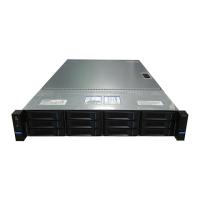
Identifies and describes components on the server's front panel, including LEDs and buttons.
Identifies components on the server's rear panel, showing views for different configurations.
Identifies components on the CPU board, including DIMM slots, CPUs, and connectors.
Identifies components on the half-height IO board, including PCIe slots and connectors.
Identifies components on the full-height IO board, including PCIe slots, connectors, and management ports.
Explains the function and usage of the CLR_CMOS jumper on the motherboard.
Provides instructions on how to power on the server.
Details the procedure for safely powering down the server, including warnings.
Explains how to extend the server from its rack mounting for maintenance or installation.
Guides on how to remove the server's access panel for component access, with safety warnings.
Provides steps to remove a compute node from the server, including safety precautions.
Details the procedure for removing the IO module from the server, with safety warnings.
Guides on how to reinstall the server's access panel after maintenance.
Describes requirements for the server's installation environment, including space and airflow.
Specifies clearances needed in front, behind, and between racks for proper airflow and servicing.
Outlines maximum recommended ambient operating temperatures for safe server operation.
Details electrical regulations and guidelines for server installation, including circuit loading.
Explains essential electrical grounding requirements for server operation and safety.
Provides crucial safety warnings related to rack installation and stability.
Lists the items typically included in the server shipping carton.
Instructs to install hardware options before server initialization, referring to option documentation.
Provides guidance on installing the server into a rack, emphasizing weight distribution.
Guides on installing a supported operating system on the server, including method and driver information.
Advises reading installation instructions for multiple hardware options and identifying similar steps.
Details the procedure for installing or replacing a processor, including safety and compatibility notes.
Provides guidelines for DIMM population and installation positions for optimal memory configuration.
Explains the process of installing or removing hot-plug HDDs, with cooling precautions.
Guides on installing or removing hot-plug PCIe cards, with cooling and safety considerations.
Details the procedure for installing or removing non-hot-plug PCIe cards, requiring system power down.
Guides on installing redundant hot-plug power supplies, with cooling precautions.
Illustrates and describes signal cable connections using color coding for NVME, SAS, I2C, and VGA/UI/OLED lines.
Illustrates and describes power cord connections using color coding for HDD backplanes and GPUs.
Provides instructions on how to access the BIOS setup interface during system startup.
Details various BIOS parameter descriptions, including Front Page, Main, and Advanced menus.
Describes the Front Page interface of the BIOS, including product, BIOS, CPU, and memory information.
Details the Main interface of the BIOS setup, displaying system information like product name, serial number, and firmware versions.
Introduces the Advanced menu in BIOS, covering peripheral, video, SIO, socket, ME, PCH, and power management configurations.
Configures administrative security settings, including TPM, supervisor, and user password settings.
Configures system boot options, including boot type, boot priority, and EFI settings.
Provides instructions for updating BIOS and ME firmware using the UEFI Shell or Linux tools.
Provides instructions for updating BIOS and ME firmware using the UEFI Shell.
Details how to update BIOS and ME firmware using H2OFFT tools on a Linux OS.
Introduces the Inspur Server Management System, its specifications, and main functions like remote control and monitoring.
Describes the composition and functions of BMC modules: IPMI, command line, WEB, KVM Over IP, and virtual media.
Introduces the BMC Web interface, including login steps and layout overview.
Describes the storage interface, focusing on LSI RAID card support for controller, physical, and logical drives.
Covers the remote control interface, including console redirection, server location, remote session, and virtual media.
Explains the power supply and fan interface, covering monitor, configuration, fan speed control, and server power control.
Covers BMC settings interfaces for network, services, NTP, SMTP, alerts, access control, and BIOS boot options.
Describes the log interface, including system event log, BMC audit log, black box log, and log settings.
Explains the fault diagnosis interface, covering BMC self-inspection, recovery, screen capture, and POST codes.
Covers administration interfaces for user management, security, dual image, firmware updates, and factory defaults.
Details services and protocols supported by BMC for network configuration, including HTTP/HTTPS, KVM, and SSH.
Describes user management for BMC, including IPMI user privileges and system user details.
Provides instructions for updating BMC firmware via Web GUI or SOCFlash tool.
Introduces Redfish, a RESTful interface for server management, explaining GET, POST, DELETE operations.
Introduces Web interface login and command line functions, including login methods and available commands.
Provides a comprehensive table listing various time zones and their corresponding GMT offsets.
Discusses common hardware issues like power-on failure, no display, abnormal LEDs, and fan noise, with troubleshooting steps.
Addresses common software issues including system installation failures, large disk utilization, and memory capacity inconsistencies.
Provides instructions and safety warnings for replacing the server's real-time clock battery.
Explains the purpose and location of the unique regulatory model number for compliance identification.
Details FCC rules on RF emission limits and device classifications (Class A/B).
Specifies the use of shielded cables with metallic RFI/EMI connector hoods for compliance.
Lists EU directives (Low Voltage, EMC, Eco-design) for CE marking compliance.
Provides guidance on proper disposal of waste equipment according to EU regulations.
Provides Korean notices regarding Class A and Class B equipment compliance.
Provides Chinese notices regarding Class A equipment and potential interference.
Repeats safety warnings for handling and replacing battery packs.
Warns about static electricity damage and provides precautions for handling sensitive components.
Details methods for proper grounding when handling electrostatic-sensitive parts.
Introduces the standard three-year warranty for Inspur hardware products and service variations by country.
Outlines the service overview, including remote services and RMA procedures.
Lists exclusions from warranty coverage, such as misuse, unauthorized repairs, and consumables.

 To Next Page
 General