
 Need help?
Do you have a question about the Invacare Softform and is the answer not in the manual?
Essential nursing care for pressure ulcer prevention. Promotes positive outcomes.
Explains warning symbols and their severity levels for user safety.
Outlines the manufacturer's warranty terms and conditions for the product.
Details the specific purpose and approved applications of the pressure redistribution mattress.
Provides an estimate of the product's expected lifespan and factors affecting it.
Crucial warnings and precautions for safe product usage and potential hazards.
Explains the meaning and importance of various symbols found on the product itself.
Detailed overview of the mattress features, benefits, and design for pressure reduction.
Lists and illustrates the individual parts included in the product's delivery scope.
Key safety guidelines for setting up and using the mattress correctly.
Guidelines and precautions for safely handling and transporting the mattress.
Procedures for regularly checking the mattress for damage or signs of wear.
Instructions on how to clean and care for the mattress covers and components.
Detailed instructions for cleaning the mattress when heavily soiled.
Steps for safely removing and fitting new covers onto the foam core.
Guidelines for storing the mattress properly to maintain its condition.
Information and requirements for reusing the mattress, including cleaning records.
Procedures for disposing of the mattress in compliance with local regulations.
Table detailing product specifications, warranty, fire testing, and user weight limits.
Lists the materials used in the construction of the mattress components.
Specifies operating and storage/shipping conditions for the product.
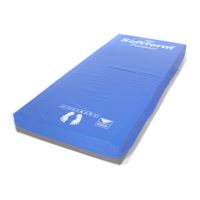
The Invacare Softform mattress is a pressure redistribution mattress designed to be used in conjunction with an appropriately sized bed frame as part of an overall pressure ulcer prevention program. It aims to provide effective pressure reduction to users by promoting even weight distribution, thereby reducing tissue pressure at potentially vulnerable areas. The mattress is suitable for beds with an adjustable lying surface.
The product is intended for use with a cotton, cotton combination, or linen bed sheet as the only item between the support surface and the user to maximize its clinical effectiveness. Any other use is prohibited.
It is crucial to read and understand the user manual completely before using the product or any optional equipment. Failure to do so may result in injury or damage. Invacare product manuals are available online or from your local dealer. If any warnings, cautions, or instructions are unclear, contact a healthcare professional, dealer, or technical personnel before attempting to use the equipment.
Regular repositioning of the patient, based on the clinical judgment of a qualified healthcare professional, is very important to relieve pressure and help prevent tissue compression and potential ulcer formation. Patients should be monitored frequently.
Bed sheets must be loosely fitted and smoothed out to prevent creases. The support surface in contact with the user must always be kept free from crumbs, food debris, drip cables, stents, and other foreign objects, as these can become entrapped and lead to pressure ulcer development.
Invacare products are specifically designed and manufactured for use with Invacare accessories. Accessories from other manufacturers have not been tested by Invacare and are not recommended, as they may reduce or impede the clinical effectiveness of the product. "Third-party products" include items like under blankets, plastic sheets, and sheepskins. Heated over-blankets should only be used in consultation with a suitably qualified healthcare professional, as increased temperature can elevate the risk of pressure ulcers.
There is a risk of fire or explosion. A cigarette can burn holes in the bed surface and damage the mattress. Patient clothing, bed sheets, and other items may be combustible. Do not use the mattress in oxygen-rich environments and do not smoke near it.
The mattress cover must always face upwards. Ensure that the distance between the mattress surface and the top of the side rail is at least 220 mm.
If holes are present in the mattress cover, there is a risk of liquid ingress and contamination. Medical equipment, including infusion pumps and monitors, should be attached to appropriate bed accessories. For home use, common causes of damage include cigarette burns and pet claws that can puncture sheets, leading to fluid ingress and staining.
To prevent accidental damage to the mattress cover, avoid placing sharp objects like hypodermic needles, venflons, or scalpels on the mattress. Ensure all venflons are taped down correctly with no sharp edges exposed. When using patient transfer aids, check for any sharp edges or burrs that could damage the mattress. When used on beds with an adjustable frame, ensure the mattress is not jammed or damaged by sharp edges. On profiling beds, the knee break should be used before the backrest.
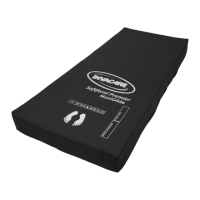
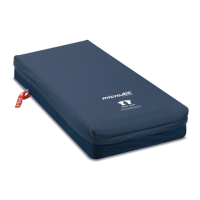
The mattress typically includes a multi-stretch waterproof polyurethane cover, a castellated foam insert, and a single-piece foam "U" core. Other mattress configurations may vary. An antimicrobial Softform Silver3 cover is available as an optional extra for Softform mattresses.
When handling mattresses, take care to avoid damage to the cover. It is recommended that two people lift/carry mattresses. Avoid contact with jewelry, nails, abrasive surfaces, walls, door frames, door catches, or locks. Do not drag mattresses. If transporting in roll cages, ensure the mattress is completely protected from sharp edges. Refer to the storage and shipping conditions in the environmental parameters section for more details.
The mattress (foam and cover) should be checked for strike-through (fluid ingress, stains, rips, or damage) after each patient's release, after the period of use ends, or at least monthly, whichever comes first. This inspection should be performed by a suitably qualified and competent person.
To check the mattress, unzip the cover completely and inspect for any staining on the white underside of the cover and the interior foam. Any stained items should be replaced and disposed of according to local authority procedures.
All cleaning agents and disinfectants used must be effective, compatible with each other, and protect the materials being cleaned. For detailed information on decontamination in healthcare environments, refer to 'The National Institute for Clinical Excellence' guidelines on Infection Control (www.nice.org.uk/CG139) and your local infection control policy.
Hang mattress covers from a line or bar and drip dry in a clean indoor environment, or tumble dry on a low heat setting. The tumble dry setting must not exceed 40 °C and should not exceed 10 minutes. Dry thoroughly before re-fitting to the foam.
Contact your hygiene specialist in case of contamination. Ensure any residual detergent has been removed prior to disinfection.
For heavily soiled mattresses, cleaning with a dilute cleaning solution at 80 °C in a washing machine is recommended. Large blood spillages should first be absorbed and removed with paper towels.
Polyurethane-coated fabrics can absorb liquids temporarily, causing a temporary change in their characteristics. The mattress cover swells temporarily and is more vulnerable to physical damage during this period. It will revert to its previous state once completely surface dried. Regular use of 1% Chlorine Solution can diminish the life of the cover if not rinsed and dried properly. Do not use granules.
Do not use phenols, alcohols, bleaches, or other abrasive materials. Remove contaminated foams from use. Keep clear of open heat sources.
Mattresses are sometimes compact-rolled for ease of storage and handling, which does not affect performance or longevity. When unrolled for the first time, allow at least one hour for recovery to optimize performance. Store mattresses in a dry environment, within a protective cover. Store items on clean, dry, off-flooring surfaces, free from sharp edges to prevent damage. Never store other items on top of a mattress. Do not store mattresses next to radiators or other heating devices. Protect mattresses from direct sunlight. Refer to the storage and shipping conditions in the environmental parameters section.
A cleaning record must be kept as part of cleaning the system. The product is suitable for repeated use, with the number of uses depending on frequency and manner of use. Before reuse, clean the product thoroughly as described in the "Cleaning and care" section.
Disposal and recycling of used devices and packaging must comply with applicable local legal regulations. Ensure the mattress is cleaned prior to disposal to avoid any risk of contamination.
 General
| Material | Foam |
|---|---|
| Pressure Relief | Yes |
| Cover Material | Polyurethane |
| Intended Use | Pressure ulcer prevention |
| Cover | Polyurethane |
| Cleaning | Wipe clean with mild detergent |



 To Next Page