C.P. SENTINEL AUTOMATIC TYPE CATHODIC PROTECTION RECTIFIER MANUAL
INTEGRATED RECTIFIER TECHNOLOGIES, INC.
Doc #: APC0010
Rev. 3.0, November, 2004
Page 13 of 22
POTENTIAL CONTROL AND EXTERNAL IR DROP
In applying and operating IR-Drop Free C.P. SENTINEL Automatic Rectifiers, it is important
that Cathodic Protection personnel are familiar with the methods & principles of using this type
of rectifier to mitigate corrosion. Briefly described as follows:
Current flowing in the measurement circuit will cause a voltage drop (referred to the Ohm’s
Law equivalent of Current “I” multiplied by Resistance “R” or “IR”), which becomes
incorporated into measurements as an error. In addition, any external currents flowing through
the electrolyte in the area between the reference electrode and the structure will cause their
own voltage drop, which also becomes part of the measurement as an additional error.
Cathodic protection systems and AC & DC electrical power systems are some of the possible
sources of these currents. The magnitude of errors from external IR drops can be substantial.
To accurately maintain the required polarization potential on a given structure, these errors
must be minimized during the design phase and then eliminated by electronic circuitry within
the SENTRY Controller, which is used in the C.P. SENTINEL Automatic Rectifiers.
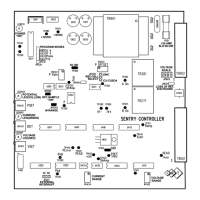
The SENTRY Controller removes the IR drop error from the potential measurement by
interrupting the cathodic protection current supplied by the rectifier momentarily. This action
produces an instantaneous voltage drop, which is considered to be the external IR Drop. The
potential from Reference Electrode to Structure is measured immediately after this
instantaneous drop, and is considered to be the "IR Drop Free" potential of the structure.
Clearly, this method only works with an impressed current cathodic protection system where
all the rectifiers on that system can be interrupted simultaneously, and there are no other
sources of current flowing through the electrolyte.
An issue that should be considered when using current interruption for instant-off
measurements is: What is meant by instantaneous? The answer is not simple since it depends
upon the structure, the electrolyte and the method of interrupting the current. Putting the
answer in electrical terms, it depends upon the capacitance and the inductance of the circuit.
IR drop free measurements can be made microseconds after current interruption on small,
uncoated specimens in a low resistance electrolyte. Large coated structures, such as
pipelines, or high resistance electrolytes, such as concrete, usually require several hundred
milliseconds or more for IR-drop free measurements. Interrupting current on the AC side rather
than on the DC side of the rectifier will increase the time delay because the circuit inductance
is higher. An oscilloscope should be used if measurement precision is necessary; it should be
either battery powered or connected through an isolation transformer to eliminate ground
loops.
NOTE:
This section applies only to C.P. SENTINEL Automatic Rectifiers which have been ordered
and manufactured to function as IR-Drop Free Reference Electrode controlled outputs.
Consult your Rectifier Specification Sheet.


 To Next Page