C.P. SENTINEL AUTOMATIC TYPE CATHODIC PROTECTION RECTIFIER MANUAL
INTEGRATED RECTIFIER TECHNOLOGIES, INC.
Doc #: APC0010
Rev. 3.0, November, 2004
Page 7 of 22
RECTIFIER CONNECTIONS AT SITE
DO NOT INSTALL, REMOVE, or REWIRE
THIS EQUIPMENT WITH POWER APPLIED!!
After the rectifier has been installed in a suitable location, have a qualified electrician connect
the rectifier unit to the AC supply following local and national codes. Please note that most
electrical codes require a disconnect device between the AC power supply and the rectifier.
Ensure that for dual AC input rectifiers (115 / 230 or 230 / 460 VAC), that the AC input terminal
jumpers are properly configured for the actual AC input voltage being supplied and that the AC
input wires are connected to the correct AC input terminals.
The grounding rod(s) should be connected to the ground lug terminal adjacent to the AC input
terminals within the rectifier.
Next, connect the cable(s) from the anode bed to the RECTIFIER POSITIVE output lug
terminal(s) and the structure cable(s) to the RECTIFIER NEGATIVE output lug terminal(s).
Ensure that these cables are suitably sized for the expected current and the length of the
cable run. Also, it is absolutely imperative that the polarity of DC connections is correct. A
reversal of the DC cables can actually cause accelerated corrosion and eventually, severe
damage to the structure to be protected.
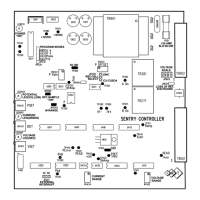
C.P. SENTINEL Automatic Potential Controlled Rectifiers require two additional connections
for proper operation, the Reference Electrode and the Structure Sensing leads. Connect the
Reference Electrode to the rectifier terminal marked “REFERENCE” (REF) and the Structure
Sensing lead to the terminal marked “STRUCTURE” (STR.). The Structure Sensing lead must
be a separate non-current carrying lead connected to the protected Structure, usually adjacent
the Reference Electrode.
APPLICATION NOTES:
1. Superior Potential Mode control is achieved by minimizing noise on the lead wires
used for the REFERENCE Electrode & STRUCTURE sensing. It is recommended that
lead lengths in excess of 25 feet or leads in noisy electrical environments be shielded
in a separate conduit, or consist of shielded, twisted-pair conductors installed using
recommended shielding practices.
2. C.P. SENTINEL Automatic Potential controlled rectifiers are equipped with “Loss-of-
Reference” shutdown feature. Upon degrading or failure of the Reference Electrode,
internal cell resistivity increases, and the voltage “reference” decreases. The natural
condition for an automatic potential rectifier is to increase to full output to counter the
reduced voltage sensed. This feature is designed to prevent structure coating failure
due to excessive polarization if this cell failure condition occurs. If this type of rectifier is
to be used in Current or Voltage Modes without a Reference Electrode attached, it will
be necessary to jumper the REFERENCE- STRUCTURE hook-up terminals of the
rectifier. The rectifier REFERENCE SELECT switch must be set to sense an active and
functional Reference Cell input, or no output will occur from the unit. A “Loss-of-
Reference” shutdown will be evident by the analog Potential Meter reading full scale or
if equipped with a digital Potential Meter reading overload; first digit a “1” followed by
remainin
di
its blank.


 To Next Page