C.P. SENTINEL AUTOMATIC TYPE CATHODIC PROTECTION RECTIFIER MANUAL
INTEGRATED RECTIFIER TECHNOLOGIES, INC.
Doc #: APC0010
Rev. 3.0, November, 2004
Page 14 of 22
GENERAL COMPONENT DESCRIPTION
When operating any equipment, it is a good practice to become familiar with the key
components and the general operation of that piece of equipment. The following is a summary
of the key components of a rectifier and their function:
The AC Input Surge Arrestor is a device that protects the rectifier components from voltage
surges that may occur across the AC input of the rectifier. It does this by providing a bypass
circuit for the resultant current from these high voltage surges after a specific voltage threshold
has been reached. Most surge arrestors are designed to handle a certain number or energy
value of surges prior to failing.
The rectifier AC Input Circuit Breaker (CB1) is a fully magnetic type that serves three key
functions. It is used as an “OFF-ON” switch for the rectifier, it provides “short circuit”
protection, and, to a lesser degree, provides input overload protection.
The rectifier Main Transformer (T1) provides full electrical isolation between the utility AC
power and the Cathodic Protection DC circuit. It also steps the voltage up or down as required
for the DC circuit and, for tap type units, provides a means of output adjustment.
The rectifier AC Secondary Fuse is a time lag or slow-blow type that provides protection from
not only short-circuits or overloads in the DC output circuit but also in the diode bridge circuit.
The rectifier SCR-Diode Bridge Assembly is comprised of silicon controlled diodes (SCR’s)
and diodes configured into a full-wave bridge configuration. The SCR-diodes are supplied with
suitably sized heatsinks to ensure that the SCR-diodes do not exceed 100°C at full rated
output. The SCR-diode bridge controls and rectifies the AC secondary voltage of the
transformer into DC voltage that can be used for Cathodic Protection. This DC voltage level is
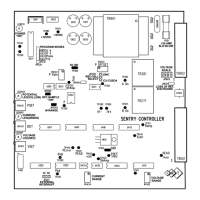
then automatically maintained by the SENTRY Controller in Potential, Current or Voltage
Mode, as set by the operator.
A Varistor is supplied across the AC input to the diode bridge to provide additional protection
from any voltage surges that may pass the main AC surge arrestor or be developed by the
main transformer. A second varistor may also be supplied across the DC output of the diode
bridge at special request.
The Current Monitoring Shunt is a block style calibrated resistor with an accuracy of 0.25%.
The DC current and voltage rating are stamped into the body of the shunt. Shunts used in
rectifiers equipped with digital meters will be either 1 Millivolt or 10 Millivolts per ampere,
depending upon the rectifier output current rating.
The rectifier Ammeter & Voltmeter utilize an analog, taut-band type movement that provides
±2% accuracy. The DC output amperage of the rectifier is monitored by a meter connection
across the calibrated test screws of the above shunt. The DC output voltage of the rectifier is
monitored by a meter connection across the DC output terminals of the rectifier.
On Potential Controlled rectifiers, an additional Potential Meter is supplied to monitor the
Structure to Reference Cell Potential, and the desired “Set Potential”. This meter receives the
potential reading from the SENTRY Controller.


 To Next Page
 Loading...