C.P. SENTINEL AUTOMATIC TYPE CATHODIC PROTECTION RECTIFIER MANUAL
INTEGRATED RECTIFIER TECHNOLOGIES, INC.
Doc #: APC0010
Rev. 3.0, November, 2004
Page 15 of 22
Potential Adjust Potentiometer is a front, panel-mounted multi-turn potentiometer used to
set the required Structure to Reference Electrode potential required by the CP System. The
setting can be read on the Potential Meter by activating the Potential Switch to the “Set”
position.
The “Set-Actual” Switch permits the operator to monitor, via the rectifier Potential Meter,
either the “Actual“ potential or the “Set” potential of the rectifier. The “Actual” potential may be
either free of IR-Drop error, as determined by the SENTRY Controller, or the “ON” potential, if
the rectifier is equipped with filtering or if configured to operate in the ”ON” potential Mode.
Metering Test Points (Optionally supplied
) are located on the touch-safe instrument panel for
purposes of verifying the digital meter readings. Metering Test Points are 0.093 diameter test
jacks, with polarity and function as indicated by the silk screening on the panel. The “Potential”
test points will indicate the potential voltage reading as determined by the “POTENTIAL
ACTUAL/SETPOINT” toggle switch.
The Reference Electrode (Cell) – Structure Input Terminal Block is used to make field
connections to the CP system Reference Cell and Structure sensing leads.
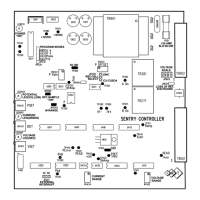
External Interrupt Terminal Block: (NOT Supplied on IR-Free rectifiers
) Two terminals are
provided on the front panel of the rectifier for purposes of interrupting the rectifier output using
the SENTRY Controller. Jumper “JP241” on the controller board as required for Normally
Open equals rectifier “ON” or Normally Closed contacts equals “rectifier “ON” as dictated by
the interrupter being used. This is the preferred method to interrupt the rectifier by an external
means. Special circuitry in the SENTRY Controller retains all of the operating parameters for
resumption of control parameters after conclusion of an interrupt procedure and will not reset
the slow start circuitry.
The DC Output Surge Arrestor is a device that protects the rectifier components from voltage
surges that may occur across the DC output of the rectifier. It’s operation and characteristics
are similar to the AC input surge arrestor.
As many optional features / components are available for our customers, it is not practical for
this manual to describe all of the possible options in detail. As such, it is recommended that
the rectifier data sheet and the electrical schematic be reviewed in detail to become familiar
with any features not detailed in this manual.
APPLICATION ALERT!!
IR-Free Automatic Potential controlled rectifiers typically do not utilize external interrupters
when operating. For proper IR-Free potential control, the SENTRY Controller must not be
impeded by external interrupter cycles as it controls the desired “Set Potential” of the CP
system.
NOTE:
If no reference electrode is used, a jumper should be placed across these input terminals.


 To Next Page