
 Need help?
Do you have a question about the Isotherm Classic Compact 2010 and is the answer not in the manual?
Examine box and contents for shipping damage and notify carrier if found.
Ensure all circuits are off, disconnect power, follow ABYC standards for electrical installations.
Lists required tools like drill, wire cutters, screwdrivers, and wrenches for installation.
Emphasizes proper installation, insulation, and sealing for efficient operation and reduced power consumption.
Plan tubing/wire runs, avoid dirt, ensure air circulation for condenser, use dedicated 15 amp circuit breaker.
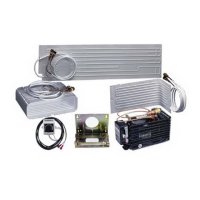
Mount compressor in well-ventilated area, ensure airflow from bottom to top for efficient heat transfer.
Ensure low voltage loss, use dedicated circuit, proper wire gauge, and tinned cable for reliable power delivery.
Shore power requirement via regulated battery charger of at least 5 amps capacity connected to the battery.
Connect electronic unit directly to battery or main switch, using correct cable dimensions.
Mount compressor in well-ventilated area, within 6 ft of evaporator, horizontally, and at a heeling angle up to 30°.
Mount evaporator horizontally or vertically near the box top, consider tubing routing, drill correct hole size.
Install thermostat in dry area, check sensor tube length, connect wiring to electronic unit's "T" and "C" terminals.
Connect self-sealing quick couplings to complete the refrigeration circuit, keeping fittings clean and dry.
Turn on circuit, compressor should start within 30s. Adjust thermostat for desired temperature.
Compressor protection against overload, low voltage (below 10.3V), or overcharging, ensuring system reliability.
 General
| Category | Refrigerator |
|---|---|
| Model | Classic Compact 2010 |
| Voltage | 12/24 V DC |
| Refrigerant | R134a |
| Installation | Built-in |
| Capacity | 42 liters |
| Weight | 17 kg |
| Energy Source | DC |


 To Next Page