
 To Next Page
D
devinhernandezAug 4, 2025
What to do if iTechworld 40Amp MPPT shows overload detected?
- MMrs. Ashley SnyderAug 4, 2025
If the iTechworld Controller detects an overload, reduce the load on the load output of the solar charge controller.

What to do if iTechworld 40Amp MPPT shows overload detected?
If the iTechworld Controller detects an overload, reduce the load on the load output of the solar charge controller.
How to fix iTechworld 40Amp MPPT Controller over temperature?
To resolve an over-temperature issue with your iTechworld solar charge controller, ensure it has adequate ventilation and that none of the heat sink fins are blocked. Allow the regulator to cool down; it will restart charging automatically once cooled.
Why is my iTechworld Controller not charging the battery with enough sunlight?
If your iTechworld Controller isn't charging the battery despite sufficient sunlight, it could be due to a disconnected solar input or the solar input voltage being lower than the battery voltage. Check that all solar input connections and fuses/breakers are correctly connected. The voltage of the solar panel should be more than the battery voltage.
What to do if the input voltage of iTechworld 40Amp MPPT Controller solar panels is too high?
If the input voltage of the solar panels connected to your iTechworld Controller is too high, check the voltage of the solar input and reduce the number of panels connected in series.
What to do if iTechworld 40Amp MPPT detects over voltage?
If your iTechworld Controller detects an over voltage, check that the selected battery profile is correct for the battery connected.
What to do if nothing is displaying on the LCD of iTechworld 40Amp MPPT Controller?
If nothing is displaying on the LCD of your iTechworld Controller, check the battery voltage, connections, and fuses. The controller will only turn on if the battery is above 8 Volts, because the battery voltage is less than 8 Volts or there are incorrect connections.
Essential safety guidelines for operating the solar charge controller.
Details specific dangers like electrical shock, explosion, and misuse.
Outlines conditions and applications where the controller should not be used.
Overview of the controller's purpose, technology, and capabilities.
Identifies the physical components and display of the solar charge controller.
Guidance on physical installation and mounting requirements for the controller.
Instructions for connecting components to the controller.
Recommended fuse types and ratings for circuit protection.
Explains the meaning of display icons and the controller's startup process.
Guides users on how to navigate through the controller's menus and screens.
Accessing and modifying controller settings like battery type and voltage.
Allows selection of appropriate charging profiles for different battery types.
Explains how to set or auto-detect the system voltage (12V/24V).
Details manual and automatic control options for the load output.
How to view the current solar panel input voltage.
Setting equalisation and absorption charging parameters.
Lists common issues, their causes, and solutions.
Details operational parameters, voltage ranges, and environmental limits.
Lists safety features, protective measures, and charging parameters.
Guidance on upkeep, warranty terms, and limitations.
Procedure for repairs, warranty claims, and company contact information.
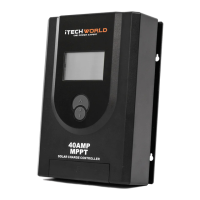
The iTechworld 40 Amp MPPT Solar Charge Controller is a sophisticated device designed to optimize the performance of solar panel and battery combinations, particularly excelling with iTECH120X lithium batteries and iTechworld solar panels. This controller incorporates patented technology and a unique charging algorithm to ensure you harness the maximum power from your solar panels, significantly enhancing your overall system efficiency. It is intended for indoor use only.
At its core, the iTechworld 40 Amp MPPT Solar Charge Controller acts as an intelligent intermediary between your solar panels and your battery system. It utilizes advanced Maximum Power Point Tracking (MPPT) technology, boasting an impressive efficiency of 99.5% and a maximum conversion efficiency of 97%. This technology ensures rapid maximum power point tracking, allowing the controller to continuously find and maintain the optimal operating point of your solar panel to deliver the most power possible to your batteries.
The controller features automatic voltage identification, capable of recognizing both 12V and 24V systems. It is versatile, suitable for charging a wide range of common 12-Volt automotive and recreational batteries. This includes various lead-acid battery types such as Gel, Sealed Lead Acid, and Flooded Lead Acid. Furthermore, it is specifically designed to work with advanced lithium chemistries like LiFePO4 (Lithium Iron/Ferro Phosphate), including the iTECH120X, and Li (NiMnCo)O2 (Li-po/NMC) 12-Volt Lithium batteries, provided they contain an inbuilt Battery Management System (BMS).
A key function of this solar regulator is to provide a constant and reliable maximum input power from the solar panel, ensuring safe charging for your batteries. It supports a wide solar panel operating voltage range, up to 100VDC. The controller also offers power statistics recording functionality, logging the amount of power delivered to the battery, which is useful for monitoring system performance over time.
The device also includes load control capabilities. It can manually turn a connected load on or off, and offers various load control modes. These modes include a light control mode, where the load automatically turns off when solar input is detected (day) and turns on when no solar input is detected (night), and a dual time mode, which allows the load to be turned on for a set duration during both night and day. An inverted light control mode is also available, where the load turns on during the day and off at night.
The iTechworld 40 Amp MPPT Solar Charge Controller is designed for intuitive user interaction, primarily through its Liquid-Crystal Display (LCD) and two control buttons (Button A and Button B). The LCD dynamically displays operational data and the working status of the solar charge controller, making it an intelligent control point for your solar panel system. Easy-to-read display icons and indicators provide clear information about the operating status of your solar panels.
Upon powering on, the controller enters a main navigation flow chart, allowing users to scroll through various parameters by short pressing Button A or B. The settings menu, accessed by pressing and holding Button A for more than 3 seconds from the Home Screen, enables users to customize various parameters. To alter a parameter, the value starts flashing, and short presses of Button A or B adjust it. Holding Button A for more than 3 seconds saves the changes, while holding Button B discards them and returns to the Home Screen.
Battery selection is a critical feature, allowing users to choose the correct charging profile for their specific battery type. This is accessed via the Battery Type menu within the settings. The controller offers profiles for Usr1, Gel, Sld, Fld, and various lithium batteries. For lithium profiles, users can set the total battery capacity in 5AH increments. It is crucial to select the correct profile, especially for iTechworld's lithium batteries like the iTECH120X, for which the 4-3.2 (Lithium Battery, 3.2V/Cell, 4 in series) profile is specifically recommended.
The system voltage setting, by default, is auto-sensing (12V/24V), but can be manually set. Users can also adjust equalisation charging voltage and duration, as well as absorption charging voltage and duration, specifically for the Usr1 battery charging profile. These adjustments are made through a similar flashing parameter and button press sequence.
The load output can be manually controlled from the Home Screen by short pressing Button B, which toggles the load on or off, indicated by a light bulb symbol. The various load control modes (LD1, LD2, LD3, LD4) offer flexibility in how the load is managed based on solar input and time.
The controller provides diagnostic fault codes and symptoms on the LCD, such as "E-11" for battery voltage less than 8 Volts, "E-12" for over-discharged battery, "E-13" for overload, "E-15" for over-temperature, and "E-16" for high solar panel input voltage. These codes assist in troubleshooting common issues.
The iTechworld 40 Amp MPPT Solar Charge Controller requires minimal maintenance to ensure its proper operation and longevity. The primary maintenance steps are straightforward:
First and foremost, it is essential to ensure that the solar charge controller is turned off before performing any maintenance tasks. This is a critical safety precaution to prevent electrical shock or damage to the unit.
For general upkeep, the exterior of the controller should be cleaned periodically. Using a dry cloth, wipe down the unit to prevent the build-up of dust and dirt. This helps maintain proper ventilation and prevents any potential obstruction of the heatsink fins, which are crucial for dissipating heat.
Additionally, it is recommended to regularly check and tighten the fasteners on the DC input terminals. Loose connections can lead to increased resistance, heat generation, and potential performance issues or damage. Ensuring these connections are secure helps maintain optimal electrical contact and system efficiency.
The device is designed for durability, and with these simple maintenance steps, it should continue to operate reliably. The user guide emphasizes that the product is guaranteed against defects in materials and workmanship for 12 months from the date of purchase. However, the warranty is voided by misuse, alteration, accidental damage, or incorrect installation/connection, including wiring to improper polarity sources. The controller is not intended for commercial use, and the warranty does not cover accessories or damage from normal wear and tear or environmental exposure.
 General
| Maximum PV Input Power (12V) | 520W |
|---|---|
| Maximum PV Input Power (24V) | 1040W |
| Maximum PV Input Power (36V) | 1560W |
| Maximum PV Input Power (48V) | 2080W |
| Maximum Output Current | 40A |
| Display | LCD |
| Type | MPPT |
| Battery Voltage | 12V/24V/36V/48V Auto |
| Nominal System Voltage | 12V/24V/36V/48V |
| Protection Features | Reverse polarity |
| Communication | RS485 |