9/55
1. Hold the lance at the normal working height and spray into the bottle
while walking the distance required to spray an area corresponding to
25 m².
2. Place the bottle on a level surface and observe the liquid level visible
through the side of the bottle. Match the liquid level to the corresponding
scale on the calibrator bottle.
3. Empty the bottle and repeat this operation to determine the average of
two or more readings.
NOTE: For the volume in liters per bushel (L / alk), simply multiply the value ob-
tained in liters per hectare (L / ha) by 2.42.
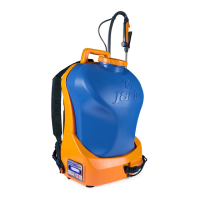
9.2. Calibration of battery powered knapsack sprayer
PROCEDURE
1. USING CALIBRATOR BOTTLE (OPTIONAL)
2. Hold the lance at the working height and spray to measure the applica-
tion band width.
3. Based on the band width, calculate the total walking distance required to
spray the desired area. Use the chart as shown next.
Band
width
Lance
Cover
Filter
Nozzle
Nozzle cap
Calibrator
bottle
• Attach the calibrator bottle to the lance as shown:
• Remove the cap, nozzle and lter.
• Mount the calibrator cover to the lance.
• Reinstall the lter, nozzle and cap.
• Screw the calibrator onto the cover.
Band width
(m)
0.5 0.7 1.0 1.2 1.5
Distance to
walk (m)
50.5 35.7 25.0 20.8 16.7
NOTE*: Nozzle has not reached working pressure (15 psi).
NOTE**: The values above may vary as to the wear, clogging and variation of the
nozzles, the density and viscosity of the liquid to be applied, the temperature and
relative humidity of the environment, the altitude and consequent atmospheric
pressure of the site, the height of the lance spraying, etc.
NOTE***: The minimum working nozzle pressure should always be observed, so
we do not recommend spraying at pressures below 15 psi for fan nozzles and
below 45 to 60 psi for conical nozzles depending on the model. In addition, we
do not recommend using ISO standard nozzles of brown color (05 gal/min at 3
bar pressure).
9.4. Solution preparation and tank filling
1. To dilute and premix the product, place 5 liters of water in a separate
container;
2. Mix to a homogeneous solution and pour into the sprayer tank during
lling.
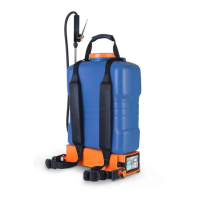
9.5. Shoulder strap adjust
The tank is contoured for the operator comfort. The shoulder straps can be quickly
adjusted to properly position the sprayer on the operator’s back.
1. Mount the strap belt onto the tank as shown in position A.
2. Hook the buckle of the strap to the plastic couplers located at the side of
the sprayer’s base, as shown in position B.
Nozzle Level Pressure (psi)
Flow rate
(L/min)
Autonomy
(h)
01
(ORANGE)
Min. 30 0,38 13,0
Med. 46 0,44 8,9
Max. 61 0,50 5,6
015
(GREEN)
Min. 20 0,48 14,3
Med. 35 0,59 8,8
Max. 49 0,69 5,5
02
(YELLOW)
Min. 15 0,58 14,6
Med. 27 0,72 8,5
Max. 39 0,84 5,6
025
(PURPLE)
Min. 15 0,78 10,7
Med. 23 0,87 7,5
Max. 32 0,96 5,7
03
(BLUE)
Min. 15 0,85 9,8
Med. 20 0,95 7,2
Max. 25 1,05 5,9
04
(RED)
Min. N/A * N/A * N/A *
Med. N/A * N/A * N/A *
Max. 16 1,19 6,2
9.2. Pressure, flow rate and autonomy of each nozzle
type
Record the time it takes to
walk 25 m²
Simulate the spraying
of 25 m²
WARNING!
Use the correct dose and volume of chemical according
to the product label.


 To Next Page