CTI-CRYOGENICS
HELIX TECHNOLOGY CORPORATION
TECHNICAL DATA
CRYODYNE
®
CLOSED CYCLE
HELIUM REFRIGERATORS
•
The cooling process (cycle) of
CRYODYNE Helium Refrigerators
is analogous to that of common
household refrigerators. In the
latter, a working fluid (freon gas)
is compressed, the heat of com-
pression removed by air-cooled
heat exchangers, and the gas is
then expanded to produce cooling
below the ambient temperature.
This simple compression-expansion
process will suffice for the house-
hold refrigerator, where tempera-
tures in the sub-zero fahrenheit
range are required. However,
CRYODYNE systems must operate
effectively and routinely at temp-
eratures down to 6K (-449°F).
Attainment of such extreme low
levels requires highly efficient heat
exchangers, and the use of a
working fluid (helium gas) that re-
mains fluid at temperatures ap-
proaching absolute zero (-459.6°F,
-273.1°C, OK).
All CRYODYNE systems com-
prise an air-cooled or water-cooled,
oil-lubricated compressor unit with
oil separation system (carry-over
oil vapors would solidify at cry-
ogenic temperatures and plug the
heat exchangers of the refrigera-
tor); and a refrigerator unit (re-
motely located from the com-
pressor), which operates at slow
speeds, has ample clearances, and
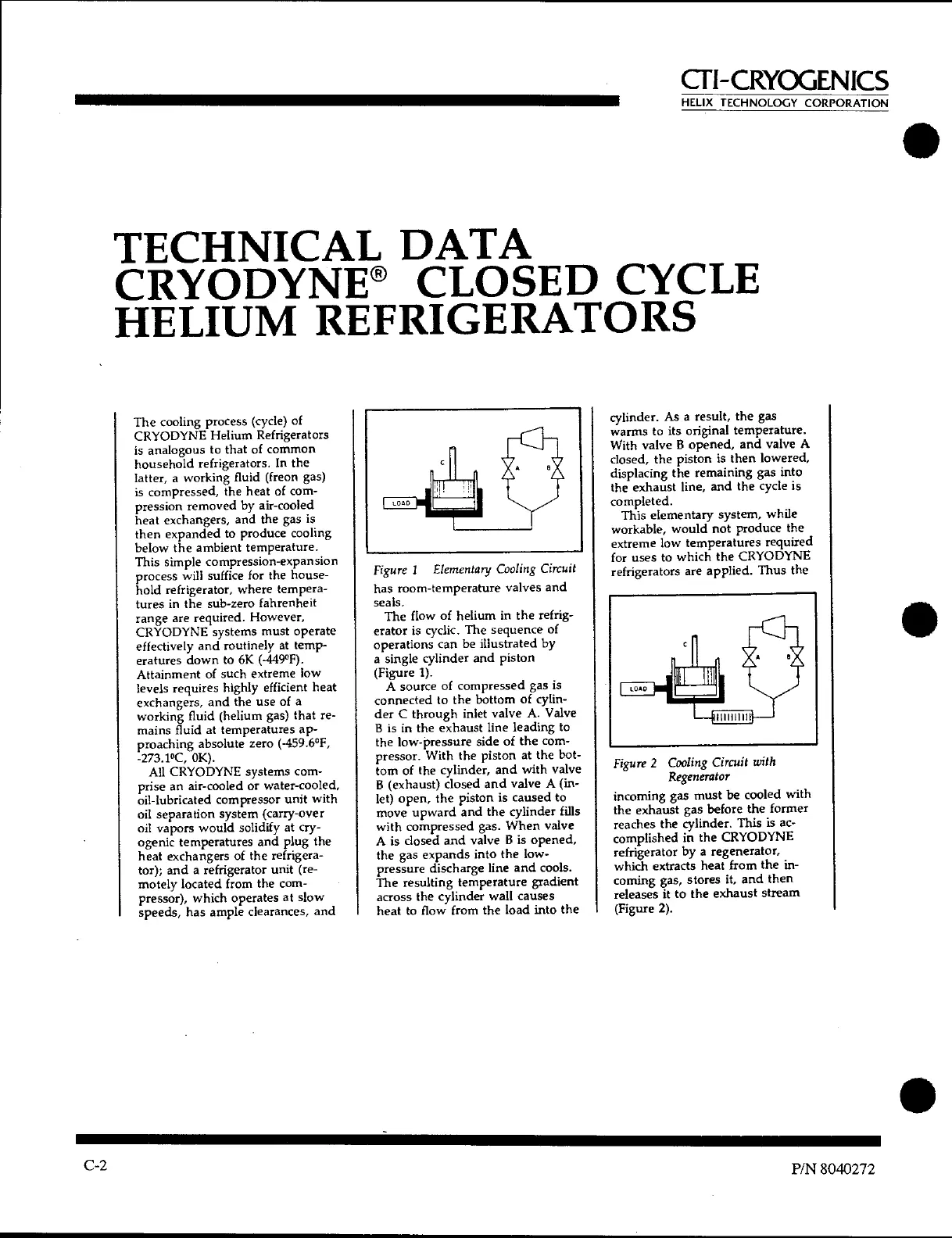
Figure
I
Elementary Cooling Circuit
has room-temperature valves and
seals.
The flow of helium in the refrig-
erator is cyclic. The sequence of
operations can be illustrated by
a single cylinder and piston
(Figure 1).
A source of compressed gas is
connected to the bottom of cylin-
der C through inlet valve A. Valve
B is in the exhaust line leading to
the low-pressure side of the com-
pressor. With the piston at the bot-
tom of the cylinder, and with valve
B (exhaust) closed and valve A (in-
let) open, the piston is caused to
move upward and the cylinder fills
with compressed gas. When valve
A is closed and valve B is opened,
the gas expands into the low-
pressure discharge line and cools.
The resulting temperature gradient
across the cylinder wall causes
heat to flow from the load into the
cylinder. As a result, the gas
warms to its original temperature.
With valve B opened, and valve A
closed, the piston is then lowered,
displacing the remaining gas into
the exhaust line, and the cycle is
completed.
This elementary system, while
workable, would not produce the
extreme low temperatures required
for uses to which the CRYODYNE
refrigerators are applied. Thus the
Figure 2 Cooling Circuit with
Regenerator
incoming gas must be cooled with
the exhaust gas before the former
reaches the cylinder. This is ac-
complished in the CRYODYNE
refrigerator by a regenerator,
which extracts heat from the in-
coming gas, stores it, and then
releases it to the exhaust stream
(Figure 2).
•
•
C-2
P/N 8040272


 To Next Page
 Loading...