EasyManua.ls Logo

JBL 6290 - External Connections

JBL 6290
30 pages
Print Icon
To Next Page IconTo Next Page
To Previous Page IconTo Previous Page
Loading...
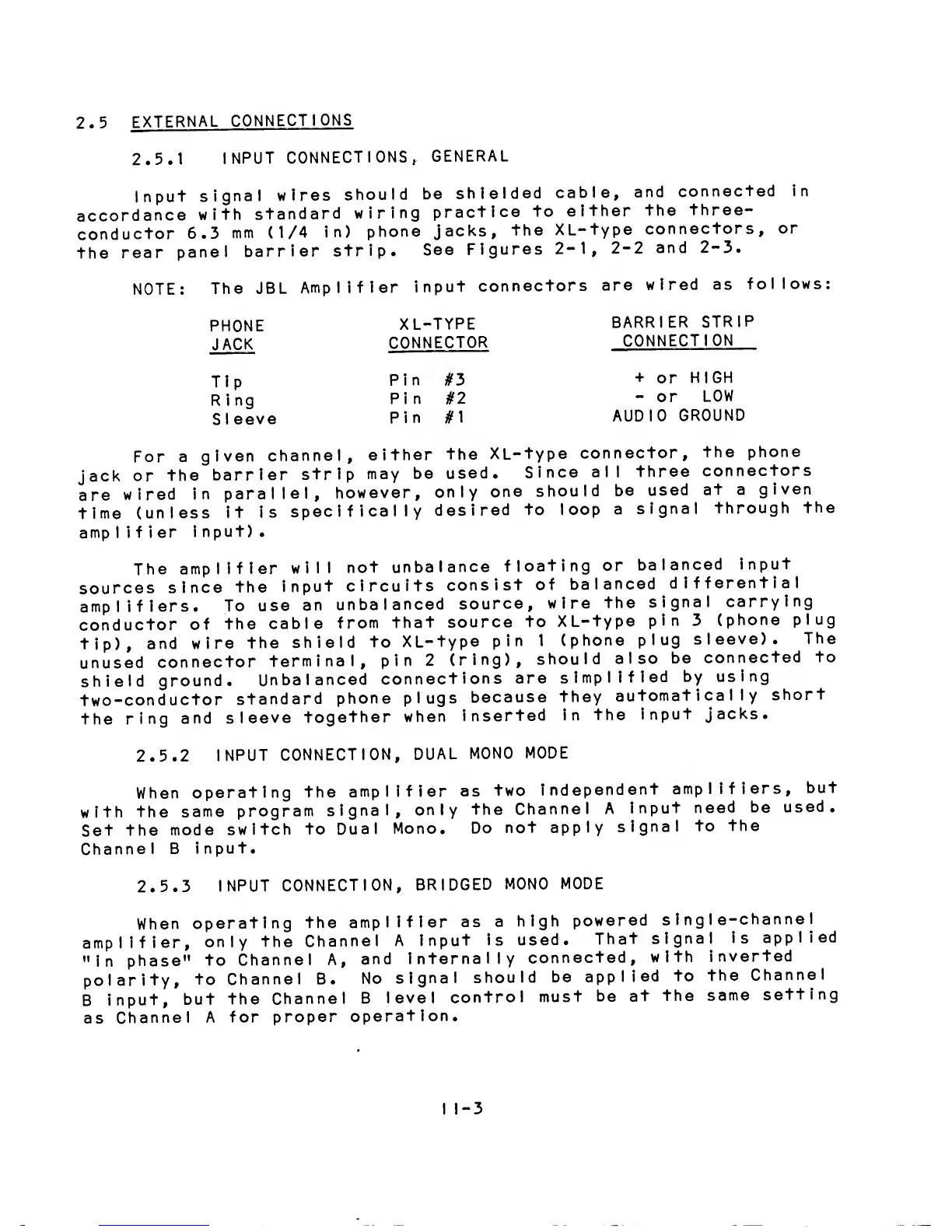
2.5
EXTERNAL
CONNECTIONS
2.5.1
INPUT
CONNECTIONS,
GENERAL
Input
signal
wires
should
be
shielded
cable,
and
connected
in
accordance
with
standard
wiring
practice
to
either
the
three-
conductor
6.3
nm (1/4
In)
phone
jacks,
the
XL-type
connectors,
or
the
rear
panel
barrier
strip.
See
Figures
2-1,
2-2
and
2-3.
NOTE:
The JBL
Amplifier
Input
connectors
are
wired as
follows;
phone
XL-type
barrier
strip
jack
connector
connection
Tip
Pin #3
+
or
HIGH
Ring
Pin #2
-
or
LOW
Sleeve
Pin
#1
AUDIO
GROUND
For a
given
channel,
either
the
XL-type
connector,
the
phone
Jack
or
the
barrier
strip
may
be
used.
Since
all
three
connectors
are
wired
in
parallel,
however,
only
one
should
be
used
at a
given
time
(unless
it is
specifically
desired
to
loop a
signal
through
the
amp I
I f i er
1
nput)
.
The
amplifier
will
not
unbalance
floating
or
balanced
Input
sources
since
the
input
circuits
consist
of
balanced
differential
amplifiers.
To use
an
unbalanced
source,
wire
the
signal
carrying
conductor
of
the
cable
from
that
source
to
XL-type
pin
3
(phone plug
tip),
and
wire
the
shield
to
XL-type
pin
1
(phone
plug
sleeve).
The
unused
connector
terminal,
pin
2
(ring),
should
also
be
connected
to
shield
ground.
Unbalanced
connections
are
simplified
by
using
two-conductor
standard
phone
plugs
because
they
automatically
short
the
ring
and
sleeve
together
when
inserted
In
the
input
jacks.
2.5.2
INPUT
CONNECTION,
DUAL
MONO
MODE
When
operating
the
amplifier
as
two
independent
amplifiers,
but
with
the same
program
signal,
only
the
Channel A
input
need
be
used.
Set
the
mode
switch
to
Dual
Mono.
Do
not
apply
signal
to
the
Channel
B
input.
2.5.3
INPUT
CONNECTION,
BRIDGED
MONO
MODE
When
operating
the
amplifier
as
a
high
powered
single-channel
amplifier,
only
the
Channel
A
input
is
used.
That
signal
is
applied
"in
phase"
to
Channel A,
and
internally
connected,
with
inverted
polarity,
to
Channel B.
No
signal
should
be
applied
to
the
Channel
B
input,
but
the
Channel
B
level
control
must
be at
the
same
setting
as
Channel A
for
proper
operation.
I
1-3

Related product manuals