EasyManua.ls Logo

JBL 6290 - Calculating Losses in Speaker Cable

JBL 6290
30 pages
Print Icon
To Next Page IconTo Next Page
To Previous Page IconTo Previous Page
Loading...
When
a
signal
drives
a
woofer,
current
flowing
through
the
voice
coll
creates a
magnetic
field.
This
field
Interacts
with
the
permanent
magnetic
field
In
the gap
and
forces
the
d I
aphragm/vo
I ce
coll
assembly
to
move
outward.
When
the
signal
Is
removed,
the
d I a
p h r
a
gm/
VO I ce
coll
assembly
begins
to
move
Inward,
but
Its
momentum
causes
It
to
overshoot
Its
resting
point.
This
overshoot
will
eventually
damp
Itself
out,
but
you
can
see
how
unwanted
cone
movements
are
generated.
After
signal Is
removed
and
the
voice
coll
Is
moving
Inward
through
the
magnetic
field.
It
generates
a
current
of
opposite
polarity
to
the
original
signal.
This
current
Induces
a
voltage
or
"back
EMF"
which
travels
through
the
speaker
wire
to
the
amplifier's
output
and
through
the
amplifier
to
ground.
The
lower
the
amplifier's
output
Impedance,
the
better
the
damping
action
on
the
voice
coll.
The
result
of
a
higher
damping
factor
Is
more
accurate
reproduction
of
bass
and
lower
midrange
frequencies.
The
theoretical
damping
factor
of
an
amplifier
may
not be
realized
at
the
speaker
due
to
added
Impedance
of
the
cable.
^
Larger
gauge
cables
not
only
reduce
signal
losses,
but
they
Increase
damping
factor
when
long
lengths
are
used.
To
calculate
damping
factor,
divide
the
speaker's
rated
Impedance
by
the
amplifier's
output
Impedance.
For
example,
an
amplifier
with
0.04
ohms
output
Impedance
(assuming
no
cable
losses)
at 1
kHz
would
have
a
damping
factor
of
200
to
an 8
ohm
speaker (8
/
0.04
=
200) .
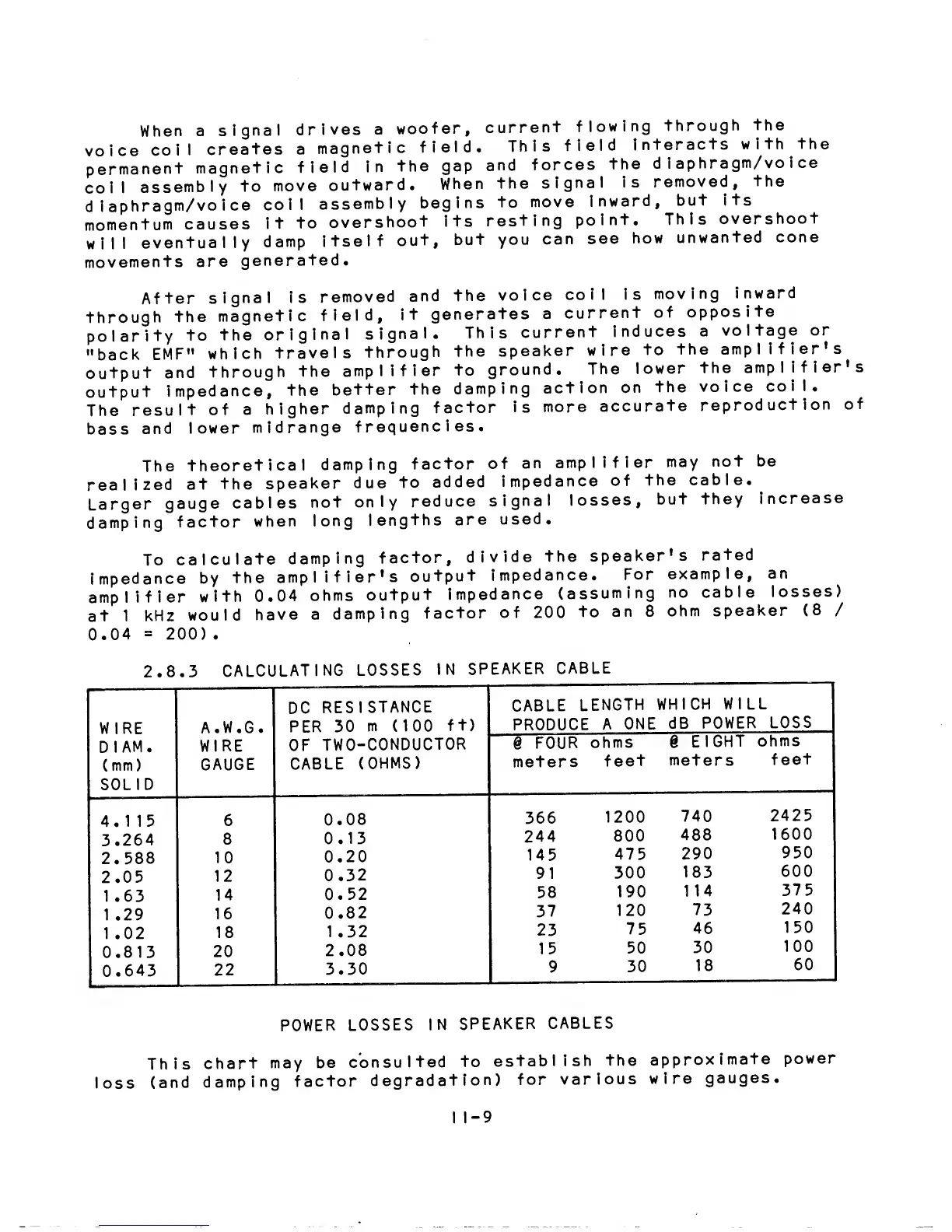
2.8.3
CALCULATING
LOSSES
IN
SPEAKER
CABLE
WIRE
D
I
AM.
( mm
)
SOLID
A.W.G.
WIRE
GAUGE
DC
RESISTANCE
PER
30
m
(100
ft)
OF
TWO-CONDUCTOR
CABLE
(OHMS)
CABLE
LENGTH
PRODUCE
A
ONE
WHICH
WILL
dB
POWER
LOSS
@
FOUR
meters
ohms
feet
&
EIGHT
ohms
meters
feet
366
1200
740
2425
244
800
488
1600
145
475
290
950
91
300
183
600
58
190
114
37 5
37
120
73
240
23
75
46
150
15
50
30
100
9
30
18
60
4.115
3.264
2.588
2.05
1.63
1 .29
1 .02
0.813
0.643
6
8
10
12
14
16
18
20
22
0.08
0.13
0.20
0.32
0.52
0.82
1.32
2.08
3.30
POWER
LOSSES
IN
SPEAKER
CABLES
This
chart
may
be
consulted
to
establish
the
approximate
power
loss
(and
damping
factor
degradation)
for
various
wire
gauges.
I
1-9

Related product manuals