Make sure the Airspeed Sensor is working, before using features that require a
minimum flight speed to operate. If the system is not operating properly, you may
inadvertently shut off your engine, in flight. To verify that the Airspeed Sensor is
functioning, apply a little air pressure and note the change in “Airspeed” on the run
menu display.
Two examples:
Example 1 – Hold-Speed function
SpdCtrl SW0 Act assigned to “Hold-Speed” and AUX switch set in the SW0 position:
1. Flight speed is measured and stored, when the AUX switch is moved to the SW0
position. Thrust is then regulated automatically, to maintain this memorized
speed, despite the throttle stick position. This regulator function is turned off
immediately, by returning the AUX switch to the SW1 position (normal thrust
control).
2. If this function is activated while flight speed < 40 km/h, turbine will shut off,
immediately (normal Off function).
Example 2 – Linear speed regulation
SpdCtrl SW2 Act assigned to “Lin-SpeedCtrl” and AUX switch set in the SW2
position:
Cruise Control mode becomes active, featuring linear speed regulation to the throttle
stick position.
1. The minimum throttle stick position corresponds to the parameter “Min AirSpeed”
and the maximum throttle stick position corresponds to the parameter “Max
AirSpeed”.
2. If flight speed < 40 km/h when this function is activated, the turbine will shut off
(normal AutoOff function).
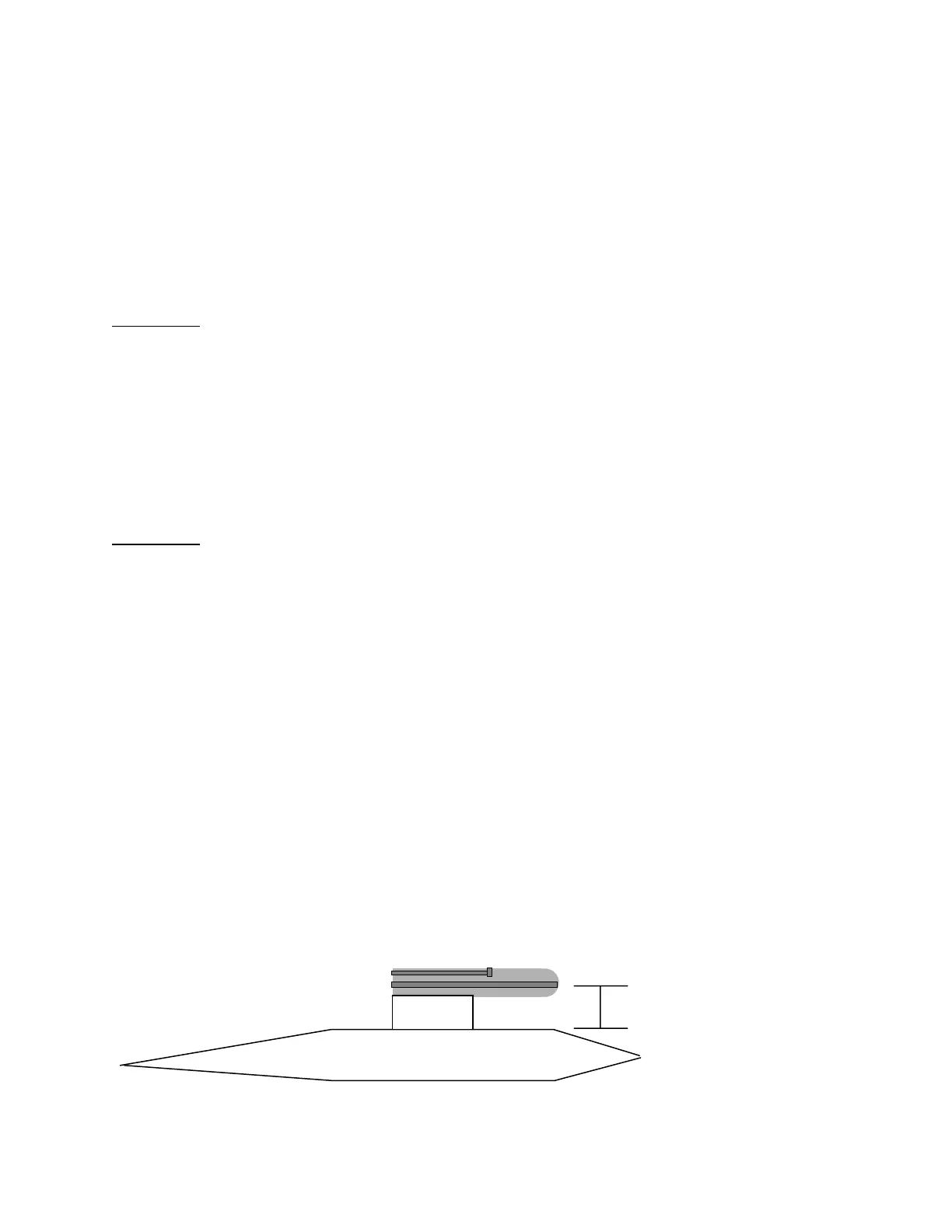
Airspeed Sensor Mounting:
Experiments indicate that the Airspeed Sensor is more accurate when the pitot tube is
side-mounted on the widest part of the fuselage. In this configuration, the pitot tube
should stand off from the fuselage, by at least two (2) inches. Because each model
installation is different, JetCat will have additional mounting information for review, as
auxiliary data becomes available.
> 2 inches
Fuselage
Page 69/74


 To Next Page