113242-3 25
!
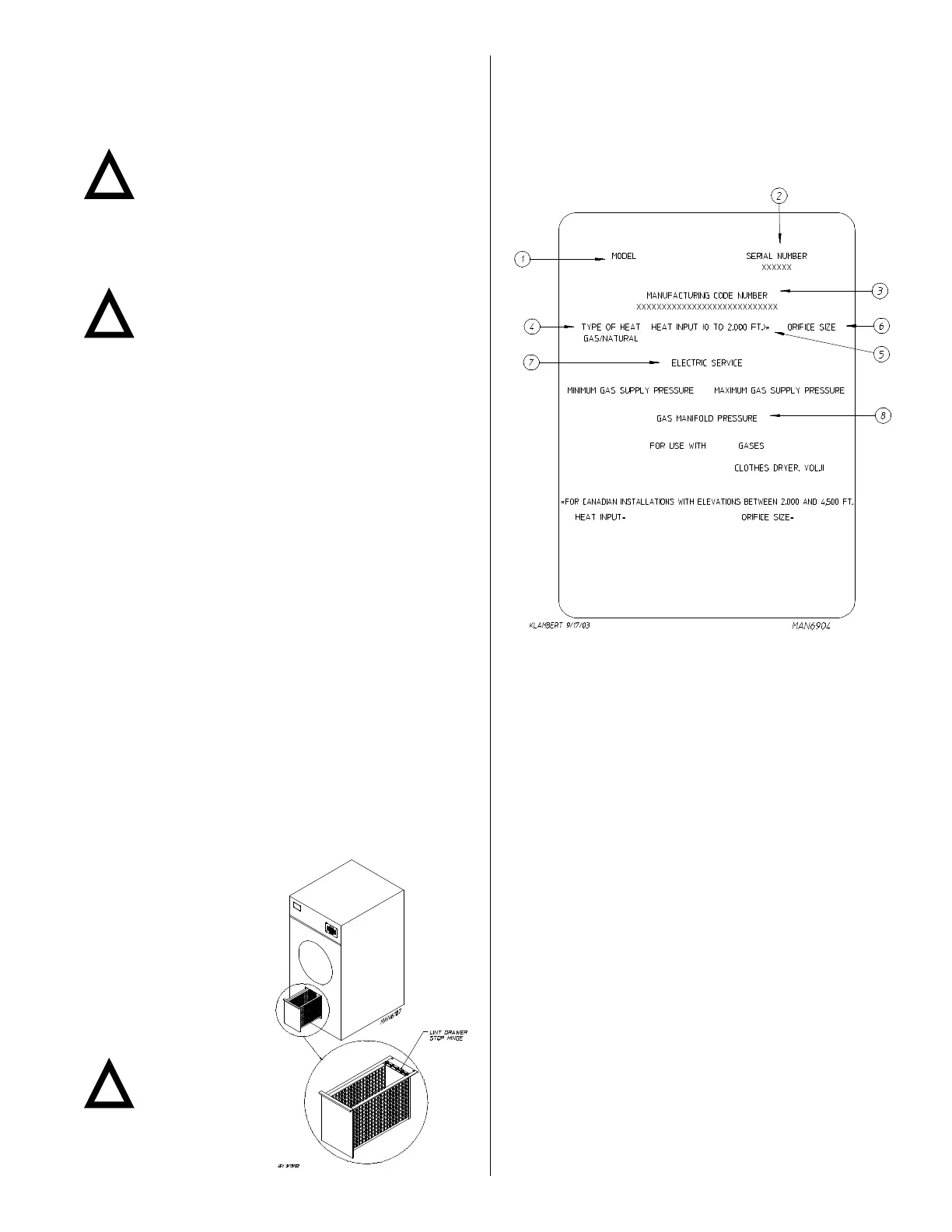
Data Label Information ______________
When contacting JLA, certain information is required to
ensure proper service/parts information from JLA. This
information is on the data label affixed to the left side panel
area behind the top control (access) door. When contacting
JLA please have the model number and serial number
available.
1. Model Number – Describes the size of the dryer and the
type of heat (gas, electric, or steam).
2. Serial Number – Allows the manufacturer to gather
information on your particular dryer.
3. Manufacturing Code Number – The number issued by
the manufacturer, which describes all possible options
on your particular model.
4. Type of Heat – This describes the type of heat for your
particular dryer, gas (either natural gas or liquid propane
[L.P.] gas), electric, or steam.
5. Heat Input (for GAS DRYERS) – This describes the heat
input in British Thermal Units per Hour (Btu/hr).
6. Orifice Size (for GAS DRYERS) – Gives the number drill
size used.
7. Electric Service – This describes the electric service for
your particular model.
8. Gas Manifold Pressure (for GAS DRYERS) – This
describes the manifold pressure taken at the gas valve
tap.
90 Days
Inspect and remove lint accumulation in customer furnished
exhaust ductwork system and from dryer’s internal exhaust
ducting.
Warning
The accumulation of lint in the exhaust ductwork
can create a potential fire hazard.
Do not obstruct the flow of combustion and ventilation air.
Inspect and remove any lint accumulation, which can
cause the back draft damper to bind or stick.
Note
A back draft damper that is sticking partially
closed can result in slow drying and shutdown of
heat circuit safety switches or thermostats.
When cleaning the dryer cabinet(s), avoid using harsh
abrasives. A product intended for the cleaning of
appliances is recommended.
Adjustments _________________________
7 Days After Installation
and Every 6 Months Thereafter
Inspect bolts, nuts, screws, setscrews, grounding
connections, and nonpermanent gas connections (unions,
shutoff valves, and orifices). Motor and drive belts should be
examined. Cracked or seriously frayed belts should be
replaced. Tighten loose V-belts when necessary. Complete
operational check of controls and valves. Complete
operational check of all safety devices (door switches, lint
drawer switch, sail switch, burner, and hi-limit thermostats).
Lubrication ___________________________
The motor bearings, idler bearings, and under normal/most
conditions the basket (tumbler) bearings are permanently
lubricated. It is physically possible to relubricate the basket
(tumbler) bearings if you choose to do so even though this
practice is not necessary. Use Shell Alvania #2 or its
equivalent. The basket (tumbler) bearings used in the dryer
do not have a grease fitting. Provisions are made in the
bearing housing for the addition of a grease fitting which can
be obtained elsewhere, or by ordering kit Part No. 882159,
which includes two (2) fittings.
Lint Drawer
Removal_________
To remove the lint drawer
from the dryer pull drawer
out approximately halfway.
Rotate/move lint drawer
stop hinge (refer to the
illustration) downward and
pull the drawer out.
Important
After replacing
the lint drawer
back into the dryer, be
sure to rotate/move hinge
back to the upward stop
!
!



 To Next Page