8 113242-3
!
!
!
!
!
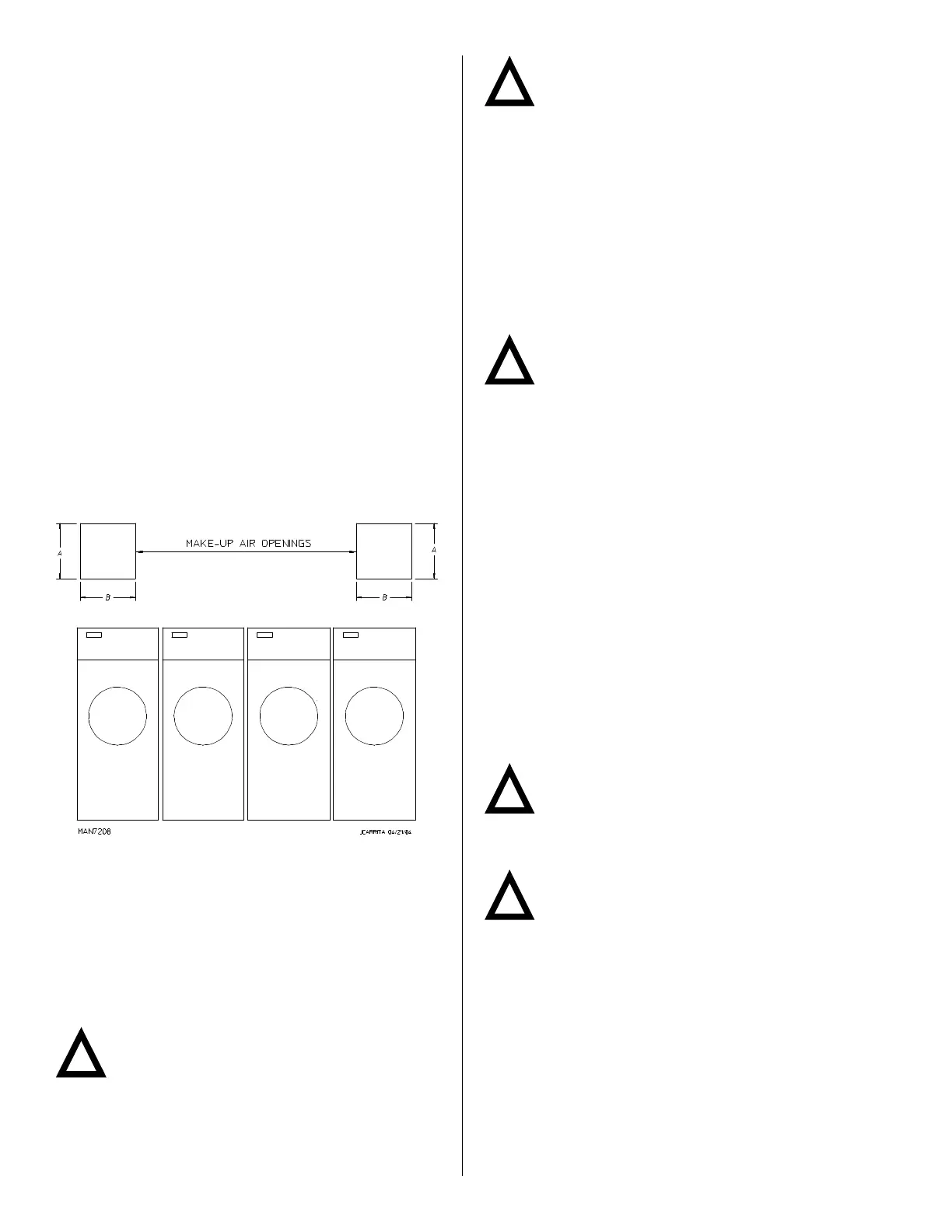
A = 12-inches B = 15-inches
Note
Component failure due to dry cleaning solvent
fumes will void the warranty.
Exhaust Requirements ______________
Exhaust ductwork should be designed and installed by a
qualified professional. Improperly sized ductwork will create
excessive back pressure, which results in slow drying,
increased use of energy, and shutdown of the burner by the
airflow (sail) switch, burner hi-limits, or lint chamber hi-limit
protector thermostat. The dryer must be installed with a proper
exhaust duct connection to the outside.
Where possible, it is suggested to provide a separate (single)
exhaust duct for each dryer.
Caution
This dryer produces combustible lint and must
be exhausted to the outdoors.
Improperly sized or installed exhaust ductwork can create
a potential fire hazard. Dryer must be exhausted to the
outdoors.
The exhaust ductwork should be laid out in such a way that
the ductwork travels as directly as possible to the
outdoors with as few turns as possible. The shape of the
ductwork is not critical so long as the minimum cross section
area is provided. Single or independent dryer venting is
recommended.
It is suggested that the use of 90° turns be avoided; use 30°
or 45° angles instead.
The ductwork should be smooth inside with no projections
from sheet metal screws or other obstructions, which will
collect lint. When adding ducts, the ducts to be added should
overlap the duct to which it is connected. All ductwork joints
must be taped to prevent moisture and lint from escaping
into the building. Additionally, inspection doors should be
installed at strategic points in the exhaust ductwork for
periodic inspection and cleaning.
Important
When connecting ductwork to the dryer exhaust
duct, be sure that when screws are used they do
not restrict the operation (both opening and closing) of the
damper.
Note
When the exhaust ductwork passes through a
wall, ceiling, or roof made of combustible
materials, the opening must be 2-inches (5.08 cm) larger
than the duct (all the way around). The duct must be
centered within this opening.
To protect the outside end of the horizontal ductwork from the
weather, a 90° elbow bent downward should be installed
where the exhaust exits the building. If the ductwork travels
vertically up through the roof, it should be protected from the
weather by using a 180° turn to point the opening downward.
In either case, allow at least twice the diameter of the duct
between the duct opening and the nearest obstruction (i.e.,
roof or ground level).
EXAMPLE: For a bank of 4 dryers, 2 unrestricted openings
measuring 12-inches by 15-inches (30.5 cm by 38.1 cm) are
acceptable.
Allowances must be made for remote or constricting
passageways or where dryers are located at excessive
altitudes or predominantly low pressure areas.
Important
Make-up air must be provided from a source free
of dry cleaning solvent fumes. Make-up air that is
contaminated by dry cleaning solvent fumes will result in
irreparable damage to the motors and other dryer
components.
Fresh Air Supply Requirements___
When the dryer is operating, it draws in room air, heats it,
passes this air through the tumbler, and exhausts it out of the
building. Therefore, the room air must be continually
replenished from the outdoors. If the make-up air is
inadequate, drying time and drying efficiency will be adversely
affected. Ignition problems and sail switch “fluttering”
problems may result, as well as premature motor failure from
overheating. The dryer must be installed with provisions for
adequate combustion and make-up air supply.
Air supply (make-up air) must be given careful consideration
to ensure proper performance of each dryer. As a general
rule, an unrestricted air entrance from the outdoors
(atmosphere) measuring a minimum size of 8-inches by
12-inches (20.32 cm by 30.5 cm) is required for each dryer.
(Based on 1 square inch per 1,000 Btus.)
To compensate for the use of registers or louvers used over
the openings, this area must be increased by approximately
thirty-three percent (33%). Make-up air openings should not
be located in an area directly near where exhaust vents exit
the building.
It is not necessary to have a separate make-up air opening
for each dryer. Common make-up air openings are
acceptable. However, they must be set up in such a manner
that the make-up air is distributed equally to all the dryers.



 To Next Page