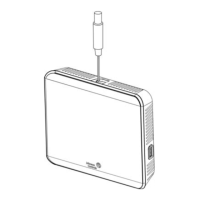
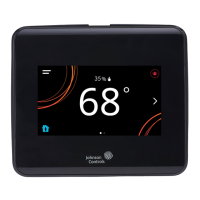
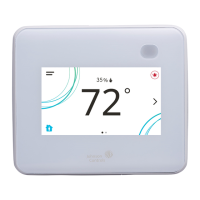
TEC3000 Series Proportional Fan Coil
Thermostats Installation Guide
Applications
The networked TEC3000 Series Thermostat Controllers
are stand-alone and field-selectable BACnet
®
MS/TP or
N2 networked devices. Wireless networked models of the
TEC3000 Series Thermostat Controller are also available.
Proportional Fan Coil and Individual Zone Thermostat
Controllers provide control of the following:
• Local hydronic reheat valves
• Pressure-dependent variable air volume (VAV)
equipment with or without local reheat
• Two- or four-pipe fan coils
• Cabinet unit heaters
• Other individual zone equipment using an on/off or
floating control input
The networked models feature a field-selectable
Building Automation System (BAS) BACnet MS/TP or N2
communication capability that enables remote monitoring
and programming for efficient space temperature control.
The wireless models (TEC30xx-xx-000) are compatible
only with the WNC1800/ZFR182x Pro Series Wireless Field
Bus System that enables communication with a building
automation system (BAS). The new wireless models
(TEC31xx-14-000) are compatible only with WRG1830/
ZFR183x Pro Series Wireless Field Bus System. All models
include a USB port configuration that reduces installation
time to allow simple backup and restore features from a
USB drive, which enables rapid cloning of configuration
between similar units.
Some models have occupancy sensing capability built into
the device. These thermostat controllers maximize up to
30% energy savings in high-energy usage commercial
buildings, such as schools and hotels, during occupied
times by using additional standby setpoints.
All models feature an intuitive onboard touchscreen UI
with backlit display that makes setup and operation quick
and easy. For Single-or Two-Stage Economizer Thermostat
Controller models, only the single-speed fan configuration
is supported. For TEC3x1x and TEC3x2x models, multiple
fan configurations are supported for fan coil equipment
types, as follows:
• Single-speed
• Multi-speed (two or three discrete speeds)
• Variable-speed/EC motors (0 to 10 VDC control)
Some models support dehumidification on two-pipe
fan coil units with reheat, and four-pipe fan coil units
with or without reheat. When no heating is required,
the thermostat controller monitors space humidity and
activates dehumidification control as necessary. Heat
and/or reheat is used as required to maintain the space
temperature. For optimal dehumidification performance,
use a fan coil unit that has a multi-speed or variable-speed
fan (VSF).
Important: The TEC3000 Series Thermostat
Controller is intended to provide an input to
equipment under normal operating conditions.
Where failure or malfunction of the thermostat
controller could lead to personal injury or property
damage to the controlled equipment or other
property, additional precautions must be designed
into the control system. Incorporate and maintain
other devices, such as supervisory or alarm systems
or safety or limit controls, intended to warn of
or protect against failure or malfunction of the
thermostat controller.
Important: Le TEC3000 Series Thermostat Controller
est destiné à transmettre des données entrantes
à un équipement dans des conditions normales
de fonctionnement. Lorsqu'une défaillance ou un
dysfonctionnement du thermostat controller risque
de provoquer des blessures ou d'endommager
l'équipement contrôlé ou un autre équipement, la
conception du système de contrôle doit intégrer des
dispositifs de protection supplémentaires.Veiller
dans ce cas à intégrer de façon permanente d'autres
dispositifs, tels que des systèmes de supervision
ou d'alarme, ou des dispositifs de sécurité ou de
limitation, ayant une fonction d'avertissement
ou de protection en cas de défaillance ou de
dysfonctionnement du thermostat controller.
North American emissions
compliance
United States
This equipment has been tested and found to comply with
the limits for a Class B digital device, pursuant to Part 15
of the FCC Rules. These limits are designed to provide
reasonable protection against harmful interference in
a residential installation. This equipment generates,
uses and can radiate radio frequency energy and, if not
installed and used in accordance with the instructions,
may cause harmful interference to radio communications.
However, there is no guarantee that interference will not
occur in a particular installation. If this equipment does
cause harmful interference to radio or television reception,
which can be determined by turning the equipment
off and on, the user is encouraged to try to correct the
interference by one or more of the following measures:
• Reorient or relocate the receiving antenna.
• Increase the separation between the equipment and
receiver.
• Connect the equipment into an outlet on a circuit
different from that to which the receiver is connected.
• Consult the dealer or an experienced radio/TV
technician for help.
LIT-12013162
2020-12-15
TEC3322-1x-xxx, TEC3323-1x-xxx, TEC3622-1x-xxx,
TEC3623-1x-xxx, TEC3022-1x-xxx, TEC3023-1x-xxx,
TEC312x-14-xxx



 To Next Page
 General