-25-
A
-
H
I
P
E
X
T
E
N
S
O
R
S
B
-
K
N
E
E
E
X
T
E
N
S
O
R
S
C
-
K
N
E
E
F
L
E
X
O
R
S
D
-
A
N
K
L
E
P
L
A
N
T
A
R
F
L
E
X
O
R
S
F
-
H
I
P
F
L
E
X
O
R
S
E
-
A
N
K
L
E
D
O
R
S
I
F
L
E
X
O
R
S
R
E
C
O
V
E
R
Y
P
H
A
S
E
1
2
O
’
C
L
O
C
K
P
O
W
E
R
P
H
A
S
E
6
O
’
C
L
O
C
K
THE SCIENCE OF PEDALING
The pedaling motion in cycling utilizes a series of muscle contractions and relaxations that must be
coordinated and synchronized. Correct pedaling must be learned and practiced repeatedly to become
effective and automatic.
• The legs should move within two parallel planes
• During pedaling, the muscles in the legs are the main contributors to the movement
• The muscles in the rest of the body work in an isometric manner (except during specific actions
such as a standing climb) and stabilize the body’s position while maintaining balance
•
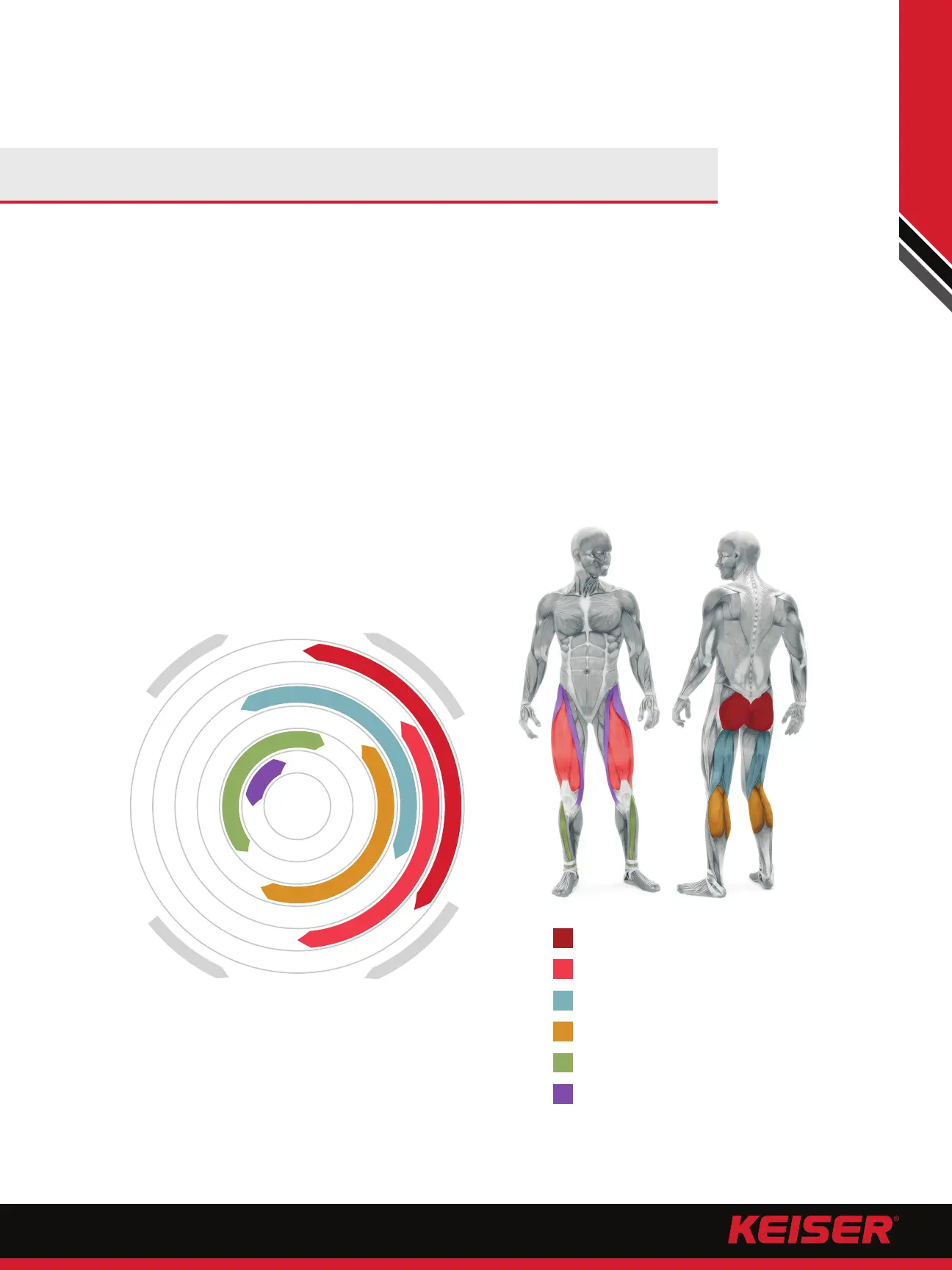
The main leg muscles that contribute to the pedaling stroke are the hip extensors (gluteus maximus,
hamstrings),
knee extensors / quadriceps (rectus femoris, vastus medialis, vastus lateralis, vastus
intermedius), knee flexors / hamstrings (biceps femoris, semimembranosus, semitendinosus),
ankle plantar flexors / calf muscles (gastrocnemius, soleus), ankle dorsiflexors (tibialis anterior),
and hip flexors (ilipsoas, sartorius, and rectus femoris)
MUSCLE CONTRIBUTION IN THE PEDALING PHASE
TECHNICAL ASPECTS
A. Hip Extensors
B. Knee Extensors
C. Knee Flexors
D. Ankle Plantar Flexors
E. Ankle Dorsiflexors
F. Hip Flexors


 To Next Page