Once regulator is in place, open the shutoff valve in the
gas supply line. Wait a few minutes for gas to move
through the gas line.
Check for leaks. After connecting the range to the gas
supply, check the system for leaks with a manometer.
If a manometer is not available, turn on the gas supply
and use a liquid leak detector (or soap and water) at
all joints and connections to check for leaks.
Do not use a flame to check for leaks
from gas connections. Checking for leaks with a flame
may result in a fire or explosion.
Tighten all connections as necessary to prevent gas
leakage in the range or supply line.
Disconnect this range and its individual manual
shutoff valve from the gas supply piping system during
any pressure testing of that system at test pressures
greater than 1/2 psig (3.5 kPa or 14" water column).
Isolate the range from the gas supply piping
system by dosing its individual manual shutoff valve
during any pressure testing of the gas supply piping
system at test pressures equal to or less than 1/2 psig
(3.5 kPa or 14" water column).
| LP/Propane Gas Conversion
This appliance can be used with Natural gas or LP/
Propane gas. It is shipped from the factory for use with
natural gas.
If you wish to convert your range for use with LP/
Propane gas, use the supplied fixed orifices located
in a bag containing the literature marked "FOR LP/
PROPANE GAS CONVERSION." Follow the instructions
packaged with the orifices for surface, oven and broil
burners conversion.
The conversion must be performed by a qualified
service technician in accordance with the
manufacturer's instructions and aii local codes and
requirements. Failure to follow these instructions
could result in serious injury or property damage.
The qualified agency performing this work assumes
responsibility for the conversion.
Failure to maize the appropriate
conversion can result in serious personal injury and
property damage.
| Electrical Requirements
120 volt, 60 Hertz, properly grounded dedicated circuit
protected by a 15 amp circuit breaker or time delay
fuse.
Note: Not recommended to be installed with a Ground
Fault Interrupt (GEl).
Do not use an extension cord with this range.
Grounding Instructions
IMPORTANT Please read carefully.
For personal safety, this appliance must be
properly grounded.
The power cord of this appliance is equipped with a
3-prong (grounding) plug which mates with a standard
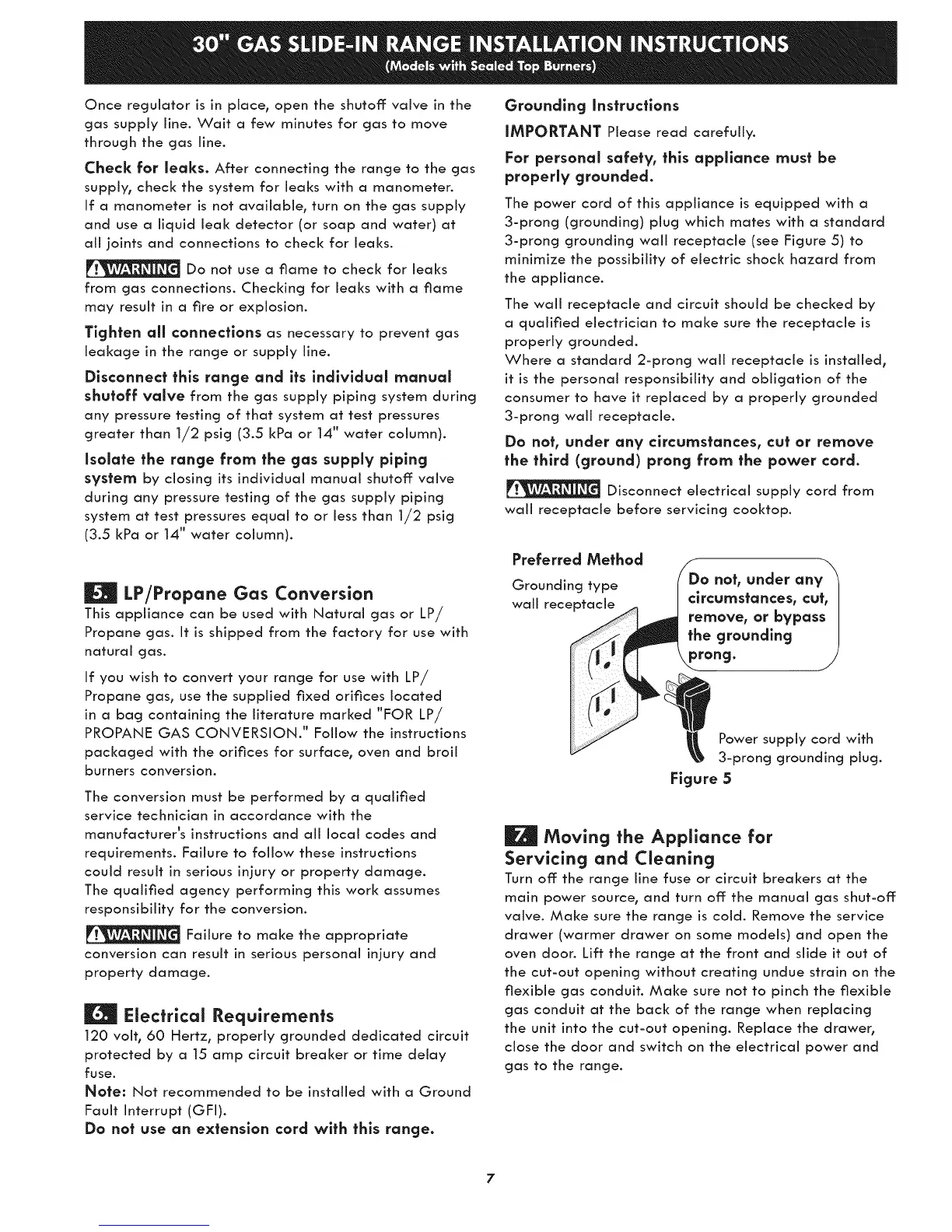
3-prong grounding wall receptacle (see Figure 5) to
minimize the possibility of electric shock hazard from
the appliance.
The wall receptacle and circuit should be checked by
a qualified electrician to maize sure the receptacle is
properly grounded.
Where a standard 2-prong wail receptacle is installed,
it is the personal responsibility and obligation of the
consumer to have it replaced by a properly grounded
3-prong wail receptacle.
Do not, under any circumstances, cut or remove
the third (ground) prong from the power cord.
Disconnect electrical supply cord from
wail receptacle before servicing cooktop.
Preferred Method
Grounding type
wail receptacle
Do not, under any
circumstances, cut,
remove, or bypass
the grounding
prong.
Power supply cord with
3-prong grounding plug.
Figure 5
Moving the Appliance for
Servicing and Cleaning
Turn off the range line fuse or circuit breakers at the
main power source, and turn off the manual gas shut-off
valve. Maize sure the range is cold. Remove the service
drawer (warmer drawer on some models) and open the
oven door. Lift the range at the front and slide it out of
the cut-out opening without creating undue strain on the
flexible gas conduit. Maize sure not to pinch the flexible
gas conduit at the back of the range when replacing
the unit into the cut-out opening. Replace the drawer,
close the door and switch on the electrical power and
gas to the range.
7



 To Next Page