KEOFITT W9 USER MANUAL V.4 PAGE 13
3.3 Valve head congurations
Valve heads come in the following congurations:
• Turn knob (type H)
• Turn knob with MicroPort option (type H)
• Key ring (type K)
• Key ring with MicroPort option (type K)
• Lever handle (type Q)
• Pneumatic (type N)
• Pneumatic with adjustable stroke (type N)
• No spring, turn knob, 0-12 bar (type B)
*
*
) type B closes mechanically like an ordinary water tap, whereas a spring provides a constant
closing force on all other valve heads
All congurations may be delivered with EPDM or Silicone membranes.
All congurations except the MicroPort options may be delivered with PTFE or FFKM membranes.
3.4 Micro Port option
The W9 valve head is available in a version (part no. 600048), where it is possible to take a sample using a
long hypodermic needle (part no. 900022).
The valve head is foreseen with a turn knob (type H) and is available with either a silicone membrane or
an EPDM membrane.
In order to take a sample, remove the plug in the turn knob and introduce the needle through the
valve head until it penetrates the membrane and enters into the process. The membrane is reinforced
at the tip in order to obtain an auto-sealing eect aer the needle has been removed. Nevertheless,
the number of samples taken using a needle is very limited (1-5 samples) and depends on the actual
operating conditions (pressure, temperature, viscosity etc.)
If a sample is taken using a needle it is highly recommended to replace the membrane before launching
the next production batch.
For further information please consult www.keott.dk.
3.5 Rubber caps and steel caps
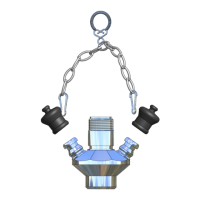
The hose piece version of the valve bodies all come with a set of rubber caps (EPDM) connected to the
body by two small chains.
The purpose of the caps is to protect the valve chamber from the environment between sampling.
Furthermore, a cap on the top port forces product to only ow out through the lower port during
sampling; in particular in case of high ow/pressure.
Steel caps (part no. 800061) may be used instead of rubber caps and will provide a stronger mechanical
xation to the hose piece and thus be operational under higher pressure and temperature. Furthermore,
the steel plugs may be autoclaved.
For further information please consult www.keott.dk.
3.6 Sampling coil
When sampling beer, the rapid pressure drop from inside the tank (CO
2
pressure of 2-3 bar) to the open
pressure less sample recipient causes excessive foaming, even when opening the valve very slowly and
very little. This phenomenon may be alleviated connecting a sampling coil (part no. 800058) between the
sampling valve and the sample recipient. A sampling coil provides a slower pressure drop as the sample
ows through the full length of the coil, approx. 1 m.
For further information please consult www.keott.dk.


 To Next Page