What to do in an emergency
107
Tire Pressure Monitoring System (TPMS)
Tire Pressure Monitoring Sys
-
tem (TPMS)
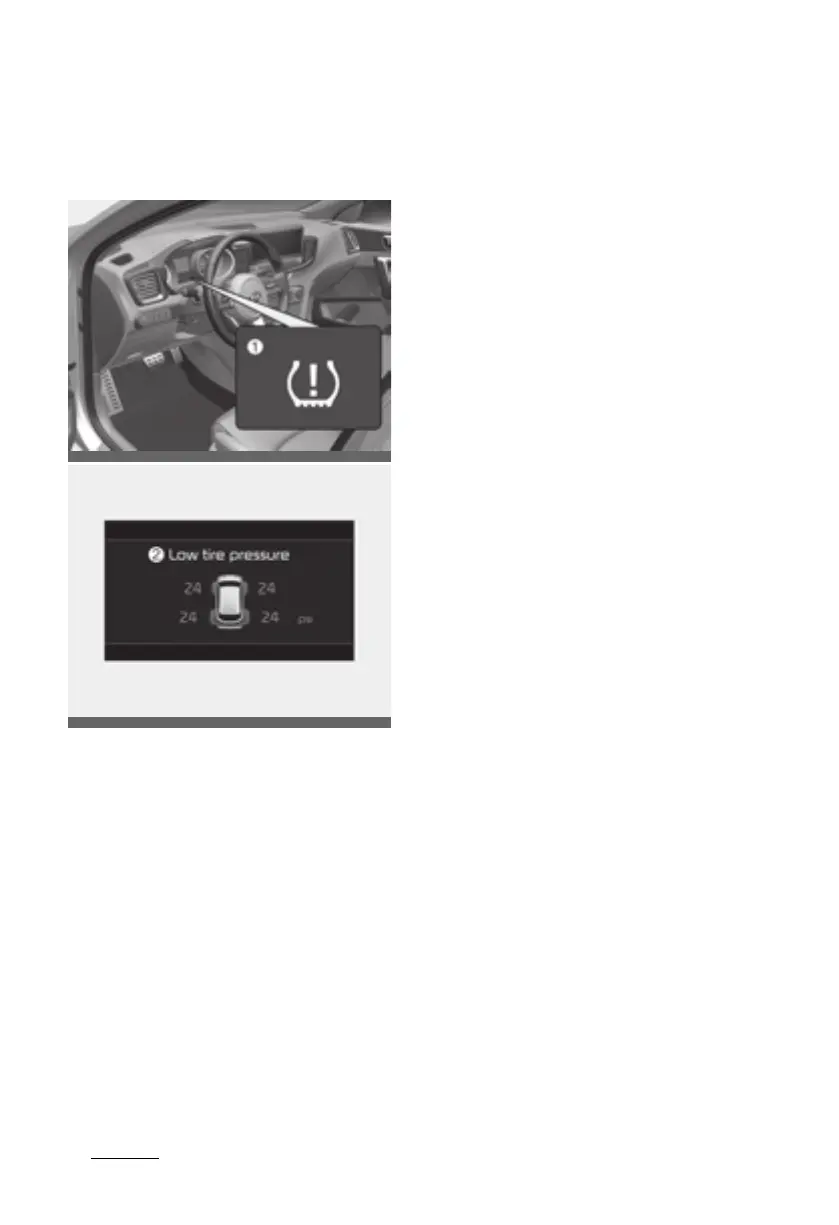
1. Low tire pressure telltale /TPMS
malfunction indicator
2. Low tire pressure position telltale
(Shown on the LCD display)
Check tire pressure
䳜 You can check the tire pressure in
the assist mode on the cluster.
- Refer to "User settings mode (if
equipped)" on page 5-70.
䳜 Tire pressure is displayed 1~2
minutes later after driving.
䳜 If tire pressure is not displayed
when the vehicle is stopped,
䳖Drive to display䳗 message dis
-
plays. After driving, check the tire
pressure.
䳜 You can change the tire pressure
unit in the user settings mode on
the cluster.
- psi, kpa, bar (Refer to "User
settings mode (if equipped)" on
page 5-70).
Each tire, including the spare (if pro
-
vided), should be checked monthly
when cold and inflated to the infla
-
tion pressure recommended by the
vehicle manufacturer on the vehicle
placard or tire inflation pressure
label.
(If your vehicle has tires of a differ
-
ent size than the size indicated on
the vehicle placard or tire inflation
pressure label, you should deter
-
mine the proper tire inflation pres
-
sure for those tires.)
As an added safety feature, your
vehicle has been equipped with a
tire pressure monitoring system
(TPMS) that illuminates a low tire
pressure telltale when one or more
of your tires is significantly under-
inflated. Accordingly, when the low
tire pressure telltale illuminates, you
should stop and check your tires as
soon as possible, and inflate them to
the proper pressure. Driving on a
significantly under-inflated tire
causes the tire to overheat and can
lead to tire failure. Under-inflation
CD_PHEV_LHD.book Page 10 Tuesday, November 12, 2019 11:29 PM













 To Next Page