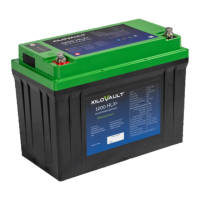
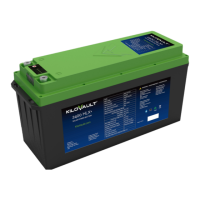
vi. 3600 HLX+ maximum charge amperage - 150A.
vii. Charger must taper the amps as the battery approaches 14.1 V.
e. After batteries are fully charged and disconnected from the charger, allow them to rest for
a minimum of two hours. During this time, the voltage will relax, even as low as 13.3 V.
Your batteries are still fully charged. This is normal.
3.2 - Location
Locate your battery bank in a place that is dry and as well protected from extreme
temperatures as possible. No ventilation is required as these do not off-gas like lead-acid
batteries do.
HLX+ batteries must be placed flat on their bottoms. Any other orientation will void the
warranty. Also, do not stack them one directly on top of another.
Batteries warm up while in use. Please consider your local average and seasonal
temperature when positioning your battery bank. If they will be in a warmer environment
you may want to leave a minimum of one inch spacing between each of the batteries.
If they will be subjected to cold temperatures you may want to place them as closely as
possible to each other. Consider adding insulation or an insulated enclosure around the
batteries if they will be exposed to temperatures that approach 32°F (0°C). The BMS will not
allow charging when the internal temperature is below freezing. Using insulation when it is
cold will maintain more of the heat generated during normal charging and reduce the
chance of the BMS shutting the battery down to protect the battery cells.
Please note: Battery capacity is reduced by 20% as its internal temperature falls between
room temperature (approximately 77°F (25°C)) and just above 32°F (0°C).
Please remember to remove the insulation in warmer months. Overheating the batteries
will shorten their life and the BMS will shut down the battery in temperatures above 149°F
(65°C).
3.3 - Cabling
All wire must be the appropriate gauge and construction to handle the loads that will be placed upon it.
Heavy gauge, fine stranded copper wire is the industry standard. A minimum of 2/0 or 4/0 AWG copper
cable is recommended for battery interconnect cables.
The cables connecting batteries in series into rows must be the same length. The cables connecting the
rows in parallel must be the same length. The home run cables to the inverter must be the same length.
Cables of different lengths will cause voltage differences in your battery bank. The rows in your battery
bank must be kept within 0.2 V of each other to ensure that they work correctly and that large currents
between rows aren’t generated.
If your battery bank suddenly shuts down as one or more rows approaches fully charged or fully
discharged, it is likely either the batteries are not all at the same state of charge or, if they are measured
KiloVault
®
LLC • 330 Codman Hill Road, Boxborough, MA 01719 • +1 (888) 218-5924 • info@kilovault.com • www.kilovault.com
Revision 1.0, 06/2021
Page 8 of 29

 To Next Page
 Loading...