1 Welcome
1.1 This guide
Welcome to the KNJN FPGA RS-232 development boards guide.
Although FPGA boards can be intimidating, the Pluto FPGA boards are easy to use. This document is partitioned in short
and easy to read chapters, and will explain all you need to know about your new FPGA board.
1.2 Why RS-232 FPGA boards?
Although RS-232 is overshadowed by USB's popularity, RS-232 provides an easier way to interact with FPGAs, and so is
valuable as a learning tool.
1.3 The Pluto boards
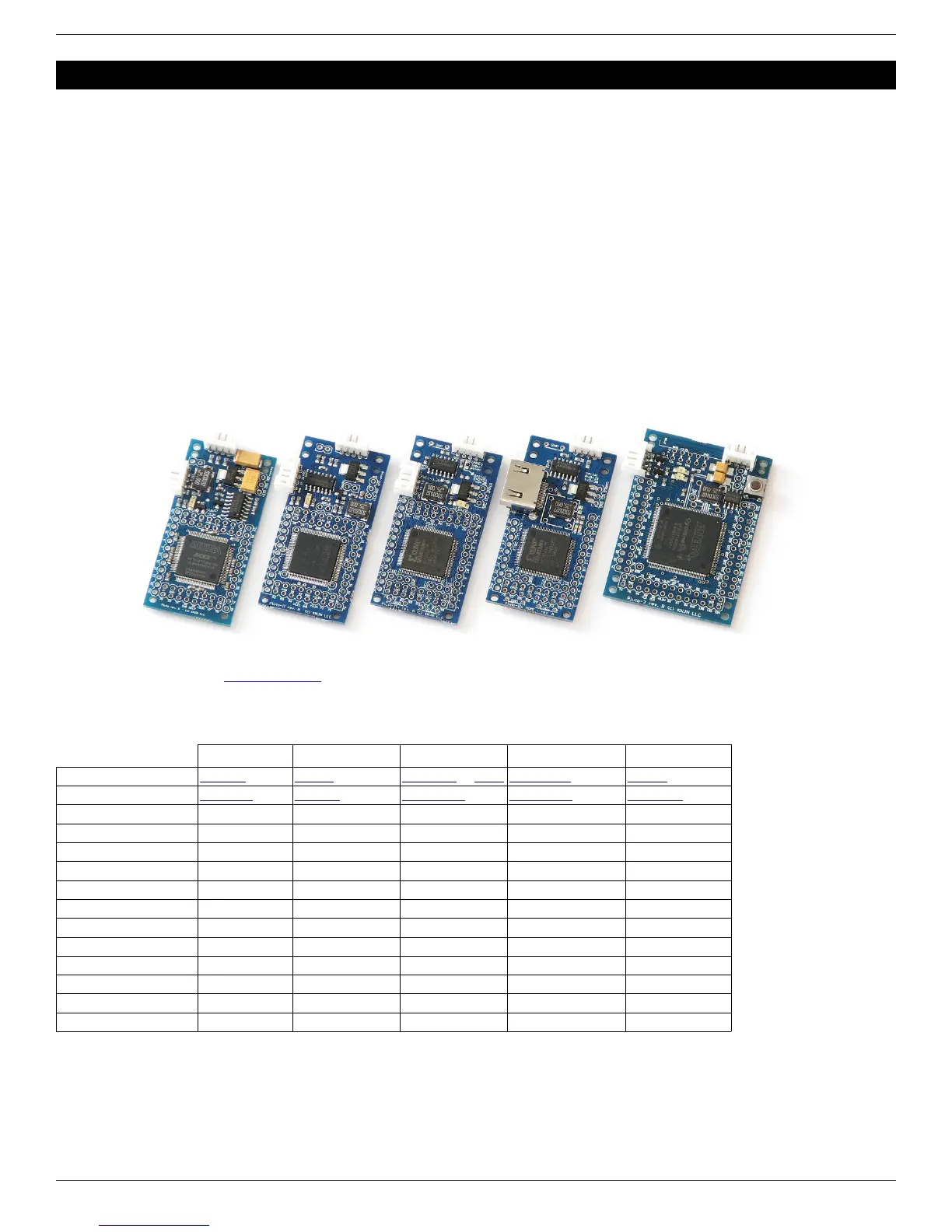
This guide applies to five different boards (Pluto, Pluto-II, Pluto-IIx / HDMI and Pluto-3).
Along this document, when a paragraph apply to all of them, they are collectively named “the Pluto boards” or “the FPGA
boards”.
Check them also on the KNJN website.
1.4 Boards characteristics
Pluto Pluto-II Pluto-IIx Pluto-IIx HDMI Pluto-3
FPGA (vendor page) EP1K10 EP1C3 XC3S50A or 200A XC3S200A EP2C5
Datasheet (PDF) ACEX 1K Cyclone Spartan-3A Spartan-3A Cyclone II
Logic cells 576 2910 1584 or 4032 4032 4608
IO pins 41 51 48 36 65
PLL/DLL - PLL DLL DLL PLL
External clocks up to 2 up to 4 up to 4 up to 4 up to 4
Boot-PROM (1) - 1Mbit 1Mbit or 4Mbit 4Mbit 4Mbit
On-board oscillator 25MHz 25MHz 25MHz 25MHz 25MHz
DIL8 oscillator header - - - Yes Yes
Push-button - - - - Yes
JTAG header - (see chapter 10) (see chapter 10) (see chapter 10) Yes
LED(s) 1 1 1 2 2
ADC board ready Flashy / Widy Flashy / Widy Flashy / Widy Flashy / Widy FlashyD / WidyD
Dimensions 58 x 28 mm 58 x 28 mm 58 x 28 mm 58 x 28 mm 58 x 41 mm
(1) Minimum boot-PROM size shown here. Actual product may use a higher capacity boot-PROM.
FPGA RS-232 development boards Page 5


 To Next Page