6
Maintenance
Warning
Always stop the machine prior to
greasing, adjustment or repair.
Greasing
SUC 100E, SUC150E, SUC 200 E,
SUC 300E:
All bearings are lubricated for life
and require no further greasing.
SUC 500E:
Grease the bearings on the blower
belt side every 200 working hours.
Use a lithium base grease of mini-
mum quality as Mobil Mobilux EP2
Belt Adjustment
Check V-belt tension regularly, espe-
cially when they are new. New V-belts
normally require adjustment after 15
minutes and again after 2- 3 hours
work.
Belt tension check
To inspect the V-belts remove the belt
guard. Use, for instance, a tension
tester to check the belts.
Order No.: 121 130 071.
Check the tension of all the belts. If it is
not possible to adjust one set of belts
so that all the belts have the proper
tension the whole set must be replaced.
SUC 100E,
Blower:
Depressoneofthebelts.Atadeec-
tion of 9.5 mm the force should be
between 1.5 and 2 kg.
Rotary valve:
Depress one of the belts. At a de-
ectionof4mmtheforceshouldbe
between 0.5 and 1 kg.
or Esso Beacon EP2. Regrease
with approx. 20 cm
3
= 20 g each
time. Never overgrease the bea-
rings.Ifthecasingislledwithtoo
much grease, the bearing will get
hot.
Cleaning
The screen inside the top of the
cyclone should be cleaned regu-
larly.
The material conveyed will determi-
ne how often cleaning is required.
If the screen is blocked the capacity
of the blower will be reduced.
Motors
Do not cover up the motors. Keep
them free of dirt reducing the coo-
ling.
Retightening
On a new blower all bolts and
screws are to be retightened after
therstworkingday.Apartfrom
that make sure that they are tight at
all times.
Storage
Clean and grease the suction
blower before storage.
To prevent rust, store the machine
in a dry place protected against
wind and moisture.
SUC 150E,
Blower:
Depress one of the belts. At a de-
ectionof9mmtheforceshouldbe
between 1.5 and 2.5 kg.
Rotary valve:
Depress one of the belts. At a de-
ectionof4mmtheforceshouldbe
between 0.5 and 1 kg.
SUC 200E,
Blower:
Depress one of the belts. At a de-
ectionof9mmtheforceshouldbe
between 1.9 and 2.8 kg.
Rotary valve:
Depress one of the belts. At a de-
ectionof4mmtheforceshouldbe
between 0.5 and 1 kg.
SUC 300E,
Blower:
Depress one of the belts. At a de-
ectionof9mmtheforceshouldbe
between 2 and 2.5 kg.
Rotary valve:
Depressoneofthebelts.Atadeec-
tion of 3.5 mm the force should be
between 1 and 1.5 kg.
SUC 500E,
Blower:
Depressoneofthebelts.Atadeec-
tion of 9.5 mm the force should be
between 3 and 5 kg.
Rotary valve:
Depressoneofthebelts.Atadeec-
tion of 3.5 mm the force should be
between 1.5 and 2 kg.
If the belts are too tight both the bearin-
gs and the belts will be overloaded and
their life considerably reduced.
If the belts are too slack they will slide
on the belt pulleys and wear quickly. At
the same time the blower will run too
slowly reducing conveying capacity.
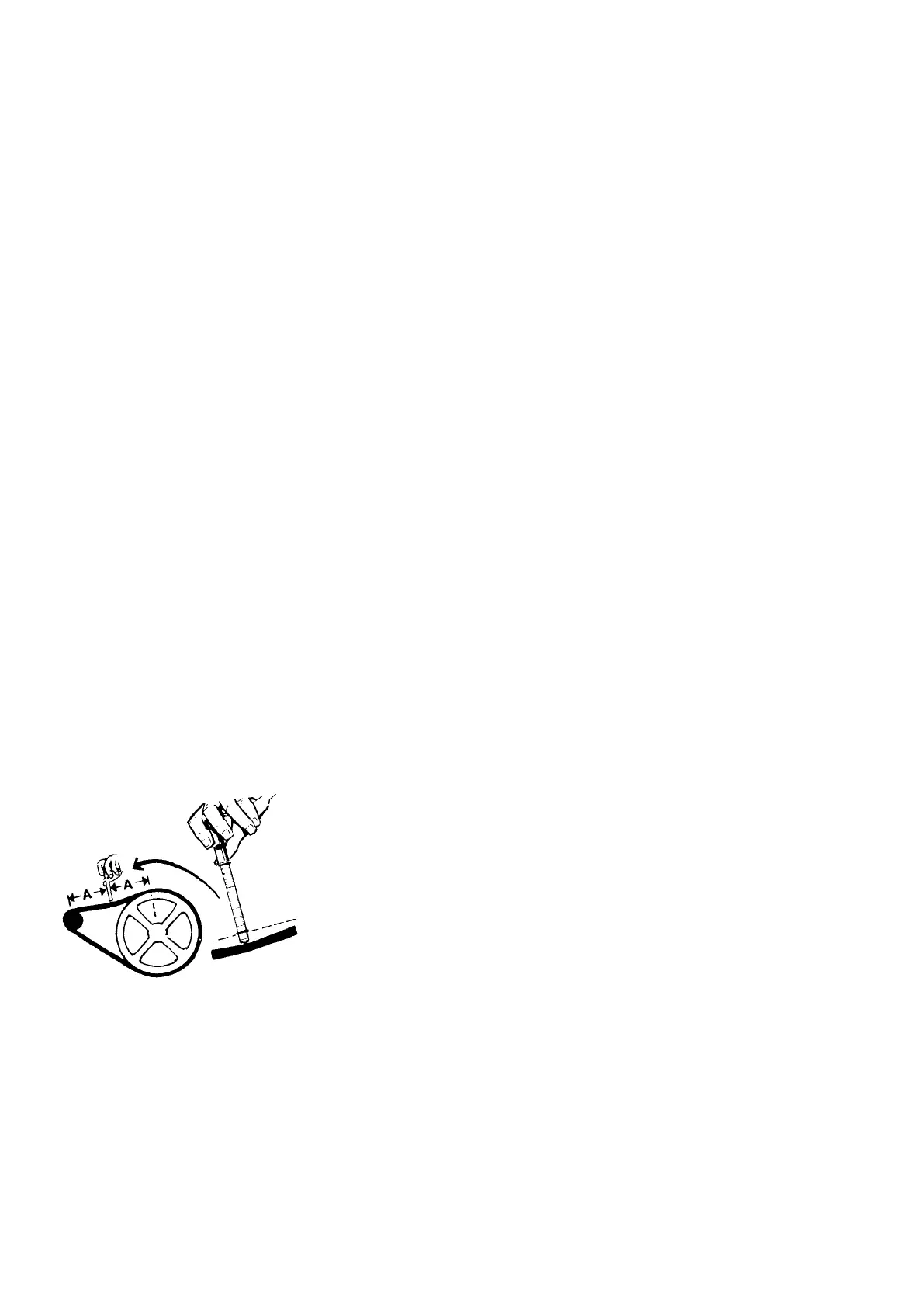
How to use the tension meter
1. Position the lower rubber ring at
thedeectiondistanceonthelower
scale. Leave the upper rubber ring
against the the edge of the sleeve.
2. At center of span length apply force,
with tension tester perpendicular
to the span, large enough to make
thedeectiondistancecorrespond
to the edge of the adjacent belt. A
straight edge across the belts will
insure accuracy of reading.
3. Remove the tension tester and
readthedeectionforceon
upper scale, at the top edge of
the rubber ring.
4. If the force is too high, belts should
be slackened, and if the force is too
low, belts should be tightened.
Tightening of belts
Make sure that the belt pulleys remain
aligned during tightening. Check by
putting a straight board against the pul-
leys to see whether both pulleys bear
against the board.
The rotary valva will remain aligned
during belt tightening.




 To Next Page