!
!
!
General Safety Instructions
2.
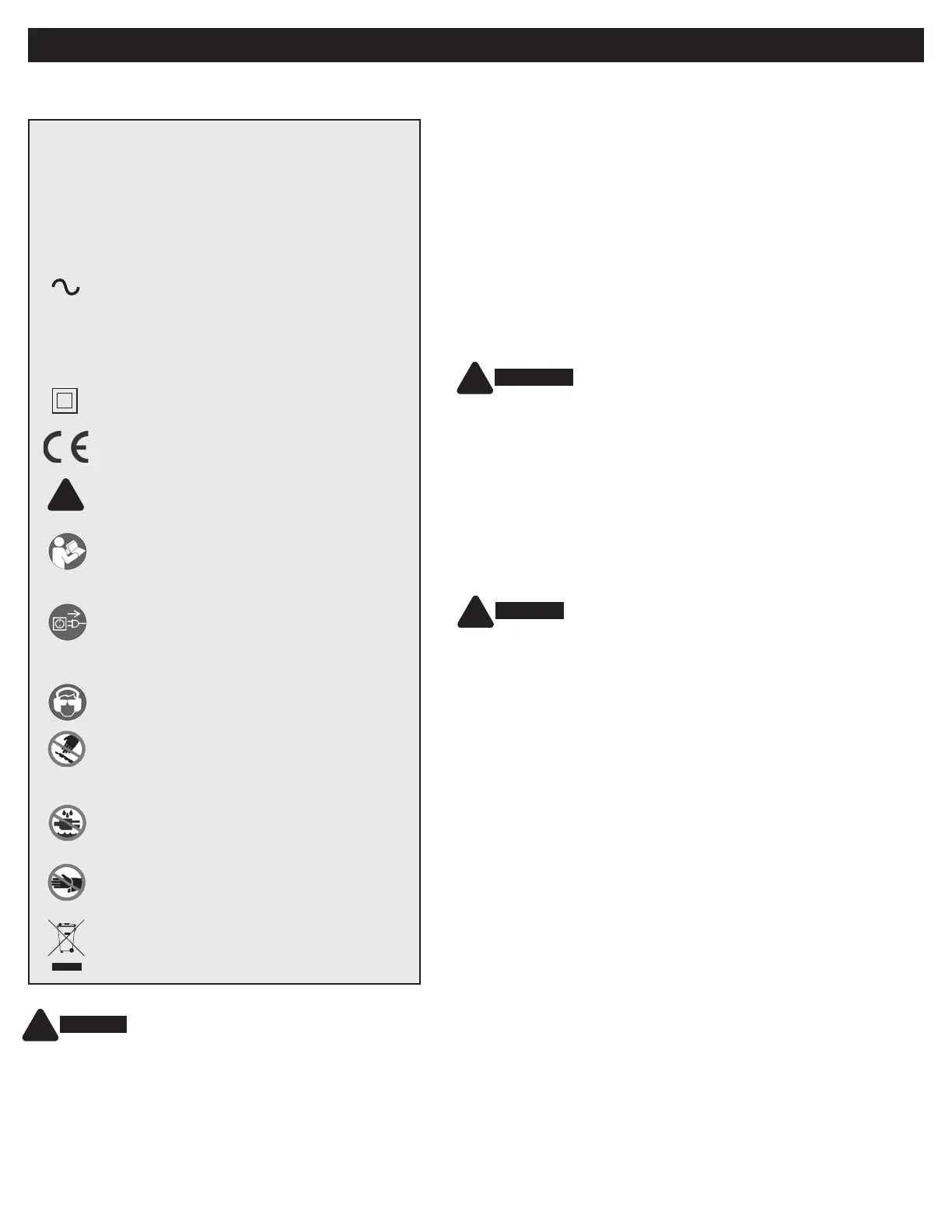
7) Thelabelonyourmachineandthismanualmayincludethesymbols
below.The symbols and their denitions are as follows:
WARNING Dust created by sanding, sawing, grinding, drilling, and
other construction activities may contain chemicals known to cause
cancer and birth defects or other reproductive harm. Examples of these
chemicals are:
a) Lead from lead-based paints
b) Crystalline silica from bricks and cement and other masonry products
c) Arsenic and chromium from chemically treated lumber
Your risk from exposure to these chemicals depends on how often you do
this type of work. To reduce your exposure, work in a well-ventilated area with
approved safety equipment, such as a dust mask specically designed to lter
out microscopic particles.
ForemanDB210-EURspecications
Input ................................................220V-240V~50-60Hz 600W
No-load speed .................................. 2,800 min-1
Minimum workpiece thickness .........13mm
Maximum workpiece thickness ........45mm
Standard drill bit ................................9.5mm-diameter, 157mm overall length,
stepped tip
Total mass including accessories .... 11 kg
Hand-Arm Vibration Level of the Foreman DB210-EUR Pocket-Hole Machine
Vibration total values determined according to EN 61029
No Load Acceleration at handle
Vibration emission value ah= 0.472 m/s
2
Uncertainty K= 1.5 m/s
2
Load Acceleration at handle
Vibration emission value ah= 4.34 m/s
2
Uncertainty K= 1.5 m/s
2
ATTENTION The vibration emission during actual use of the power tool can
differ from the declared total value depending on the way in which the tool is used.
Noise emission value
Noise emission declaration according to EN ISO 4871
A-weighted sound pressure level measuring
Unloading: Position 1-5 LpA =90.3 dB(A)
Loading: Position 1-5 LpA =91 dB(A)
Uncertainty KpA = 3 dB.
A-weighted sound power level measuring
Unloading: Calculated LwA = 101dB(A)
Loading: Calculated LwA = 101.8 dB(A)
Uncertainty KwA = 3 dB.
WARNING User exposure to tool vibration can result in loss of sense of touch,
numbness, tingling and reduced ability to grip. Long term exposure can lead to
a chronic condition. If necessary, limit the length of time exposed to vibration
and use anti-vibration gloves. Do not operate the tool with hands below a
normal comfortable temperature, as vibration will have a greater effect. Use the
gures provided in the specication relating to vibration to calculate the duration
and frequency of operating the tool.
Sound and vibration levels in the specication are determined according to
EN 61029 or similar international standards. The gures represent normal
use for the tool in normal working conditions. A poorly maintained, incorrectly
assembled, or misused tool, may produce increased levels of noise and
vibration. www.osha. europa.eu provides information on sound and vibration
levels in the workplace that may be useful to domestic users who use tools for
long periods of time.
Guidelines for extension cord use
Extension cords are only to be used for temporary purposes. They do not
replace the need for installation of outlets and proper wiring where necessary.
To reduce the risk of electric shock when using a power tool outdoors, use an
extension cord rated for outdoor use.
In the shop and on construction sites:
1. Extension cords with an equipment grounding conductor must be used
at all times.
2. Extension cords must be protected from damage, and not run through
doorways or windows where the doors or windows may close, causing
damage to the cord.
3. Extension cords should be rated for the requirements of the electrical
equipment in use with a conductor cross-section area not less than .75mm
2
.
4. Extension cords must be periodically inspected to ensure that the insulation
and conductivity of the wires are not compromised.
5. Extension cords should not be run through water or allowed to have
connections that may be exposed to accumulated water.
volts
hertz
amperes
watts
alternatingcurrent
no load speed
revolutions per minute
ClassIIConstruction(doubleinsulated)
Meets European Union safety, health, and
environmentalprotectionrequirements
Generalwarning
Read, understand, and follow all
instructionsbeforeattemptingtousethis
product.
Turn tool off and disconnect tool from
powersourcebeforemakingany
adjustmentsorremovingorinstalling
attachments or accessories.
Wearapprovedeyeandhearingprotection.
Keephandsawayfromtherotatingdrill
bitandworkpiececlampareawhen
operatingthemachine.
Do not expose to rain or use in a damp
location.
Donotwearjewelryorlooseclothing
whileoperating.
Do not dispose with household waste.
Dispose separately from municipal waste
stream.
V
Hz
A
W
English
3
• Be sure that the cutter knives are mounted as described in the
instruction manual and check that all bolts are firmly tightened
before connecting unit to power source.
• To avoid injury, never rotate the cutter block directly with your
hands.
• Keep guards in place and in good working order.
• Stay alert – never operate the unit when tired or under the
influence of drugs, alcohol, or medication.
• Do not use in dangerous environments. Do not use near
flammable substances, in damp or wet locations, or expose to
rain.
• Never plane material which is shorter than 12 inches.
• Exhaust chute: remove shavings with brush or vacuum after
power has been shut off and cutter head has stopped rotating.
• ALWAYS LOCATE PLANER WITH PROPER CLEARANCE ON
THE OUTFEED SIDE of the unit to prevent pinching or binding of
the workpiece against any obstacle.
• Clean out your tool often, especially after heavy use. Dust
and grit containing metal particles often accumulate on interior
surfaces and could create a risk of serious injury, electric shock or
electrocution. ALWAYS WEAR SAFETY GLASSES.
WARNING: For your own safety, it is recommended that two
people carry this machine or serious injury could result.
WARNING: Always wear proper personal hearing protection
that conforms to ANSI S12.6 (S3.19) during use. Under some
conditions and duration of use, noise from this product may
contribute to hearing loss.
WARNING: Some dust created by power sanding, sawing,
grinding, drilling, and other construction activities contains chemicals
known to the State of California to cause cancer, birth defects or
other reproductive harm. Some examples of these chemicals are:
• lead from lead-based paints,
• crystalline silica from bricks and cement and other masonry
products, and
• arsenic and chromium from chemically-treated lumber.
Your risk from these exposures varies, depending on how often you
do this type of work. To reduce your exposure to these chemicals:
work in a well ventilated area, and work with approved safety
equipment, such as those dust masks that are specially designed to
filter out microscopic particles.
• Avoid prolonged contact with dust from power sanding,
sawing, grinding, drilling, and other construction activities.
Wear protective clothing and wash exposed areas with
soap and water. Allowing dust to get into your mouth, eyes, or
lay on the skin may promote absorption of harmful chemicals.
WARNING: A dust mask or respirator should be worn by all
persons entering the work area. The filter should be replaced daily or
whenever the wearer has difficulty breathing. See your local hardware
store for the proper NIOSH/OSHA approved dust mask.
• The label on your tool may include the following symbols. The
symbols and their definitions are as follows:
V ......... volts A .......amperes
Hz ....... hertz W ......watts
min ..... minutes
.....alternating current
... direct current .....alternating or direct current
....... Class I Construction
n
o ......no load speed
........... (grounded)
......earthing terminal
....... Class II Construction .....safety alert symbol
........... (double insulated) BPM ..beats per minute
…/min per minute RPM ..revolutions per minute
English
3
• Be sure that the cutter knives are mounted as described in the
instruction manual and check that all bolts are firmly tightened
before connecting unit to power source.
• To avoid injury, never rotate the cutter block directly with your
hands.
• Keep guards in place and in good working order.
• Stay alert – never operate the unit when tired or under the
influence of drugs, alcohol, or medication.
• Do not use in dangerous environments. Do not use near
flammable substances, in damp or wet locations, or expose to
rain.
• Never plane material which is shorter than 12 inches.
• Exhaust chute: remove shavings with brush or vacuum after
power has been shut off and cutter head has stopped rotating.
• ALWAYS LOCATE PLANER WITH PROPER CLEARANCE ON
THE OUTFEED SIDE of the unit to prevent pinching or binding of
the workpiece against any obstacle.
• Clean out your tool often, especially after heavy use. Dust
and grit containing metal particles often accumulate on interior
surfaces and could create a risk of serious injury, electric shock or
electrocution. ALWAYS WEAR SAFETY GLASSES.
WARNING: For your own safety, it is recommended that two
people carry this machine or serious injury could result.
WARNING: Always wear proper personal hearing protection
that conforms to ANSI S12.6 (S3.19) during use. Under some
conditions and duration of use, noise from this product may
contribute to hearing loss.
WARNING: Some dust created by power sanding, sawing,
grinding, drilling, and other construction activities contains chemicals
known to the State of California to cause cancer, birth defects or
other reproductive harm. Some examples of these chemicals are:
• lead from lead-based paints,
• crystalline silica from bricks and cement and other masonry
products, and
• arsenic and chromium from chemically-treated lumber.
Your risk from these exposures varies, depending on how often you
do this type of work. To reduce your exposure to these chemicals:
work in a well ventilated area, and work with approved safety
equipment, such as those dust masks that are specially designed to
filter out microscopic particles.
• Avoid prolonged contact with dust from power sanding,
sawing, grinding, drilling, and other construction activities.
Wear protective clothing and wash exposed areas with
soap and water. Allowing dust to get into your mouth, eyes, or
lay on the skin may promote absorption of harmful chemicals.
WARNING: A dust mask or respirator should be worn by all
persons entering the work area. The filter should be replaced daily or
whenever the wearer has difficulty breathing. See your local hardware
store for the proper NIOSH/OSHA approved dust mask.
• The label on your tool may include the following symbols. The
symbols and their definitions are as follows:
V ......... volts A .......amperes
Hz ....... hertz W ......watts
min ..... minutes
.....alternating current
... direct current .....alternating or direct current
....... Class I Construction
n
o ......no load speed
........... (grounded)
......earthing terminal
....... Class II Construction .....safety alert symbol
........... (double insulated) BPM ..beats per minute
…/min per minute RPM ..revolutions per minute
English
3
• Be sure that the cutter knives are mounted as described in the
instruction manual and check that all bolts are firmly tightened
before connecting unit to power source.
• To avoid injury, never rotate the cutter block directly with your
hands.
• Keep guards in place and in good working order.
• Stay alert – never operate the unit when tired or under the
influence of drugs, alcohol, or medication.
• Do not use in dangerous environments. Do not use near
flammable substances, in damp or wet locations, or expose to
rain.
• Never plane material which is shorter than 12 inches.
• Exhaust chute: remove shavings with brush or vacuum after
power has been shut off and cutter head has stopped rotating.
• ALWAYS LOCATE PLANER WITH PROPER CLEARANCE ON
THE OUTFEED SIDE of the unit to prevent pinching or binding of
the workpiece against any obstacle.
• Clean out your tool often, especially after heavy use. Dust
and grit containing metal particles often accumulate on interior
surfaces and could create a risk of serious injury, electric shock or
electrocution. ALWAYS WEAR SAFETY GLASSES.
WARNING: For your own safety, it is recommended that two
people carry this machine or serious injury could result.
WARNING: Always wear proper personal hearing protection
that conforms to ANSI S12.6 (S3.19) during use. Under some
conditions and duration of use, noise from this product may
contribute to hearing loss.
WARNING: Some dust created by power sanding, sawing,
grinding, drilling, and other construction activities contains chemicals
known to the State of California to cause cancer, birth defects or
other reproductive harm. Some examples of these chemicals are:
• lead from lead-based paints,
• crystalline silica from bricks and cement and other masonry
products, and
• arsenic and chromium from chemically-treated lumber.
Your risk from these exposures varies, depending on how often you
do this type of work. To reduce your exposure to these chemicals:
work in a well ventilated area, and work with approved safety
equipment, such as those dust masks that are specially designed to
filter out microscopic particles.
• Avoid prolonged contact with dust from power sanding,
sawing, grinding, drilling, and other construction activities.
Wear protective clothing and wash exposed areas with
soap and water. Allowing dust to get into your mouth, eyes, or
lay on the skin may promote absorption of harmful chemicals.
WARNING: A dust mask or respirator should be worn by all
persons entering the work area. The filter should be replaced daily or
whenever the wearer has difficulty breathing. See your local hardware
store for the proper NIOSH/OSHA approved dust mask.
• The label on your tool may include the following symbols. The
symbols and their definitions are as follows:
V ......... volts A .......amperes
Hz ....... hertz W ......watts
min ..... minutes
.....alternating current
... direct current .....alternating or direct current
....... Class I Construction
n
o ......no load speed
........... (grounded)
......earthing terminal
....... Class II Construction .....safety alert symbol
........... (double insulated) BPM ..beats per minute
…/min per minute RPM ..revolutions per minute
min
-1
!


 To Next Page
 Loading...