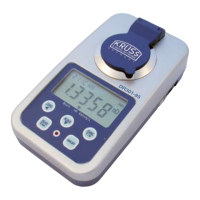
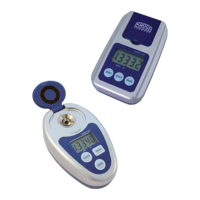
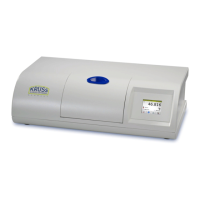
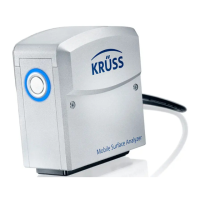
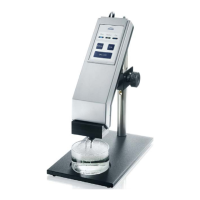
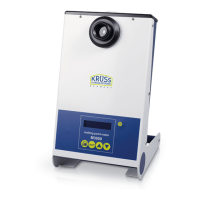
The DR201-95 is a compact, mobile, and splash-water proof digital handheld refractometer designed for the measurement of the refractive index (nD) and the sugar content in % (Brix) of liquid and viscous samples. It determines the refractive index between nD 1.3330–1.5318 and the sugar content in the range of 0–95 %Brix. The integrated temperature sensor determines the automatic temperature compensation for the whole Brix scale in the range of 10–40 °C. Details on samples and measurements can be found in the A.KRÜSS Campus.
Technical Specifications:
- Device Type: DR201-95
- Measurement Range: nD 1.3330–1.5318, 0–95 %Brix
- Measurement Accuracy: nD ±0.0003, ±0.2 %Brix
- Resolution: nD 0.0001, 0.1 %Brix
- Measurement Prism: Optical glass (Flint glass SF4)
- Measurement Time: Approx. 1 second
- Light Source: LED
- Operation: Buttons on membrane keypad
- Ambient Temperature: 10–35 °C
- Ambient Air Moisture: 10–90 %, non-condensing
- IP Code: IP64, splash-water proof
- Sample Containing Components: Flint glass SF4, fully chromed sample intake
- Housing: Synthetic material (ABS), coated
- Dimensions (H x W x D): 130 mm x 80 mm x 40 mm
- Device Weight: 180 g
- Temperature Measurement: Integrated temperature sensor
- Temperature Measurement Range: 10–40 °C
- Temperature Measurement Accuracy: ±0.5 °C
- Temperature Compensation: 10–40 °C
- Temperature Measurement Resolution: 0.1 °C
- Operating Voltage: 1.5 V (AAA battery)
Usage Features:
The DR201-95 is suitable for various applications in the food industry, pharmacies, and investigations offices, as well as in research and teaching. It is designed for the following investigations and areas of application:
- Identity tests, purity control and concentration determination of raw materials, semi-finished products, and end products
- Determination of sugar concentration
- Incoming and outgoing goods inspections
- Controlling foodstuffs and pharmaceuticals
The operator must ensure that the devices are used exclusively as intended and that any danger whatsoever to the life, limb, or health of users or third parties are avoided. In addition, accident prevention regulations and recognised safety rules are to be observed. The operator must ensure that all users have read and understood this instruction manual. Non-observance of this instruction manual will void the warranty. The same applies if improper work has been carried out on the device by the customer and/or third parties without the approval of the manufacturer. Servicing work may only be carried out by expert A.KRÜSS employees.
The device must not be opened since this could affect its functions and safety. Modifications to device components, e.g. the measurement prism, could lead to faulty measurement values. Only use fully functional batteries. Batteries which are exposed to mechanical stress or extreme environmental influences can impair the device function or safety. Influences include heat, cold, humidity, corrosion, or vibration. Remove the battery when the device is not in use for an extended period of time; battery leakage can destroy the device. Do not drop the device as it may thus be damaged.
Operation:
-
Adjusting: In daily use, it is recommended that the device be calibrated with distilled water and adjusted if necessary. In an adjustment, a sample, usually a calibration standard, is measured with a known setpoint. The device is adjusted on the basis of the comparison between the measuring result of the device and the setpoint. The adjustment permanently changes the device and minimises the deviation between the measurement result and the setpoint. For adjustment of the refractometer a temperature compensation for distilled water is used. Therefore only distilled water is to be used. Before the adjustment begins, ensure the refractometer, the water for adjusting and the environment have the same temperature.
- Procedure: Switch on the device. Pour about 0.4 ml of distilled water onto the measuring prism. The prism must be completely covered. Ensure that there are no bubbles in the sample. Close the lid of the device. Wait for 5 seconds after pouring the water onto the prism. Press the ZERO button and keep it pressed until "CAL" and "END" are displayed in succession. Carefully clean the measuring prism with a soft, dry cloth.
- Result: The adjustment of the device with distilled water has been carried out. To check whether the adjustment has been carried out correctly, the refractometer can be calibrated with distilled water.
-
Calibrating: To check whether an adjustment has been carried out correctly or to determine the deviations between measured values and expected values, the device can be calibrated. For calibration, a sample usually a calibration standard is measured with a known setpoint. Comparing the measurement result of the device with the setpoint will reveal deviation of the device.
- Procedure: Switch on the device. Pour about 0.4 ml distilled water onto the measuring prism. The prism must be completely covered. Ensure that there are no bubbles in the sample. Close the lid of the device. Wait for 5 seconds after pouring the water onto the prism. Briefly press the ZERO button once. Check that the displayed reading is between nD 1.3327 and 1.3333. The device displays the refractive index of distilled water for 20 °C. Due to the tolerances of the refractometer, the range of the expected measured value is given. Carefully clean the measuring prism with a soft, dry cloth.
- Result: Calibration of the device with distilled water has been carried out. If the measured value at the measuring temperature lies beyond the tolerances, repetition of the measurement is recommended after thorough and residue-free cleaning of the prism. If the deviation remains unchanged, an adjustment should be carried out. If the refractometer is to be calibrated with (certified) calibration standards, this can be done with measurements obtained via the READ button.
-
Measuring Samples: In order to avoid contamination and damage of the prism as well as sample carry-over, clean the prism immediately after the measurement. Make sure that the sample does not come in contact with the housing of the refractometer. Any sample material on the housing should be removed immediately.
- Procedure: Switch on the device. Pour about 0.4 ml distilled water onto the measuring prism. The prism must be completely covered. The sample must not contain any bubbles. Close the lid of the device. Wait for 5 seconds after pouring the water onto the prism. Press the READ button once. After 1 second, the measured value is displayed in the currently selected measurement scale. To obtain the measured value of the same sample in the second measurement scale change the scale. Afterwards measure the sample once more. Carefully clean the measuring prism with a soft, dry cloth. When cleaning, use a solvent suitable for the sample material for cleaning. For details see chapter 5.3 Recommended sample-specific agents.
- Result: The measurement has been carried out.
Maintenance Features:
-
Cleaning and Maintenance: Servicing work may only be carried out by expert A.KRÜSS employees. Do not clean the device under flowing water or completely immerse it as damage could thus be caused.
- Note: Improper cleaning can damage the device. Aggressive and abrasive cleaning agents can damage the refractometer. Avoid strong bases and acids. They damage the plastic housing. Do not clean the measurement prism with mechanical means (scraper, tweezers, ...) to avoid damaging it.
- Procedure: Correct cleaning of a refractometer is a basic requirement for precise determination of the refractive index. The device should be cleaned before and after each use. If the cleaning procedure is carried out incorrectly, a very thin layer of the previous sample may remain, which causes sample carry-over. An incorrect refractive index will subsequently be measured for the next sample. Details of cleaning procedures available at the A.KRÜSS campus.
-
Recommended Sample-Specific Cleaning Agents: In general, it is sufficient to clean the refractometer and measurement prism using a high quality, lint-free, antistatic cloth, and water. First remove the sample with a cloth and then wipe clean with a moistened cloth. The best cleaning results are achieved with the following cleaning agents:
- Fruit juices: Water (Cleaning Agent 1), Ethanol (Cleaning Agent 2)
- Soft drinks: Water (Cleaning Agent 1), Ethanol (Cleaning Agent 2)
- Sugar solutions, salt solutions, honey: Water (Cleaning Agent 1)
- AdBlue/urea: Water (Cleaning Agent 1)
- Cleaning agents: Water (Cleaning Agent 1), Ethanol (Cleaning Agent 2)
- Ethylene glycol, propylene glycol: Water (Cleaning Agent 1), Ethanol (Cleaning Agent 2)
- Engine oil, lubricating oil: Benzine (Cleaning Agent 1)
- Mineral oils: Isopropyl alcohol (Cleaning Agent 1)
- Fuel, diesel, jet fuel and heating oil: Benzine, petroleum spirit (Cleaning Agent 1)
-
Exchanging the Battery: It can be assumed that a 1.5 Volt battery will have a general service life of approx. 5000 hours. The voltage of the battery may be sufficient for normal use, but not for measurements. In this case, the device will not take a measurement or provide noticeably inaccurate readings. Wide measurement discrepancies can be caused by a used battery. In case of strong measurement deviations, the device should be calibrated with distilled water after the battery has been exchanged, see chapter 4.1 Adjusting and calibrating. If the error code "LLL" is shown on the display, the battery has to be replaced by a new one.
- Procedure: Switch off the device. To exchange the battery, open the flap on the bottom of the device. Remove the empty battery and insert a replacement in correct polarity. Finally, close the flap.
- Result: The battery has been replaced. Adjust/calibrate the device with distilled water after exchanging the battery.
Troubleshooting:
- Device not working:
- Possible Causes: Battery used up or no battery, Faulty refractometer.
- Corrective Measures: Replace or insert the battery. If possible, use alkaline battery. Contact Customer Service.
- No measurement value:
- Possible Causes: Battery used up or no battery, Bubbles in the measuring cell, Faulty measurement LED.
- Corrective Measures: Replace or insert the battery. If possible, use alkaline battery. Reapply sample without bubbles. Contact Customer Service.
- Poor precision:
- Possible Causes: Unsteady ambient conditions, Bubbles in the measuring cell.
- Corrective Measures: Create external temperatures as constant as possible. Reapply sample without bubbles.
- Wrong measurement values:
- Possible Causes: Contaminated prism, Faulty adjustment, Contaminated prism.
- Corrective Measures: Clean the prism. Adjust. Clean the prism thoroughly.
- Wrong temperature:
- Possible Causes: Battery used up or no battery, Faulty temperature sensor.
- Corrective Measures: Replace or insert the battery. If possible, use alkaline battery. Contact Customer Service.
- Membrane keypad not working:
- Possible Causes: Faulty membrane pad.
- Corrective Measures: Contact Customer Service.
- Measurement values of reference substances outside the range of specification:
- Possible Causes: Reference substances contaminated or too old, Deviation of the given data of the calibrating standards.
- Corrective Measures: Check substance regarding purity and age. Use only pure and not out-of-date substances. Use only distilled water for the measuring of water. Check setpoint data.
- Error code "HHH":
- Possible Causes: Adjustment necessary, Measuring value above measurement range (over nD 1.5318).
- Corrective Measures: Perform adjustment. Sample not measurable.
- Error code "LLL":
- Possible Causes: Adjustment necessary, Battery used up, Measuring value under measurement range (below nD 1.3320), Adjustment necessary.
- Corrective Measures: Perform adjustment. Exchange battery. If possible, use alkaline battery. Sample not measurable. Perform adjustment.
Important Note: Observe the specified safety instructions; if a fault is rectified improperly, the warranty will become void. If the remedial actions cannot correct the fault, contact A.KRÜSS Optronic GmbH Customer Service.

 Need help?
 General

 To Next Page