ENGLISH
30
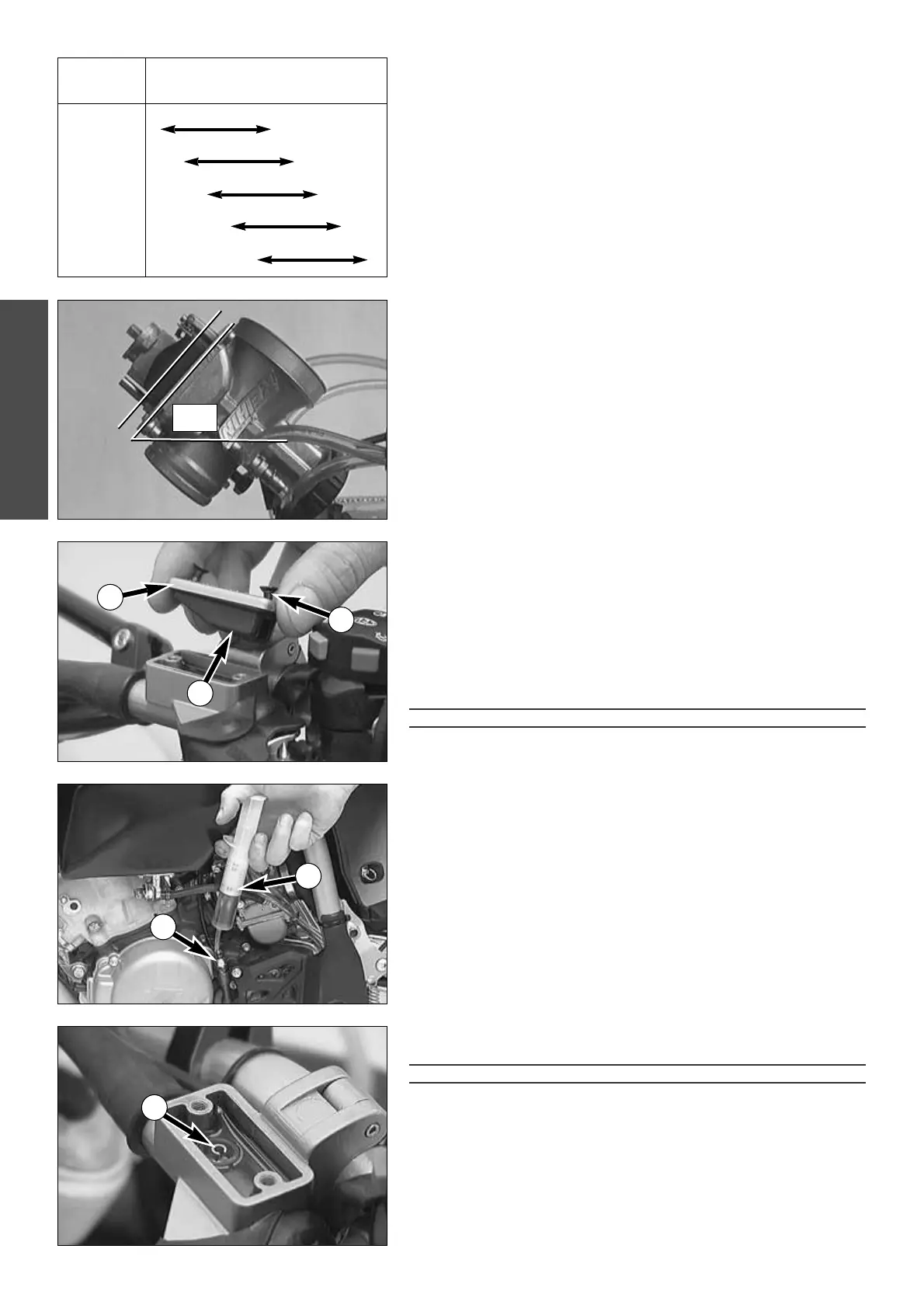
Part-throttle range C
Operation with partly open throttle valve. This range is only influenced by
the jet needle (shape and position). The optimum part-throttle setting is
controlled by the idling setting in the lower range and by the main jet in the
upper range. If the engine runs on a four-stroke cycle or with reduced
power when it is accelerated with the throttle partly open, the jet needle
must be lowered by one notch. If then the engine pings, especially when
accelerating under full power at maximum engine revs, the jet needle
should be raised.
If these faults should occur at the lower end of the part throttle range at a
four-stroke running, make the idling range leaner; if the engine pings,
adjust the idling range richer.
Full throttle range D
Operation with the throttle fully open (flat out). This range is influenced by
the main jet and the jet needle. If the porcelain of the new spark plug is
found to have a very bright or white coating or if the engine rings, after a
short distance of riding flat out, a larger main jet is required. If the porce-
lain is dark brown or black with soot the main jet must be replaced by a
smaller one.
Powerjet (250 SX)
A magnetic valve, the Powerjet nozzle, is opened when maximum torque
has been reached during acceleration, i.e. at between 6,800 – 8,500 rpm.
This sends additional petrol through the carburettor. If the engine is too fat
a smaller Powerjet nozzle must be fitted. If the engine is too lean a larger
Powerjet nozzle must be fitted.
Checking the float level *
Arrange the carburetor diagonally at about 60° so that the spring in the
float needle valve is not pressed together. In this position, the edge of
the
float should be parallel with the float chamber sealing surface (see
illustration).
Checking the oil level of the hydraulic clutch
To check the oil level in the master cylinder of the clutch remove the
cover. For this purpose, remove screws
1 and cover 2 together with
the rubber boot
3. The oil level in the horizontal-standing master cylin-
der should be 4 mm below the upper edge. If necessary add SAE 10
hydraulic oil
!
CAUTION
!
O
NLY USE SAE 10
MINERAL HYDRAULIC OIL (i.e. Shell Naturelle HF-E15) TO REFILL
THE MASTER CYLINDER
. NEVER USE BRAKE FLUID!
Bleeding of the hydraulic clutch
For bleeding, the cover of the master cylinder of the clutch needs to be
removed. For this purpose, remove screws 1 and take off cover 2 together
with rubber bellows
3. At the slave cylinder of the clutch, remove the blee-
der nipple 4. At its place, mount the bleeder syringe 5 which is filled with
SAE 10 hydraulic oil. Refill oil, until oil is discharged from the bore
6 of the
master cylinder in a bubble-free state. Make sure that the oil does not over-
flow. The bleeder syringe can be purchased at your KTM dealer.
!
CAUTION
!
H
AVING COMPLETED THE BLEEDING PROCEDURE, YOU HAVE TO VERIFY THAT THE OIL
LEVEL IN THE MASTER CYLINDER IS CORRECT
. FOR FILLING OF THE MASTER CYLINDER, USE
SAE 10
MINERAL HYDRAULIC OIL (e.g. Shell Naturelle HF-E15) ONLY; NEVER USE
BRACKE FLUID
!
NOZD
NOZE
NOZF
NOZG
NOZH
JET NEEDLE
RANGE OF ACTION
TYPE RICHER LEANER
60°
1
2
3
6
4
5


 To Next Page