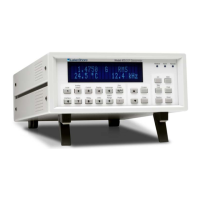
Lake Shore Model 421 Gaussmeter User’s Manual
A-2 Glossary of Terminology
cathode. The terminal from which forward current flows to the external circuit.
2
Anode Cathode
+–
Celsius (°C) Scale. A temperature scale that registers the freezing point of water as 0 °C and the boiling point as 100 °C
under normal atmospheric pressure. Celsius degrees are purely derived units, calculated from the Kelvin
Thermodynamic Scale. Formerly known as “centigrade.” See Temperature for conversions.
cgs system of units. A system in which the basic units are the centimeter, gram, and second.
2
coercive force (coercive field). The magnetic field strength (H) required to reduce the magnetic induction (B) in a
magnetic material to zero.
coercivity. generally used to designate the magnetic field strength (H) required to reduce the magnetic induction (B) in a
magnetic material to zero from saturation. The coercivity would be the upper limit to the coercive force.
compliance voltage. See current source.
Curie temperature (Tc). Temperature at which a magnetized sample is completely demagnetized due to thermal
agitation. Named for Pierre Curie (1859
– 1906), a French chemist.
current source. A type of power supply that supplies a constant current through a variable load resistance by
automatically varying its compliance voltage. A single specification given as “compliance voltage” means the output
current is within specification when the compliance voltage is between zero and the specified voltage.
demagnetization. when a sample is exposed to an applied field (H
a
), poles are induced on the surface of the sample.
Some of the returned flux from these poles is inside of the sample. This returned flux tends to decrease the net
magnetic field strength internal to the sample yielding a true internal field (H
int
) given by: H
int
= H
a
– DM ,where M is the
volume magnetization and D is the demagnetization factor. D is dependent on the sample geometry and orientation with
respect to the field.
deviation. The difference between the actual value of a controlled variable and the desired value corresponding to the
setpoint.
1
differential permeability. The slope of a B versus H curve: µ
d
= dB/dH.
differential susceptibility. The slope of a M versus H curve: χ
d
= dM/dH.
digital controller. A feedback control system where the feedback device (sensor) and control actuator (heater) are joined
by a digital processor. In Lake Shore controllers the heater output is maintained as a variable DC current source.
digital data. Pertaining to data in the form of digits or interval quantities. Contrast with analog data.
2
dimensionless sensitivity. Sensitivity of a physical quantity to a stimulus, expressed in dimensionless terms. The
dimensionless temperature sensitivity of a resistance temperature sensor is expressed as S
d
= (T/R)(dR/dT) which is
also equal to the slope of R versus T on a log-log plot, that is S
d
= d lnR / d lnT. Note that the absolute temperature (in
kelvin) must be used in these expressions.
drift, instrument. An undesired but relatively slow change in output over a period of time, with a fixed reference input.
Note: Drift is usually expressed in percent of the maximum rated value of the variable being measured.
2
electromagnet. A device in which a magnetic field is generated as the result of electrical current passing through a helical
conducting coil. It can be configured as an iron-free solenoid in which the field is produced along the axis of the coil, or
an iron-cored structure in which the field is produced in an air gap between pole faces. The coil can be water cooled
copper or aluminum, or superconductive.
electron. An elementary particle containing the smallest negative electric charge. Note: The mass of the electron is
approximately equal to 1/1837 of the mass of the hydrogen atom.
2
electrostatic discharge (ESD). A transfer of electrostatic charge between bodies at different electrostatic potentials
caused by direct contact or induced by an electrostatic field.
error. Any discrepancy between a computed, observed, or measured quantity and the true, specified, or theoretically
correct value or condition.
2
Fahrenheit (°F) Scale. A temperature scale that registers the freezing point of water as 32 °F and the boiling point as
212 °F under normal atmospheric pressure. See Temperature for conversions.
flux (φ). The electric or magnetic lines of force in a region.
1
flux density (B). Any vector field whose flux is a significant physical quantity; examples are magnetic flux density, electric
displacement, and gravitational field.
1
gamma. A cgs unit of low-level flux density, where 100,000 gamma equals one oersted, or 1 gamma equals 10
–5
oersted.
gauss (G). The cgs unit for magnetic flux density (B). 1 gauss = 10
–4
tesla = 1 Mx/cm
2
= line/cm
2
. Named for Karl Fredrich
Gauss (1777 – 1855) a German mathematician, astronomer, and physicist.
gaussian system (units). A system in which centimeter-gram-second units are used for electric and magnetic qualities.
general purpose interface bus (GPIB). Another term for the IEEE-488 bus.
gilbert (Gb). A cgs electromagnetic unit of the magnetomotive force required to produce one maxwell of magnetic flux in
a magnetic circuit of unit reluctance. One gilbert is equal to 10/4π ampere-turn. Named for William Gilbert (1540
– 1603),
an English physicist; hypothesized that the earth is a magnet.
gilbert per centimeter. Practical cgs unit of magnet intensity. Gilberts per cm are the same as oersteds.


 To Next Page