2 Camera Shutter
2.1 Introduction
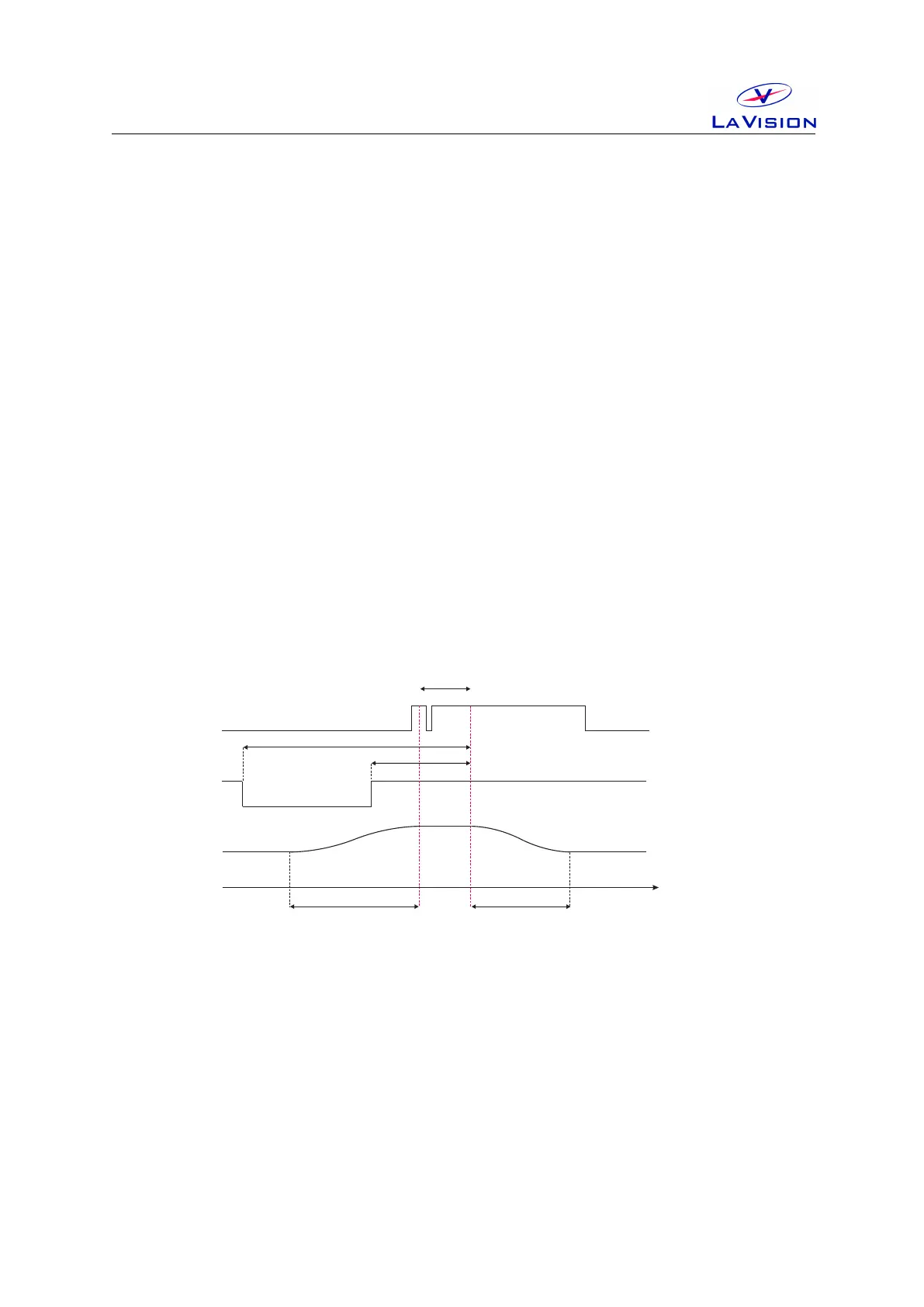
PIV cameras in frame straddling mode typically work with different inte-
gration times for the two frames (see camera manual for details). For this
reason a 532 nm interference filter that is used in front of the camera lens
is included in the PIV system to suppress the background light in the sec-
ond frame. So the effective exposure time is given by the length of the
laser pulse which is in the order of 10 ns. Since the wavelength of the
background light (e.g. of flames) is in the range of the used laser light it
can be necessary to use a mechanical camera shutter additionally. This can
reduce the exposure time of the second frame and the background noise
to ensure a higher validation rate for the evaluation.
time
camera
exposure
shutter
trigger
shutter
aperture
dt
open
duration
close
duration
T1A T1B
open duration + close duration
close duration
The shutter has been designed to give accurate, repeatable exposures for a
wide variety of applications. The standard shutter is available with 40 mm
aperture in cased configuration.
The benefit of the 40 mm aperture is that the camera shutter may be con-
nected in front of the camera lens and not in between the camera lens
and the CCD chip what allows for example to arrange the camera and lens
according to the Scheimpflug criterion in combination with the external
mechanical shutter. The camera shutter may be connected via external
(male) M52-filter thread to the camera lens while a bandpass filter may be
attached using the internal (female) M52-filter thread. The camera shutter
9


 To Next Page