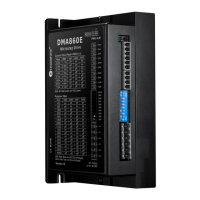
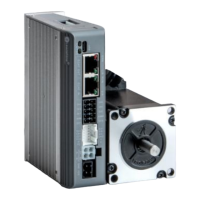
DMA860H Fully Digital Stepper Drive Manual V1.0
11
a) t1: ENA must be ahead of DIR by at least 5µs. Usually, ENA+ and ENA- are NC (not connected). See
“Connector P1 Configurations” for more information.
b) t2: DIR must be ahead of PUL effective edge by 5µs to ensure correct direction;
c) t3: Pulse width not less than 2.5µs;
d) t4: Low level width not less than 2.5µs.
11. Prot
ection Functions
To improve reliability, the driver incorporates some built-in protections features.
Over-voltage protection
When power supply voltage exceeds +94VDC, over-voltage protection will be activated and power indicator LED will
turn red.
Over-current Protection
Protection will be activated when continuous current exceeds the limit.
Short Circuit Protection
Protection will be activated in case of short circuit between motor coils or between motor coil and ground.
When above protections are active, the motor shaft will be free or the LED will turn red. Reset the driver by
repowering it to make it function properly after removing above problems.
12. Frequently Asked Questions
In the event that your driver doesn’t operate properly, the first step is to identify whether the problem is electrical or
mechanical in nature. The next step is to isolate the system component that is causing the problem. As part of this
process you may have to disconnect the individual components that make up your system and verify that they operate
independently. It is important to document each step in the troubleshooting process. You may need this documentation
to refer back to at a later date, and these details will greatly assist our Technical Support staff in determining the
problem should you need assistance.
Many of the problems that affect motion control systems can be traced to electrical noise, controller software errors, or
mistake in wiring.
Problem Symptoms and Possible Causes
Symptoms Possible Problems
Motor is not rotating
No power
Microstep resolution setting is wrong
DIP switch current setting is wrong
Fault condition exists
The driver is disabled
Motor rotates in the wrong direction
Motor phases may be connected in reverse


 To Next Page