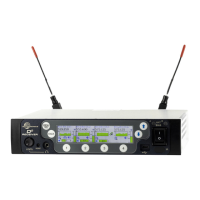
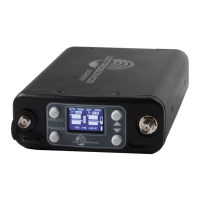
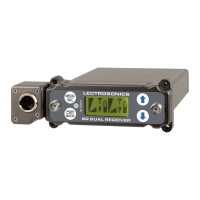
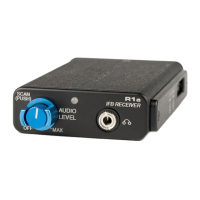
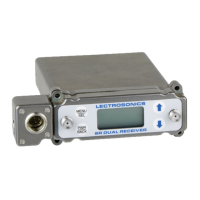
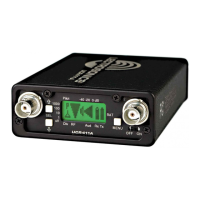
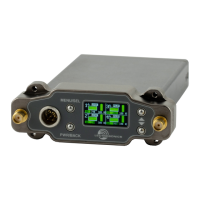
Four Channel Digital Receiver
Rio Rancho, NM
13
receivers to Universal key type, and the encryption
is in place. This allows for convenient encryption
amongst multiple transmitters and receivers, but is
not as secure as creating a unique key.
• Shared: This key policy is designed for sports cov-
erage and similar applications where a unique key
provides enhanced security, but multiple transmit-
ters and receivers can share the same key. Once
generated by the receiver, the key can be trans-
ferred via IR to transmitters or additional receivers.
• Standard: This key policy provides excellent se-
curity, second only to the Volatile key policy. Once
a unique key is created in the receiver, it can be
transferred via IR only to transmitters, but not to
other receivers. The receiver tracks the number of
times the key is transferred. Once a Standard key
has been transferred 256 times, an alert will indi-
cate that a new key must be created.
• Volatile This is the most robust key policy available.
After a unique key is created, it can be transferred
only to transmitters, not other receivers. If a trans-
mitter is powered o, it must have the key sent to
it again from the receiver. If the receiver is powered
o, a new key must be generated and sent to the
transmitters. In encryption terms, this is the “one
time use” key management policy.
Encryption Keys
The DSR4 generates high entropy encryption keys to
sync with encryption-capable transmitters. The user must
select a key type and create a key in the DSR4, and then
sync the key with the transmitter.
1. Begin by selecting a Key Type.
IR&Keys --> Key Type --> Universal, Shared, Stan-
dard or Volatile.
2. Next, if using the Shared, Standard or Volatile key
type, select MAKE KEY to generate a new key.
Select “Yes” to conrm Make Key. IR&Keys -->
Make Key.
NOTE: When Universal Key type is selected,
there is no prompt to create key, as it is not
necessary.
3. A message will indicate that an Encryption Key has
been created.
4. Sync new key with transmitter (see Send Key). The
transmitted audio will then be encrypted with the
new key.
Send Key
Select SEND KEY to transfer the encryption key to any
compatible transmitters or, in Shared key policy, addi-
tional receivers. Success will be indicated by the mes-
sage “Encryption Key Sent” on the receiver display, and
“Encryption Key Received” on the transmitter display.
IR key transfer failure will be indicated by the message
“IR Sync Failed” on the receiver display.
Settings Menu
Lock/Unlock
The user can lock or unlock the receiver. In Locked con-
dition, the menus and settings can be browsed but not
changed. Attempting to change a setting or power o the
unit while in the locked condition causes the message
“Settings Locked” to appear on the screen. The Lock/
Unlock condition will persist through battery changes or
external power being removed.
Backlight
The user can set the backlight to be Always On or stay lit
for 5 seconds or 30 seconds after the last button press
on the interface. To set, use the UP/DOWN buttons to
select and save.
RX On/O
This function allows you to power o one or both receiver
channels when not in use, to save power in a portable
DC-powered system. Press the MENU/SEL button to
select Channel 1 or Channel 2. Use the UP and DOWN
buttons to turn on or o the selected receiver. The power
savings is roughly 180 mW per channel.
Tx Batt Type
Choose between Bar, Volt or Time. Use MENU/SEL to
select the channel and the UP and DOWN buttons to
change values.
Tx Batt Timer
Choose between Bar, Volt or Time. Use MENU/SEL to
select the channel and the UP and DOWN buttons to
change values.
Tx Batt Icon
Choose between Bar, Volt or Time. Use MENU/SEL to
select the channel and the UP and DOWN buttons to
change values.
AutoOn
Press the UP or DOWN buttons to enable or disable the
auto power on function. With this function enabled, the
unit will power up upon the application of external DC
power.
Locale
The locale should be chosen based on the region where
the receiver is being used. There are three options avail-
able:
- NA: (default setting) represents the North Ameri-
can locale and prevents operation in the
Astronomical Band (from 608 to 614 MHz).
- EU: represents the European locale, and has un-
restricted operation over the entire band of the de-
vice: 470.100 to 614.375 MHz for A1B1. For B1C1,
the range is 537.600 to 691.175 MHz.


 To Next Page