124 /
Bright-line view and range finder
Bright-line view and range finder
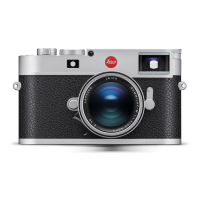
The LEICA M8.2’s bright-line view and range finder is
not only a very high-quality, large, brilliant and bright
viewfinder, it is also a highly accurate range finder
coupled to the lens. It has an enlargement factor of
0.72 x.
If lenses with nominal focal lengths* 24, 28 (Elmarit
28 mm from serial number 2 411 001), 35, 50, 75 and
90 mm are used, the associated bright-line frame
automatically adjusts to the combinations 24+35 mm,
28+90 mm, 50+75 mm.
The size of the bright-line frame is matched to the
initial format of the LEICA M8.
2 and corresponds to a
sensor size of around 18x27 mm at a setting distance
of 2 m. At longer distances, the camera records more
of the subject than can be seen in the bright-lines, at
shorter distances slightly less.
The bright-lines are linked to the distance setting in
such a way that parallax – the misalignment between
the lens and the viewfinder axes – is automatically
compensated and the bright-line image and the picture
are identical over the entire distance setting range
0.7 m to ∞.
In the middle of the viewfinder image is the rectangu-
lar distance metering image, which is brighter than
the surrounding image field. All Leica M lenses from
16 to 135mm focal length connect with the range finder
when used on the LEICA M8.
2.
If the exposure meter is turned on, the exposure
meter LEDs and the flash symbol LED appear at the
lower edge of the viewfinder image.
For more details about setting the distance and expo-
sure metering, together with flash mode, refer to the
relevant sections on pages 126/127/134.
Note:
Therefore, when using longer focal lengths than those
for which there are bright-line frames (90 mm, see
above) such as the 135 mm models, their image field
in the camera viewfinder – which is very small to start
with – can only be “determined” very imprecisely.
Frame selector
The frame selector (1.8) expands the possibilities of
the LEICA M8.2 viewfinder. This built-in universal
viewfinder allows you to display the frames that do
not belong to the lens currently being used at any
time. You can then see immediately if, for image com-
position reasons, it would be better to photograph the
relevant subject using a different focal length.
If the lever is swung outwards, that is away from the
lens, the image field limits for 24 and 35 mm focal
length are shown*.
If the lever is moved to its vertical central position, the
image field limits for the focal lengths 50 and 75 mm
are shown.
If the lever is swung inwards, that is towards the lens,
the image field limits for 28 and 90 mm focal length
are shown*.
* See “The extension factor”, p. 105


 To Next Page