ROUTER PREPARATION
18
Chapter 7 D4R Pro User Guide
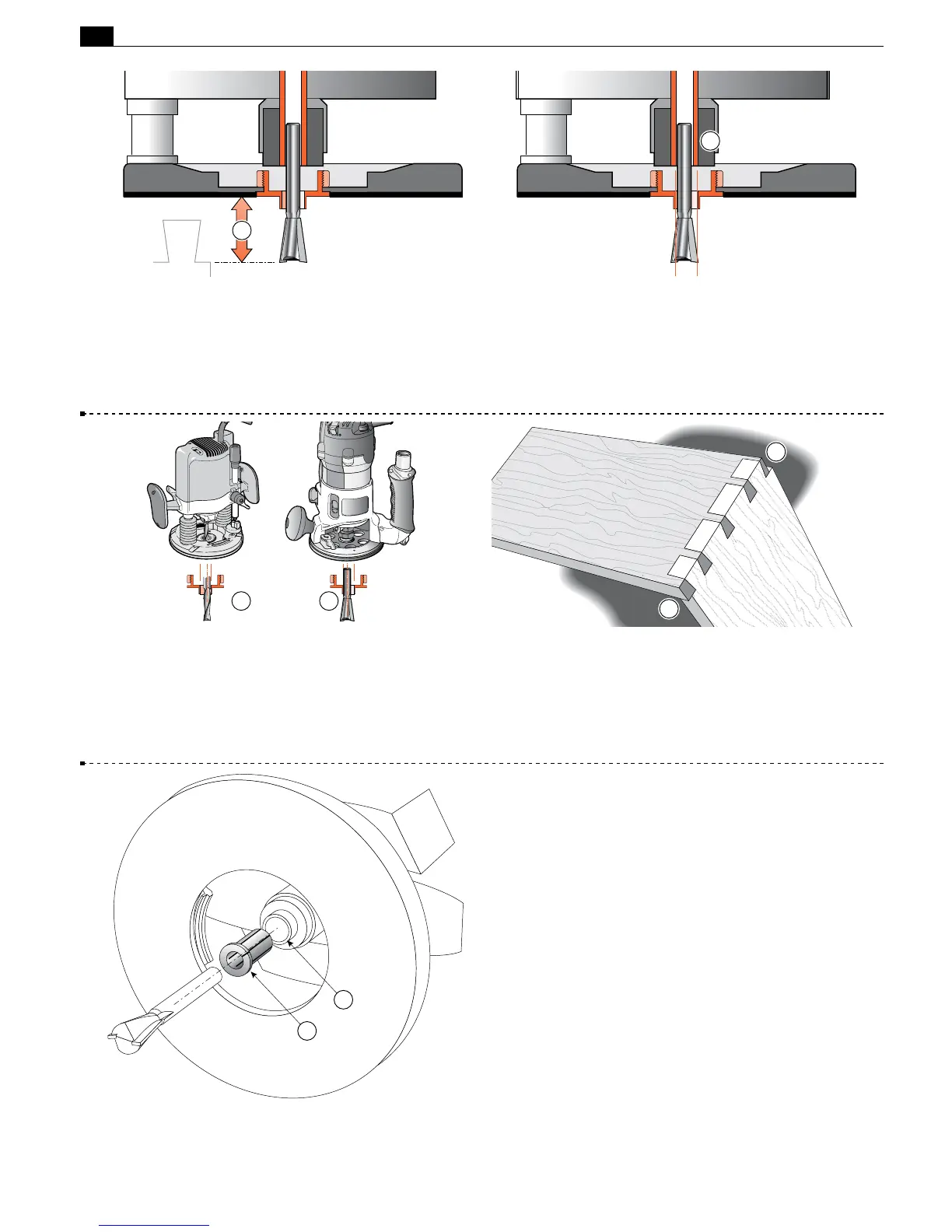
7-5 Depth of cut is not the distance the bit projects from the
router base. This is bit projection
➁
. This guide generally refers
to depth of cut. Bit projection
➁
is always .450"[11,5mm] more
than depth of cut.
2
7-6
Ideally, the router collet (and bit) should be concentric (cen-
tered) to the guidebush as in figure 7-5. Regrettably, this is often not
the case; the bit can be off center (eccentric to) the guidebush
➀
. The
illustration shows the problem highly exaggerated. The good news:
bit to bush alignment doesn’t affect joint fit or flushness; both are
“adjusted out” in normal jig setup.
1
7-7
Concentricity problems can only arise if two routers are used for
through dovetails, (one for pins; one for tails). Routers with different bit
to guidebush offsets
➁
(misalignment shown highly exaggerated)…
2 2
7-8
…will cause pin to tailboard
➂
misalignment (again, shown
highly exaggerated).
Fortunately, some newer routers have sub-bases that can adjust
for concentricity. If you don’t have this type, it might pay to stick
to a single router for through dovetails.
3
3
7-9 Shank Selection/Collet Reducer
All Leigh Dovetail jigs are shipped with superior strength 8mm
shank dovetail bits and a
1
⁄2" to 8mm collet reducer. The reducer
➃
simply slides into the
1
⁄2" collet of your router
➄
(do not remove
the collet nut) and the 8mm shank bit is inserted into the collet
reducer. The collet is tightened as normal. The collet reducer is
not required with
1
⁄2" [12,7mm] shank bits.
■
{
x



 To Next Page