SLIDING DOVETAILS
64
Chapter 16 D4R Pro User Guide
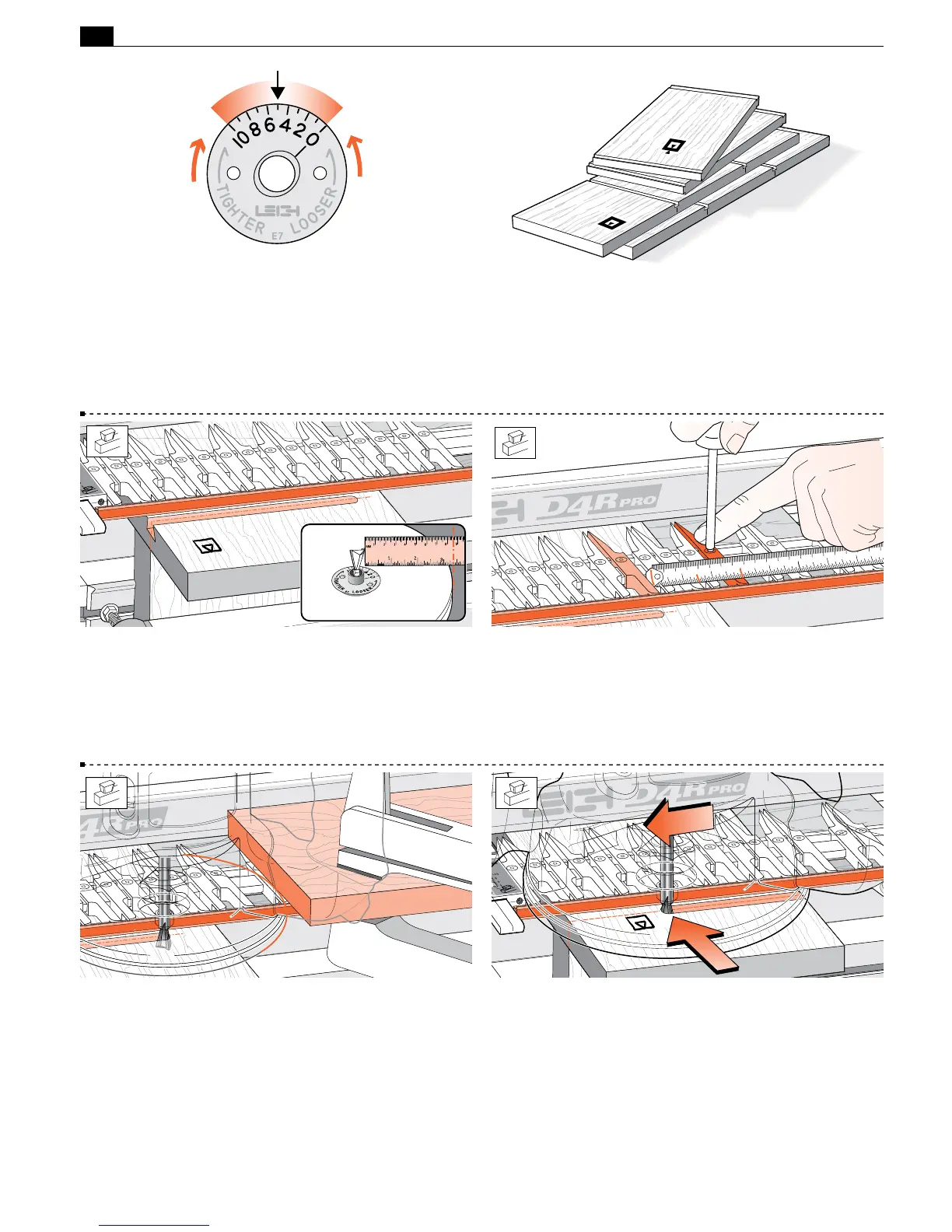
16-25 Note: the e7-Bush fit adjustment for sliding dovetails
works reverse to normal. Fit adjustments are made by adjusting the
tail size only, not the socket. The e7-Bush is turned down to a lower
number for a tighter fit, and up to a higher number for a looser fit.
Each increment changes the glue line fit by 0.001”[0,025mm] When
the fit is satisfactory, rout one end of a project tail board and test again.
If the fit is good, rout all tail board ends.
T
I
G
H
T
E
R
L
O
O
S
E
R
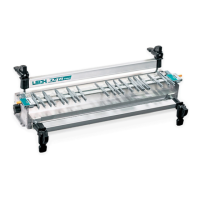
16-26 When the fit is satisfactory, rout one end of a project tail
board and test again. If the fit is good, rout all the other ends.
Note: Variations in board thickness, guidebush diameter, bit depth, angle,
diameter and concentricity, make it impractical to record sliding tail size
settings.
16-27 Stopped Sliding Dovetails
If a stopped sliding dovetail is called for...
Measure from the outside tip of the dovetail bit to the edge of
the router base.
16-28 Measure the same distance from where you want the slot
stopped to a position on the finger assembly. Move a guidefinger
to that point and mark the guidefinger with a felt pen as a visual
router stop mark…
1 2 3 4
5
6
7
16-29 Or lightly clamp (with a soft-jawed clamp) a short board
to the finger assembly to act as a router stop.
16-30
Dovetail slots preferably are routed from left to right
because the bit’s clockwise rotation pulls the guidebush
against the fence. However; as when routing close to both ends of a
board, it may be necessary to rout slots from right to left. Bit rota-
tion will tend to pull the router away from the fence. Feed slower
and maintain constant guidebush pressure against the fence.
■



 To Next Page