3
BLUES
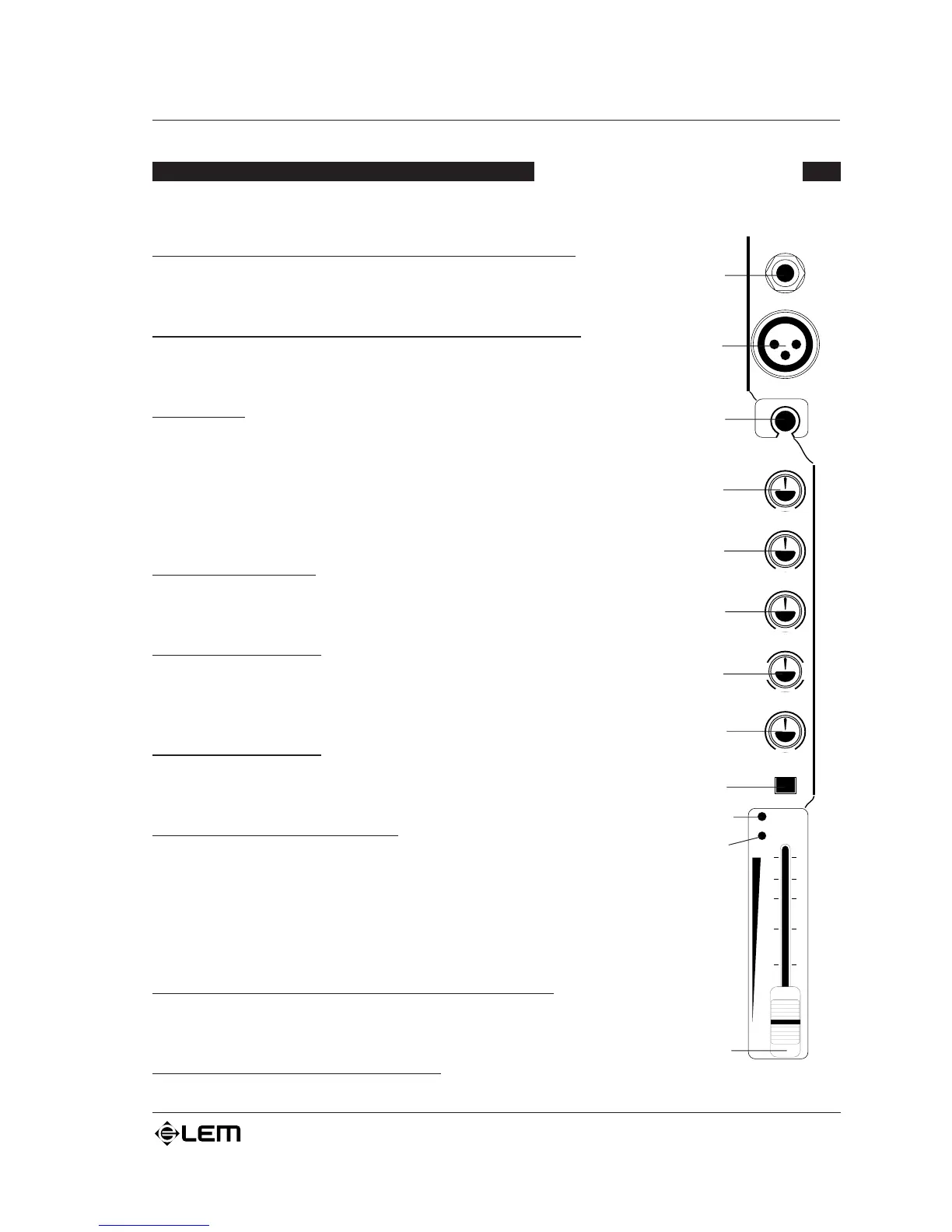
MONO input channel
1. MIC INPUT
Balanced XLR connector (from -15dB to -45dB /1kOhm): receives the
microphone input signal on the channel.
2. LINE INPUT
Balanced JACK connector (from +10dB to 20dB /10kOhms): receives the
line input signal on the channel.
3. GAIN
Gain control: regulates the amplification of external signals (microphones,
instruments, etc.) fed into the channel. Has two sensitivities:
LINE: (high level signals connected to the JACK connector) é from +10dB
(minimum gain) to -20dB (maximum gain);
MIC: (microphones connected to the XLR connector) é from -15dB (minimum
gain) to -45dB (maximum gain).
4. HIGH
HIGH frequency control: gives a 15dB boost or cut with turnover frequency
at 10 kHz. This EQ control has a SHELVING curve.
5. LOW
LOW frequency control: gives 15dB boost or cut with a 70Hz turnover
frequency. This equalizer control acts exactly like the HI control (SHELVING
curve), the only difference being that the turnover frequency is set at 70Hz.
6. EFX
EFX send volume control: controls the quantity of signal sent to the BLUES built-
in DSP.
7. AUX/MON
AUX/MONITOR send volume control: a centre-dented pot which enables to use
either the AUX (POST-FADER, for the use of EXTERNAL EFFECTS) or MON (POST-
FADER, to be used for MONITORS) send. Works as follows:
middle position (¥ position) é both sends are closed;
pot turned to the left é AUX send open (and MON send closed);
pot turned to the right é MON send open (and AUX send closed);
8. PAN
Centre-dented Pan pot for controlling the signals pan: regulates stereo
position of the signal with respect to the main L&R outputs
9. MUTE
Button for turning the channel on and off.



 To Next Page