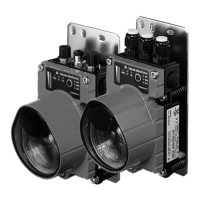
3.4 Functional characteristics
3.4.1 Transmit/receive mode
Transmission Every DLSP comprises a transmitter and a receiver. The transmitter transforms ac-
tive data signals at the 8 data inputs into a serial telegram. The transformation pro-
cess is performed using pulse pause modulation (PPM). The logic statuses "O"
and "l " at the inputs correspond to pauses of differing lengths between 2 pulses.
Signal transmission The serial telegram is converted into a modulated light signal. Transmission takes
place using invisible infrared light. The transmission time is around 400
μ
s (8 sig-
nals in each direction).
Receiving The receiver reconstructs the serial telegram from the received light signal (de-
modulation).
Data output Following serial-parallel transformation, the signals are available at the 8 outputs.
The output signals can be optionally saved or not saved.
Data safety The high degree of data safety offered by the DLSP is guaranteed by a check of
amplitude, address and parity, repetition of each telegram and the indication of
valid data with the Data Valid (DV) signal.
Transmission in
parallel operation
Transmission takes place using the burst mode, i.e. each telegram is transmitted in
the form of a short package with a long pause between 2 telegrams. The scanning
ratio is appr. 1:100. Data is actually being transmitted for only 1 % of the unit’s duty
cycle.
Notice
During parallel operation of several DLSPs, the possibility of mutual interaction can-
not be excluded. If interference between neighbouring transmissions paths (see
page 13) occurs, mount small metal lateral shielding plates between the individual
units. They should extend approx. 5 - 10 cm beyond the front surface of the unit.
Both the units forming a transmission path can transmit and receive. Data is trans-
mitted and received using the handshake mode, i.e. in alternating sequence. Syn-
chronization is taken care of automatically by the DLSP.
Benefit Both the units forming a transmission path operate on an identical basis, i.e. no
master/slave operation and no need for different settings.
Fig. 3 Transmit/receive principle
8x
8x
Se
E
E
Se
Leuze electronic DLSP 160S 7


 To Next Page
 Loading...