lfthe battery becomes
discharged
to the
extent that the car
caflnot be
slarled, the
recommended
cource of
action is to fita
substitute
batlery
whilst lhe
original
battery
is trickle
charged lf'
inanemergency,thecarhaslobe
jump'started
thesubsequent
conditions of car
use may
not allow
for suff
cient altematot
charc_
inq or the
bad€ry lo
achieve
a fully
charged
state
The batlery
s$uld be trickle
ciarqed
by exlernal
means
untl 12.8 volts
is
recorded,
which
process
may
take
24 hours
ot longer
Putting
lhe batte'y
intoserviceata
lower
state of
charge
wrll€duce
rhF
time
pe.bd
forwhich
the ca'can
be
parked without subsequenl
starting concerns.
A battery
left in
a fully discharged
state for a
prolonaed pe
od, may
not be
tecoverabls
to its
otiginalcondl
tion. A discharged
battery
is also
vulnerable
to frcezing
ofthe
electrolyte,
which could
result
in a damaged
casing.
nrrittENlttd
.
Hydrogen
gas generaled by the battery
could
cause an
€xplosion,
resultlng
in sovere
personal injuries.
Charge
battery ln a
well v€ntllated
area.
.
Never
charg€ a
frozen battery'
lt may
explode
b€Gause
of
gas
happed
in the
ice. Allow a
frozen battery
to thaw
outfirst.
'
lf
you
getelecttolyte,which ls
an acid' ln
youreyes
oron
your
skin, lmmediately
rinse with
cold water
for several
minutes
and call a
doctot
unless
an automslic
battery
management
conditioner
is to be
used,
the battery
should
be rcmoved
from the car
for recharg-
ing, to a
well ventilated
arca to
avoid a build
up of lumes
in
ihe
luggage compartmeni
and to
prevent
damage
to the car's
electrical
system. Obserue
the
safety
precautions
listed
above
when removinglhe
battery
and take care
to avoid sharp
knocks
or shocks,
keepinq
the battery as
upright as
possible. Beware
of the considerable
weight
of a batlery
and take
necessary
precautions
against
petsonal
injury
The
recommended bench
charqe
rate is 4 amps.
When the
battery
is tully
charced
(12.8 volts), allow the
battery to
stand
foran
hourbeforc refitting
to the car and
reconnecting
the leads
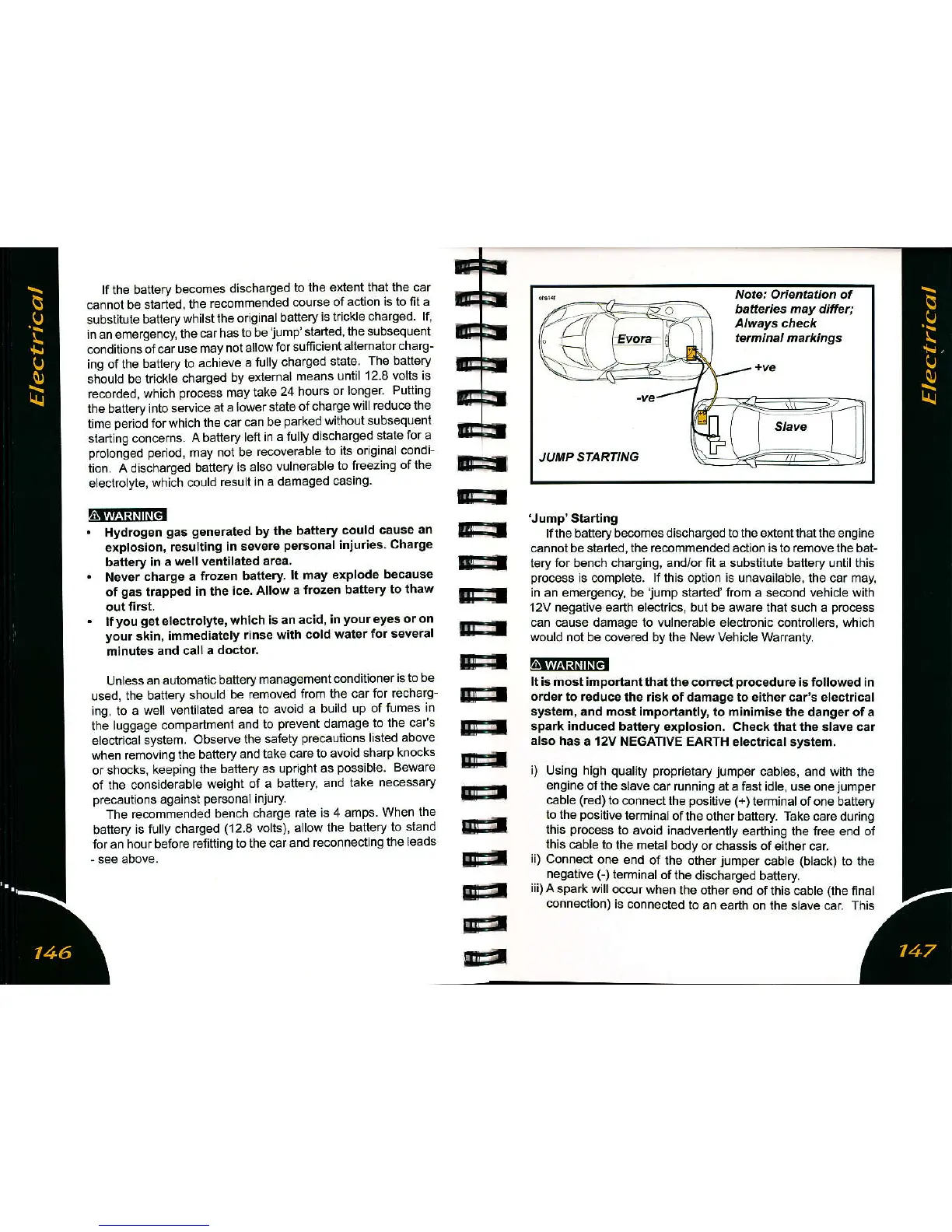
I'lote: Orientation of
\
batteries nay ditrer;
EvoE
fr
-
n
JUMP STARTING
-='-;
il
t-
I
ll":'
dn
t"
A
d"
I
IEtrl
EE!
ET
ET
EI
El
ET
EI
EH
E:I
EI
s=I
ET
r!trr
H
EEI
GI
EA
'Jump'Starting
lf the battery
becomes discharged to the extenl lhat the engine
cannot be staded, the recommended action is to remove the bat-
tery
for bench charging, and/or fit a substilute battery untilthis
process
is complete. lf this option as unavailable, the car may,
in an emergency, be 'jump staded' from a s€cond vehicle with
12V negative earth electrics, but be aware that such a
process
can cause damage lo vulnerabls €lectrcnic controllets, wh;ch
would not be
covered by the New Vehicle Waffanty,
^rlIElMltA
It i5 most importantthatthecorrect
prccedure
istollowed ln
order to reduce
the risk ofdamage to either car's el€ctrical
syslem, and most importantly,
to minimise the dangerofa
spark induced
battery explosion. Check lhat the slave car
also has
a t2V NEGATIVE EARTH
electrical syslem.
i) Using high
quality
prcprietary
jumper
cables, and with the
engine
ollhe slave
car running ata fast idle, use onelumper
cable
Ged)
to
connsct the
positive
(+)
teminatof one battery
lo the
positive
terminal
of the other battery Take
care during
lhis
process
lo
avoid inadvertentty
eadhing the fre€ €nd of
ihis cable to
the metal
body or chassis of
either car.
ii) Connect
one end
ot th€ other
jumper
cabte
(btack)
to the
negative
C)
lerminal
of
the discharged
batery.
iii) A
spark will
occur when
lhe other
end of this cabte
(th€
finat
conneclaon)
is connected
to
an earlh on the slave
car
This



 To Next Page