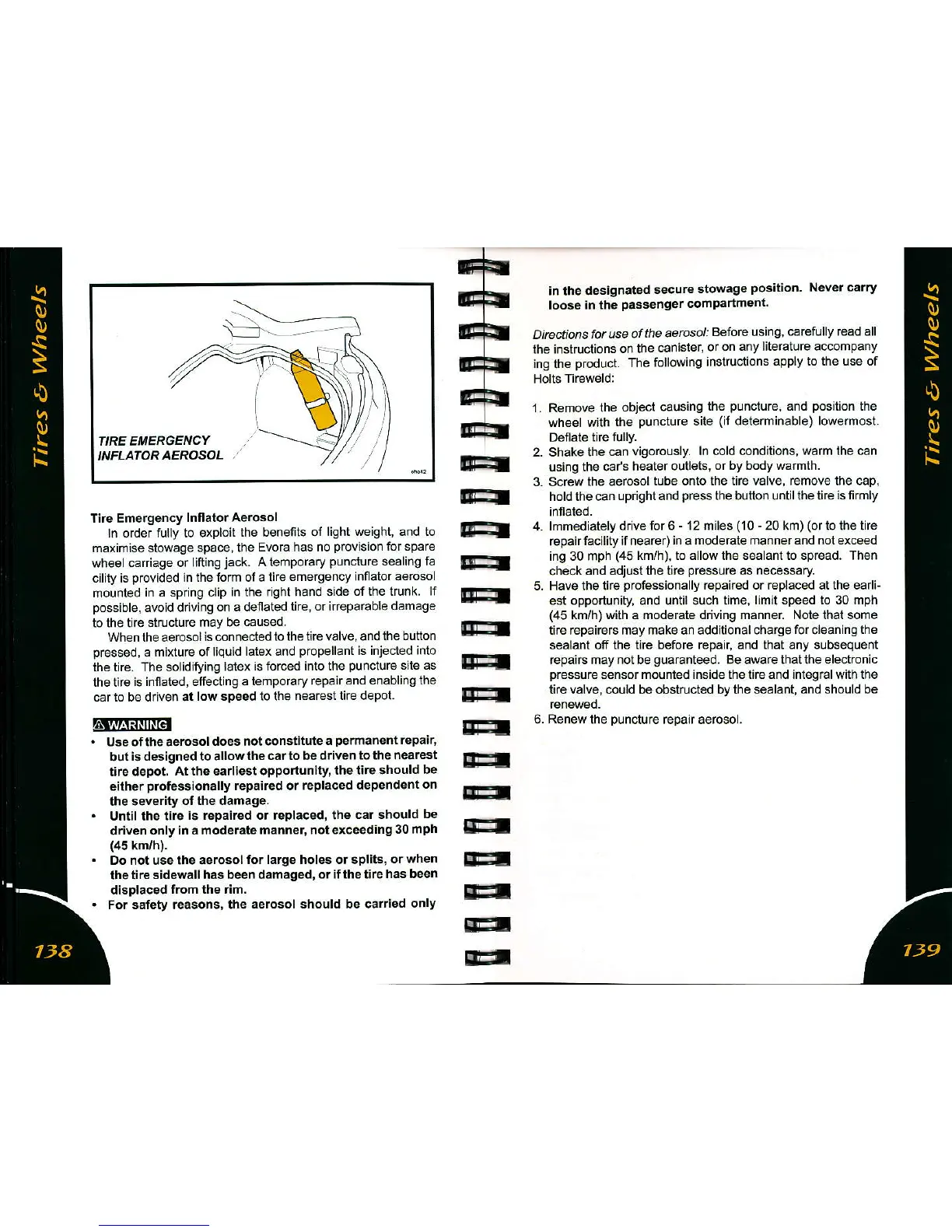
TIRE EMERGENCY
INFLATOR AEROSOL
.
The Emergency
lnfl atorAerosol
ln order fully to exploit
the benefils
of light weight, and to
maximise stowage
space, the
Evora has no
provision
forspare
wheel
caffiage or lifting
jack.
A temporary
punclute
sealing
fa
cilily is
provided in ihe form ota lite
emergency
inflator aercsol
mounted
in a sp ng clip
in the
ght
hand side
of the trunk lf
possible,
avoid driving
on a deflated
tke, orirrcparable
damage
to the tire
siructure may be
caused.
When the aerosolis
connecied to
the tke valve, and lhe
butlon
pressed,
a mixture ofliquid
latex and
propellant
is injecled inlo
lhe tire. The solidlfying
lalex is
forced into the
punclure
site as
thetire
is inflated, effecting
a tempomry
repairand enablinglhe
cario be driven
at low speed to the
neatest tire depot-
nrDEErmr.l
.
Use of the aerosol
does not constitute
a
permanenlrepair,
but
is designed to allowlhe
carto be driven
to the nearest
tire depot.
Attheea iest opportunity,
thetire should
be
either
professionally repaired or replaced
dependent
on
the severity
of the clamage,
.
Until the tire
is repaired or replaced, the
car should
be
driven only in a moderatemanner,
not exceeding
30 mph
(45
kmih).
.
Do not use the
aerosolfor large holes or splits,
orwhen
thetire
sidewallhas been damaged,
or ifthe tire
has been
displaced
from the rim.
.
For satuty reasons, the
aerosol should be carried
only
in the
designated
secure
stowage
posiiion Never carry
loose
in lh€
passenger compartment.
Directions
fot use of
the aelosol
Beforc using
carefully rcad all
ihe instructions
on the
canister,
or
on any literature accompany
ing
the
prcduct. The
following
instructions
apply to the use of
1. Remove
the object
causing
the
punclute,
and
position
the
wheel with
the
punctute
sile
{if
determinable)
lowermost.
Deflate
iirc fully.
2. Shake the
can vigorously.
ln cold condilions, warm lhe can
using the ca/s
heater oulleis,
ot by bodywarmlh.
3. Screw
the aerosol
tube onto the tirc valve, remove the c€p,
hold the can
uprightand
pressthebutton
untilthe tite is firmly
innabd.
4. lmmediately
d ve for 6
-
12 miles
(10 -
20 km)
(or
io the tire
repairfacility if nearer)
in
a
modeEte mannetand not exceed
ing 30 mph
(45
km/h), to allow the sealant to spread. Then
check
and adjust the tire
pressure
as
necessary.
5. Have the tire
professionally
repaired or replaced at the earli-
est opportunity, and until such time,
lirnlt speed lo 30 mph
(45
km/h) with a modente d ving manner Note that some
tirerepairerc may make an additional charge
for cleaning the
sealant
off the iire before repair, and that any subsequent
epairc ,nay aol be
guaranteed.
Be
aware that
the electronic
pressure
sensor mounted inside the t;rc and integral with the
iare valve, could be obstructed by the sealant, and
should be
6. Renew
the
puncture
repair aerosol.
*r
+
A
F
ET
d!
lFI
F
E=I
Fr
EH
E[
EFA
gA
Etil
Eil
EI
EI
H
Etr!
trE!
trtr|



 To Next Page