8
2.5 Convection current
The VENUS is one the few appliances that can burn both with and without fan.
2.5.1 Natural convenction
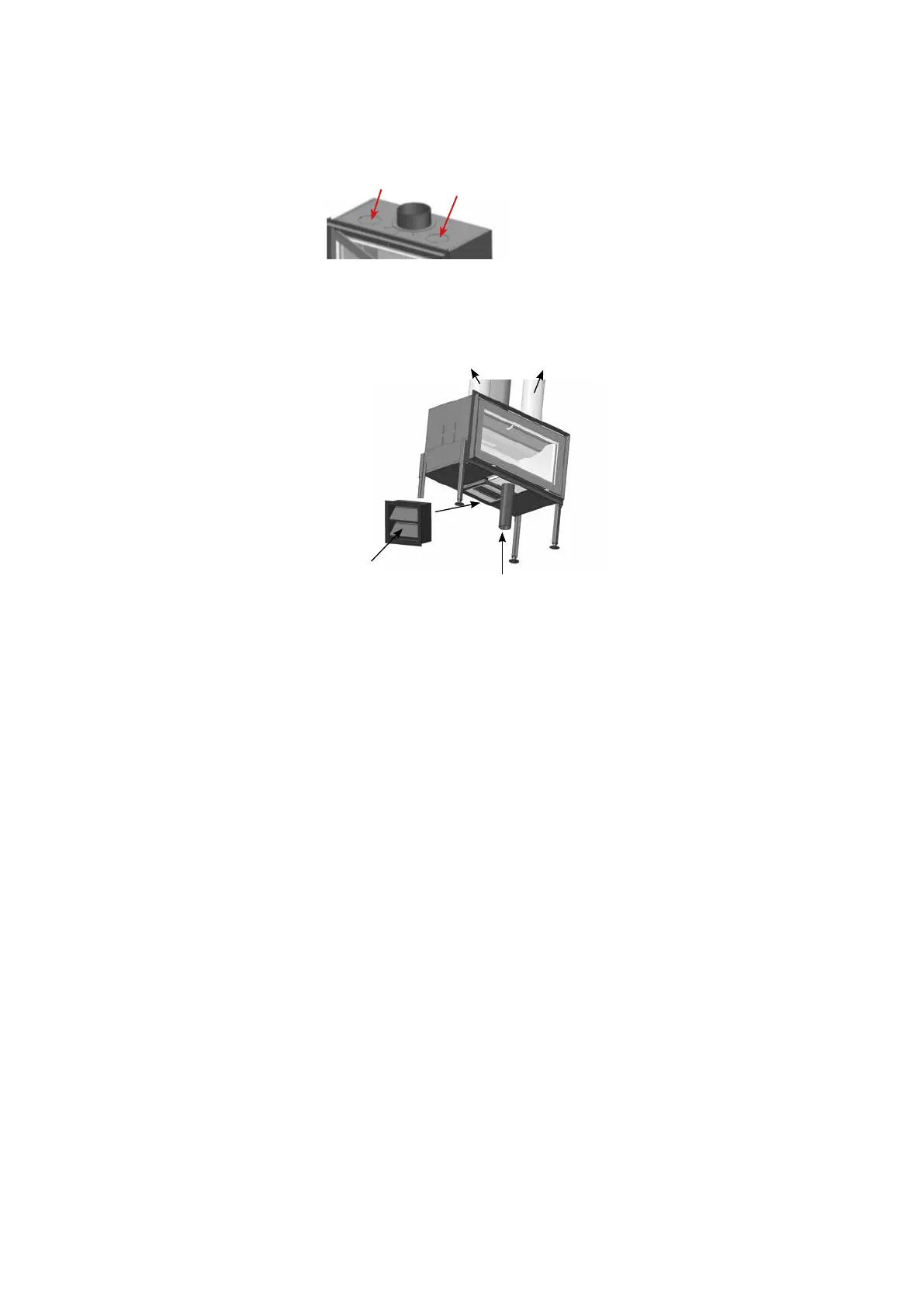
It is compulsory to open at least 2 hot air vents at the top of the appliance.
The VENUS has been constructed in such a way that if it is connected without a fan, but with hot air vents, the air at the
front, under and on the sides of the appliance is drawn in. The natural capacity to draw air in is so great that the temperature
above the stove does not exceed 60°C. As a result of our special construction, the hot air comes out of the ventilation grills at
such a speed that one could swear that a fan is being used.
External air inlet Ø100mm
convection
convection
convection
CAUTION : VENUS 850 D see-through : No fan possible
2.5.2 Convection with a fan (optional)
If you opt for a fan, the convection air will be drawn in from below and on the sides of the appliance and then blown out
through the convection casing. The fan may be mounted either inside or outside the hearth so that one has the option of
assembling or dissembling it in the future.
In this situation it is not obligatory to connect air ducts.
The enclosure of the appliance must be provided with ventilation grills or openings allowing for the elimination of heat by
convection. It is possible to have a convection kit fitted with the appliance. This system directs the heat inside the room by
means of flexible tubes (dia. 150 mm).
Thermally insulated ducts are essential for the optimal functioning of the appliance (these cause ‘draught’ in the convection
air current). By using the maximum number of ducts (at least 2), the output is improved and the noise (that is caused by the
displacement) is reduced. For the purposes of the installation of these ducts it is best to go vertically upwards first for at
least 1m and then to change direction, making a rather wide bend and avoid using a flue terminal grid with a small clearance
because the speed loss that this causes reduces the eciency of the hot air vents. Place all the fittings that you use at the
same lengths and angles if possible, otherwise some grids could give o more heat than others and, seeing that a hot air pipe
functions in a manner similar to a chimney, the one that is hot first has the most draught and therefore becomes hot even
more quickly.
Attention: Hot air is coming from ventilation grills in upper part, make sure sucient distance from inflammable materials
such as wood, curtains…
Note: A circulation of hot air requires that no under-pressure be created in the room. A grid that is near the floor sees to it
that cold air can be drawn in. Don’t connect those with a flexible. Air will find the way to get at the right place.
M-design has developed its ideal hot air grids which have many advantages (Pic. next page) and for the elimination of hot air
and the entry of warm air we advise you to use these Design grills made by M-Design. To simplify the mounting of the grids
you can use the corner profile which is furnished with the grid. This profile can be mounted on the side of the grid (two little
wholes and screws are provided).
ATTENTION: A house is never completely 100 % dust free, heating appliances and warmth circulation creates dust particles.
During the periods where you are not using the fireplace, dust is accumulated in the flexible pipe and the grills. This could
cause a problem with a smell, so we would certainly advise you to clear the flexible and air inlets and outlets using a vacuum
cleaner regularly. The smell caused by these dust particles will disappear after you have used the fireplace again a few times.
This phenomenon is very common and can be compared to the gray traces appearing above your radiators. Optionally you can
order design metal lids to cover the inlets and outlets during the summertime.



 To Next Page