Need help?
Do you have a question about the Makita 1805B and is the answer not in the manual?
Covers work area, personal attire, tool use, and safety glasses.
Includes cord care, securing work, tool maintenance, disconnecting, and pre-operation checks.
Ensure power source voltage matches tool specifications to prevent injury or damage.
Steps to remove and install planer blades, including cleaning and using correct parts.
Instructions for sharpening blades using the sharpening holder and dressing stone.
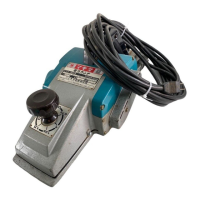
The Makita 1805B Power Planer is a robust electric tool designed for efficient and precise woodworking tasks, specifically for planing wood surfaces. It is engineered for both professional and DIY users who require a powerful and reliable tool for smoothing, shaping, and reducing the thickness of wood. The planer's design emphasizes user safety, operational ease, and consistent performance, making it suitable for a wide range of applications from rough cutting to fine finishing. Its double insulation feature enhances safety during operation by providing an additional layer of protection against electric shock.
The primary function of the Makita 1805B Power Planer is to remove layers of wood from a workpiece, creating a smooth and even surface. This is achieved through a rotating cutter drum equipped with sharp blades that shave off wood as the tool is guided across the material. The planing depth, which dictates the amount of wood removed in a single pass, is adjustable, allowing users to achieve desired thicknesses and finishes. The tool is particularly effective for tasks such as leveling uneven surfaces, chamfering edges, and fitting doors or windows by reducing their dimensions.
To operate the planer, the user first adjusts the planing depth using a knob located on the front grip. This knob allows for precise control over the cutting volume. Once the depth is set, the tool is switched on by pulling the trigger. For continuous operation, a lock button can be engaged, freeing the user from continuously holding the trigger. Before bringing the planer into contact with the wood, it is crucial to allow the blades to reach their top speed, ensuring a clean and efficient cut.
When starting a planing pass, the front shoe of the tool should be rested flat on the workpiece. Pressure is applied to the front of the tool at the beginning of the cut and shifted to the back of the tool towards the end of the pass. This technique helps maintain a consistent planing depth and prevents gouging at the start or end of the workpiece. For optimal results, especially when aiming for a fine finish, it is recommended to incline the workpiece in a stationary position, allowing the planer to work somewhat "downhill." The speed at which the tool is advanced across the wood also influences the finish; slower advancement generally yields a finer surface. The planer is designed to prevent jamming by chips, even during rough cutting, ensuring continuous operation.
The Makita 1805B Power Planer incorporates several features that enhance its usability and performance. The adjustable planing depth, controlled by the front knob, is a key feature, allowing for quick and easy changes to the cutting volume without requiring additional tools. This flexibility is essential for tackling various woodworking projects, from aggressive material removal to delicate finishing touches.
The trigger switch with a lock-on button provides convenience during extended use, reducing user fatigue. This allows the operator to maintain a steady grip and focus on guiding the tool accurately. The design also emphasizes safety, with clear instructions on how to start and stop the tool, including disengaging the lock button by simply pulling and releasing the trigger again.
The planer's ability to produce different finishes based on cutting speed and volume is another notable usage feature. For rough cuts, a higher volume of material can be removed, while for a finer finish, a shallower cut and slower advancement are recommended. This adaptability makes the planer a versatile tool for various stages of woodworking.
The inclusion of a blade gauge is a practical feature for ensuring even blade setting. While the front knob adjusts the cutting depth, the blade gauge helps ensure that the blades themselves are properly aligned and protrude evenly in relation to the work surface. This is critical for achieving a smooth, level planing surface without nicks or gouges. The manual provides detailed instructions on how to use the blade gauge to adjust the blade protrusion and how to compensate for wear on the gauge itself, ensuring long-term accuracy.
Proper maintenance is crucial for the longevity and optimal performance of the Makita 1805B Power Planer. The manual provides clear guidelines for several key maintenance tasks, focusing on blade replacement and sharpening, as well as carbon brush inspection.
Replacing or Installing Planer Blades: This is a fundamental maintenance task. The planer blades are secured to the tool drum by four installation bolts, which can be removed using the provided socket wrench. When installing new or sharpened blades, it is essential to first clean out any chips or foreign matter from the drum and blades. The manual stresses the importance of using blades of the same dimensions and weight to prevent drum oscillation or vibration, which can lead to poor planing action and tool breakdown. The process involves screwing the blade onto an adjust plate, slipping it into a groove on the drum, fitting the blade clamp, and then fastening it with hex flange head bolts. A critical caution is to carefully tighten these bolts, as a loose bolt can be dangerous. Regular checks to ensure they are securely tightened are advised.
Blade Setting with Blade Gauge: After replacing blades, ensuring they are set evenly is vital. The blade gauge helps achieve this. The process involves setting the blade on the gauge blade so that the cutting edge is flush with the inside flank of the gauge. Screws on the adjust plate are loosened, and the heel of the planer blade is pushed into full contact with the gauge's inside flank. While holding it in place, the two screws on the adjust plate are tightened. This method ensures the blade tip is set correctly for perfectly even planing. The manual also addresses adjusting the blade gauge itself to compensate for wear, ensuring its continued accuracy. This involves loosening adjusting screws on the blade gauge and, if necessary, adjusting the gauge plate.
Sharpening Planer Blades: To maintain the best performance, blades must be kept sharp. The planer comes with a sharpening holder for this purpose. The process involves loosening two wing nuts on the holder, inserting blades A and B so they contact sides C and D, and then tightening the wing nuts. Before sharpening, the dressing stone should be immersed in water for 2-3 minutes. The holder is then held so that both blades contact the dressing stone simultaneously at the correct angle. This allows for stock removal and ensures a fine edge.
Carbon Brushes: The carbon brushes are wear-and-tear components that require periodic inspection and replacement. The manual advises replacing carbon brushes when they wear down to approximately 6 mm (1/4 inch) or if sparking occurs. It is recommended to change both brushes at the same time to ensure balanced performance. This maintenance step is crucial for the motor's health and the tool's overall operational efficiency.
By following these detailed instructions for usage and maintenance, users can ensure the Makita 1805B Power Planer remains a reliable and effective tool for their woodworking needs, delivering consistent results and extending its operational life.
 General
| Power Source | Corded Electric |
|---|---|
| No Load Speed | 15, 000 RPM |
| Amperage | 10.9 A |
| Cutter Block Speed | 15, 000 RPM |
| Number of Knives | 2 |

 To Next Page