Need help?
Do you have a question about the Makita 5900B and is the answer not in the manual?
Describes the primary purpose and applications of the circular saw for cutting wood.
Details requirements for connecting the tool to a power source, including voltage and insulation.
Covers essential safety guidelines for operating the electric tool to prevent injury.
Provides further safety measures specific to the circular saw's operation and handling.
Explains how to set the cutting depth for optimal performance and safety.
Details the procedure for setting the saw for angled cuts up to 45 degrees.
Describes how to align the saw for straight and bevel cuts using the base plate.
Explains how to start, stop, and use the lock button for continuous operation.
Provides instructions for safely changing the saw blade, including tool usage.
Instructions for installing and using the side grip for better control.
Describes how to use the rip fence for accurate straight cuts and uniform widths.
Guides on checking and replacing worn carbon brushes for tool longevity.
Lists recommended accessories and attachments for use with the tool.
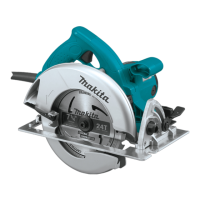
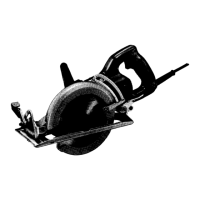
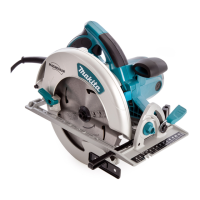
This document provides instructions for the Makita Circular Saw, Model 5900B. It covers safety guidelines, functional descriptions, usage, and maintenance.
The manual emphasizes several crucial safety precautions for operating the circular saw. Users are advised to keep their work area clean and well-lit, and to avoid using the tool in damp or wet locations. It's important to guard against electric shock by avoiding body contact with earthed or grounded surfaces. Children and visitors should be kept away from the work area, and idle tools should be stored securely out of reach.
Users should never force the tool; it's designed to perform better and safer at its intended rate. Using the correct tool for the job is essential, meaning circular saws should not be used for tasks like cutting tree limbs or logs. Proper attire is also highlighted: loose clothing or jewelry can get caught in moving parts, and rubber gloves, non-skid footwear, and hair covering are recommended. Safety glasses and hearing protection are mandatory, and a face or dust mask should be used in dusty conditions. If dust extraction equipment is provided, it must be connected and used properly.
The cord should never be abused by carrying the tool by it or yanking it from the socket; it must be kept away from heat, oil, and sharp edges. Workpieces should be secured with clamps or a vice for safer operation. Users must maintain proper footing and balance and avoid overreaching. Tools need to be maintained with care, keeping cutting tools sharp and clean. The tool cord and extension cords should be inspected periodically and repaired if damaged by an authorized service facility. Handles must be kept dry, clean, and free from oil and grease.
Tools should be disconnected when not in use, before servicing, or when changing accessories. Adjusting keys and wrenches must be removed from the tool before turning it on. To avoid unintentional starting, users should ensure the switch is off before plugging in and never carry a plugged-in tool with a finger on the switch. When using the tool outdoors, only extension cords intended for outdoor use should be used. Users must stay alert, watch what they are doing, and avoid operating the tool when tired.
Damaged parts, such as guards or other components, must be carefully checked to ensure proper operation and repaired or replaced by an authorized service center. Defective switches should be replaced by an authorized service facility. The manual warns against using any accessory or attachment not recommended in the instruction manual or catalog, as it may present a risk of personal injury. All repairs should be carried out by qualified persons using original spare parts to prevent danger to the user.
Specific safety rules for the circular saw include wearing hearing protection and ensuring guards are in place and working correctly. The lower guard should never be wedged or tied open, and its operation must be checked before each use. If the lower guard does not close briskly over the saw blade, the tool should not be used. A bent lower guard after the saw is dropped can restrict its return.
Blades that are deformed or cracked, or made of high-speed steel, should not be used. Lateral pressure should not be applied to stop the blades. Blades must be kept clean and sharp to minimize stalling and kickback. A critical warning is to keep hands away from the cutting area and blades, and never reach underneath the work while the blade is rotating or attempt to remove cut material when the blade is moving. Users should be aware that blades coast after the tool is turned off.
Large panels must be supported as shown in the figures to minimize blade pinching and kickback. When the saw rests on the workpiece, it should be rested on the larger portion, with the smaller piece cut off. To avoid kickback, the board or panel should be supported near the cut. The manual advises against supporting the board or panel away from the cut, as this can lead to kickback.
A rip fence or straight edge guide should always be used when ripping. The manual provides detailed instructions on guarding against kickback, which occurs when the saw stalls rapidly and is driven back towards the operator. Users should release the switch immediately if the blade binds or stalls, keep blades sharp, and support large panels. Forcing the tool should be avoided, and users must stay alert and exercise control. The saw should not be removed from the work during a cut while the blade is moving, and hands or fingers should never be placed behind the saw, as kickback could cause severe injury.
The lower guard should only be retracted manually for special cuts, such as "Compound Cuts," by using the retracting lever. As soon as the blade enters the material, the lower guard must be released to operate automatically for all other sawing. Before cutting, depth and bevel adjustments must be tight. Only correct blades with the appropriate size holes, washers, and bolts should be used. Defective or incorrect blade components are prohibited. Users should inspect lumber for nails and remove them before cutting.
When operating the saw, the cord must be kept away from the cutting area and positioned to avoid being caught by the workpiece. Proper hand support, workpiece support, and supply cord routing away from the work area are essential. The manual stresses the importance of supporting the workpiece properly and holding the saw firmly to prevent loss of control, which could cause personal injury.
The manual illustrates typical hand support of the saw and proper workpiece support. It advises placing the wider portion of the saw base on the solidly supported part of the workpiece, not on the section that will fall off after the cut. It provides examples of the correct and incorrect ways to cut off the end of a board. Short or small workpieces should be clamped down, not held by hand. The circular saw should never be held upside down in a vise, as this is extremely dangerous and can lead to serious accidents. Before setting the tool down after a cut, users must ensure the lower (telescoping) guard has closed and the blade has come to a complete stop.
When using manufacturer data, users must ensure the saw blade's diameter, thickness, and other characteristics are suitable for the tool, and that the blade is suitable for the spindle speed. Abrasive wheels should not be used.
The functional description section details how to adjust the saw for different cutting operations. Before any adjustments or function checks, the tool must be switched off and unplugged.
To adjust the depth of cut, the lever on the depth guide must be loosened, and the base moved up or down. Once the desired depth is set, the lever should be tightened securely. For cleaner and safer cuts, the cut depth should be set so that no more than one blade tooth projects below the workpiece. This proper cut depth helps reduce the potential for dangerous kickbacks.
For bevel cuts, the clamping screw on the bevel scale plate at the front of the base needs to be loosened. The base can then be tilted to the desired angle (0° - 45°), and the clamping screw tightened securely to fix the angle.
For straight cuts, the "A" position on the front of the base should be aligned with the cutting line. For 45° bevel cuts, the "B" position should be used for alignment.
Before plugging in the tool, users must check that the switch trigger actuates properly and returns to the "OFF" position when released. For tools with a lock button, pulling the switch trigger starts the tool, and releasing it stops it. For continuous operation, the switch trigger is pulled, and then the lock button is pushed in. To stop the tool from the locked position, the switch trigger is pulled fully and then released. For tools without a lock button, simply pulling the switch trigger starts the tool, and releasing it stops it.
Before performing any work on the tool, it must be switched off and unplugged.
To remove the blade, the shaft lock is pressed to prevent the blade from revolving. The wrench is then used to loosen the hex bolt counterclockwise. After loosening, the hex bolt, outer flange, and blade can be removed. To install the blade, the removal procedure is followed in reverse. It is crucial to ensure the blade is installed with the teeth pointing up at the front of the tool. Only the Makita wrench should be used for installation or removal. The hex bolt must be tightened clockwise securely.
The side grip should be installed securely on the tool before operation.
When operating the saw, it is important to move the tool forward in a straight line gently. Forcing or twisting the tool can lead to motor overheating and dangerous kickback, potentially causing severe injury. The tool should be held firmly using both the front grip and rear handle. The base should be set on the workpiece without the blade making contact. The tool is then turned on, and the blade is allowed to reach full speed before moving the tool forward over the workpiece surface. The movement should be flat and smooth until the cut is completed.
To achieve clean cuts, the sawing line must be kept straight, and the speed of advance uniform. If the cut deviates from the intended line, the tool should not be turned or forced back into the cut line. This can bind the blade and lead to dangerous kickback. Instead, the switch should be released, the blade allowed to stop, and the tool withdrawn. The tool should then be realigned on the new cut line, and the cut restarted. Users should try to avoid positioning themselves where chips and wood dust are ejected from the saw and use eye protection to prevent injury.
The rip fence allows for extra-accurate straight cuts. It is slid snugly against the side of the workpiece and secured in position with the screw on the front of the base. This feature also enables repeated cuts of uniform width.
Before performing any inspection or maintenance, the tool must always be switched off and unplugged.
Carbon brushes should be removed and checked regularly. They need to be replaced when they wear down to the limit mark. The carbon brushes should be kept clean and free to slip in their holders. Both carbon brushes must be replaced at the same time, using only identical carbon brushes. To replace the brushes, a screwdriver is used to remove the brush holder caps. The worn carbon brushes are taken out, new ones are inserted, and the brush holder caps are secured. For product safety and reliability, all repairs, maintenance, or adjustments should be performed by Makita Authorized Service Centers, using genuine Makita replacement parts.
The manual lists recommended accessories and attachments for the Makita tool, emphasizing that only those specified in the manual should be used to avoid injury. Users are advised to contact their local Makita service center for assistance with accessory details. Recommended accessories include:
 General
| Voltage | 120V |
|---|---|
| No Load Speed | 5, 800 RPM |
| Power Source | Corded Electric |
| Motor Power | 15 AMP |
| Blade Diameter | 7-1/4 inches |
| Spindle Thread | 5/8" |

 To Next Page