Need help?
Do you have a question about the Makita 5903R and is the answer not in the manual?
Keep area clean, avoid hazards, stay alert, use PPE, prevent unintentional starting.
Proper plug use, avoid earthed surfaces, protect from rain/wet, care for cord.
Explains kickback causes, prevention, blade sharpness, depth, and guard operation.
Rules for riving knife, plunge cuts, material handling, and avoiding blade contact.
Instructions for setting cutting depth and bevel angles for various models.
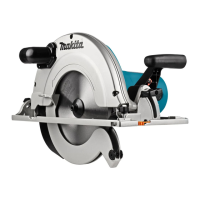
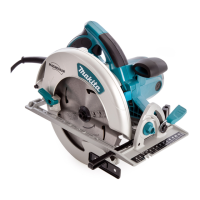
This document is an instruction manual for a Makita Circular Saw, covering models 5603R, 5703R, 5705R, 5903R, 5103R, and 5143R. It provides essential safety warnings, functional descriptions, operating instructions, and maintenance guidelines to ensure safe and effective use of the tool. The manual emphasizes that users should read and understand all instructions for their personal safety and save them for future reference.
The circular saw is designed for performing lengthways and crossways straight cuts and miter cuts in wood, requiring firm contact with the workpiece. It is a double-insulated tool, suitable for single-phase AC supply, and can be used from sockets without an earth wire. The manual highlights the importance of using the tool only for its intended purpose to prevent hazardous situations.
The manual begins with general power tool safety warnings, covering work area safety, electrical safety, and personal safety. Users are advised to keep their work area clean and well-lit, avoid operating in explosive atmospheres, and keep children and bystanders away. Electrical safety includes ensuring power tool plugs match the outlet, avoiding body contact with earthed surfaces, and not exposing power tools to rain or wet conditions. For outdoor use, a suitable extension cord is recommended, and for damp locations, a ground fault circuit interrupter (GFCI) protected supply should be used.
Personal safety emphasizes staying alert, wearing eye protection, and using personal protective equipment like dust masks and hearing protection. Users should prevent unintentional starting by ensuring the switch is in the off-position before connecting to a power source. It is crucial to remove any adjusting key or wrench before turning the power tool on and to maintain proper footing and balance. Loose clothing, jewelry, and long hair should be kept away from moving parts. If dust extraction and collection facilities are provided, they should be connected and properly used to reduce dust-related hazards.
Specific safety rules for circular saws are detailed, focusing on preventing kickback and ensuring proper blade handling. Users must keep hands away from the cutting area and the blade, and never reach underneath the workpiece. It is important to wait until the blade stops completely after turning off the tool before grasping cut material. The cutting depth should be adjusted to the workpiece thickness, ensuring no more than one blade tooth projects below the workpiece. Workpieces must be secured to a stable platform, not held in hands or across legs, to minimize body exposure, blade binding, or loss of control.
The manual warns against using dull or damaged blades, as they can cause excessive friction, binding, and kickback. Blade depth and bevel adjusting locking levers must be tight and secure before making any cut. Extra caution is advised when making "plunge cuts" into existing walls or blind areas, as protruding blades can cause kickback. Users should always hold the tool firmly with both hands and never place hands or fingers behind the saw.
To prevent kickback, the manual instructs users to maintain a firm grip, position their body to either side of the blade (not in line with it), and release the trigger if the blade binds. When restarting a saw in the workpiece, the blade must be centered in the kerf and checked for engagement with the material. Large panels should be supported to minimize blade pinching and kickback. The saw should be rested on the larger portion of the workpiece when cutting.
The manual also stresses the importance of checking the lower guard for proper closing before each use and ensuring it moves freely. The lower guard should only be retracted manually for special cuts like "plunge cuts" and "compound cuts," and released as soon as the blade enters the material. It is critical to always observe that the lower guard is covering the blade before placing the saw down on a bench or floor.
The circular saw features a depth guide with a lever for adjusting the cutting depth. To adjust, the lever is loosened, the base is moved up or down to the desired depth, and the lever is tightened securely. For optimal safety and cleaner cuts, the cut depth should be set so that only one blade tooth projects below the workpiece.
For bevel cutting, the tool allows for angle adjustments. For models 5603R, 5703R, 5705R, 5903R, and 5103R, clamping screws in the front and back are loosened, the tool is tilted to the desired angle (0° - 45°), and the screws are tightened. For model 5143R, a clamping screw in front is loosened, the tool is tilted to the desired angle (0° - 60°), and the screw is tightened.
Sighting features include alignment marks on the front of the base for straight cuts (A position) and 45° bevel cuts (B position) for most models. Model 5143R has notches for 0°, 30°, 45°, and 60° angle cuts.
The tool includes a riving knife, which is crucial for preventing kickback. The manual provides instructions for adjusting the riving knife using a hex wrench. The riving knife must be positioned so that the distance between it and the toothed rim of the saw blade is not more than 5 mm, and it does not extend more than 5 mm beyond the lower edge of the riving knife. The riving knife should always be used, except when performing plunge cuts, and must be engaged in the workpiece to be effective.
The switch action involves a lock-off button to prevent accidental starting. To operate, the lock-off button is pushed, and the switch trigger is pulled. Releasing the trigger stops the tool.
The manual describes how to connect a vacuum cleaner for clean cutting operations. A joint is installed on the tool, and a vacuum cleaner hose is connected to it.
For operation, users are instructed to hold the tool firmly with both hands (front grip and rear handle), place the base on the workpiece without the blade making contact, turn the tool on, and wait for the blade to reach full speed. The tool should then be moved forward smoothly and in a straight line over the workpiece. Forcing or twisting the tool is warned against, as it can cause overheating, kickback, and injury. If the cut deviates from the intended line, the switch should be released, the blade allowed to stop, and the tool realigned before restarting the cut.
A rip fence (guide rule) is provided for extra-accurate straight cuts and repeated cuts of uniform width. It is slid snugly against the side of the workpiece and secured with a screw on the front of the base.
Regular maintenance is essential for product safety and reliability. Users are advised to always switch off and unplug the tool before performing any inspection or maintenance.
Replacing carbon brushes is a key maintenance task. Users should regularly remove and check the carbon brushes, replacing them when they wear down to the limit mark. Both brushes should be replaced at the same time with identical carbon brushes. The process involves removing brush holder caps with a screwdriver, taking out worn brushes, inserting new ones, and securing the caps.
When changing the saw blade, the manual instructs users to press the shaft lock fully to prevent blade revolution, then use the hex wrench to loosen the hex bolt counterclockwise. The hex bolt, outer flange, and blade are then removed. Installation is the reverse process, ensuring the blade teeth point up at the front of the tool and the hex bolt is tightened clockwise securely. During blade changes, upper and lower blade guards should also be cleaned of accumulated sawdust.
The manual emphasizes that all repairs, maintenance, or adjustments should be performed by Makita Authorized Service Centers, using only Makita replacement parts, to maintain product safety and reliability.
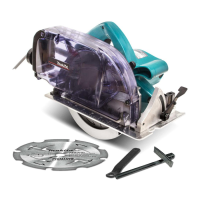
Recommended accessories for the circular saw include saw blades, a rip fence (guide rule), a hex wrench, and a joint for vacuum cleaner connection. Users are cautioned to use only accessories or attachments specified in the manual for their stated purpose to avoid injury.
 General
| Input power | 1550 W |
|---|---|
| Power source | AC |
| Blade diameter | 235 mm |
| Idle speed (max) | 4500 RPM |
| Cutting depth (45º) | 64 mm |
| Cutting depth (90º) | 85 mm |
| Noise level | 106 dB |
 Weight and Dimensions
| Weight | 7200 g |
|---|


 To Next Page