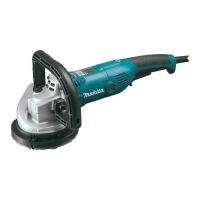
This document is an instruction manual for the Makita Concrete Planer, model PC5010C. It provides detailed information on the tool's specifications, safety warnings, functional description, assembly, operation, and maintenance.
Function Description
The Makita PC5010C is primarily intended for planing concrete surfaces. With optional accessories, it can also be used for grinding, sanding, and cutting metal and stone materials without the use of water. The tool features double insulation, ensuring enhanced safety during operation.
Key functional aspects include:
- Shaft Lock: Prevents spindle rotation for easy installation or removal of accessories.
- Slide Switch: Controls the tool's ON/OFF state, with a lock-on feature for continuous operation.
- Speed Adjusting Dial: Allows users to change the rotation speed, offering versatility for different applications.
- Indication Lamp: Serves as a visual indicator for power connection and potential malfunctions (e.g., worn carbon brushes, controller issues).
- Electronic Functions:
- Overload Protector: Automatically stops the tool if overloaded to protect the motor.
- Constant Speed Control: Maintains a consistent rotating speed under load, enabling a fine finish.
- Soft Start Feature: Suppresses starting shock for smoother operation.
- Unintentional Restart Proof: Prevents the tool from starting if the switch is in the lock-on position when plugged in, enhancing safety.
Important Technical Specifications
- Model: PC5010C
- Wheel Diameter: 125 mm
- Max. Wheel Thickness (When using as a grinder): 7.2 mm
- Spindle Thread: M14 or 5/8" (country specific)
- Rated Speed (n): 9,000 min⁻¹
- Overall Length: 350 mm
- Net Weight: 2.5 - 3.6 kg
- Safety Class: Double Insulation (indicated by the square within a square symbol)
- Noise Level (A-weighted, according to EN60745-2-3):
- Sound Pressure Level (LPA): 85.0 dB(A)
- Sound Power Level (LWA): 96.0 dB(A)
- Uncertainty (K): 3 dB(A)
- Vibration Total Value (tri-axial vector sum, according to EN60745-2-3):
- Work mode: surface grinding with loop handle:
- Vibration emission (ah,AG): 5.5 m/s²
- Uncertainty (K): 1.5 m/s²
- Work mode: disc sanding with normal side grip:
- Vibration emission (ah,DS): 2.5 m/s² or less
- Uncertainty (K): 1.5 m/s²
- Power Supply: Designed for single-phase AC supply of the same voltage as indicated on the nameplate. Double-insulated, usable from sockets without earth wire.
- Speed Adjusting Dial Settings:
- 1: 4,000 min⁻¹
- 2: 5,000 min⁻¹
- 3: 6,000 min⁻¹
- 4: 7,000 min⁻¹
- 5: 9,000 min⁻¹
Usage Features
The manual outlines various usage features and safety precautions for different operations:
General Operation:
- Firm Grip: Always hold the tool firmly with both hands, one on the housing and the other on the auxiliary handle.
- Dust Collection: For clean concrete-planing, connect a Makita vacuum cleaner to the tool. The dust collecting wheel guard is specifically designed for this purpose.
- Corner Planing: The front-edge cover can be removed by sliding it to allow planing in corners.
Accessory Installation:
- Loop Handle: Installs securely with bolts and a hex wrench, only in a specified direction.
- Dust Collecting Wheel Guard: Must be installed before operation as a concrete planer. It aligns with a protrusion on the bearing box and is secured with a screw.
- Offset Diamond Wheel: Mounts onto the spindle with an inner flange and a lock nut. For thinner wheels (4 mm or less), the convex section of the lock nut faces upwards. Requires a genuine Makita offset diamond wheel.
- Side Grip (Handle): Screws securely onto the tool.
- Wheel Guard (for depressed center wheel, flap disc, flex wheel, wire wheel brush / abrasive cut-off wheel, diamond wheel):
- For depressed center wheels, flap discs, flex wheels, and wire wheel brushes, the closed side of the guard must point towards the operator.
- For abrasive cut-off/diamond wheels, a special wheel guard designed for cut-off wheels must be used (though in some European countries, an ordinary guard may be used for diamond wheels, depending on local regulations).
- Mounts with protrusions aligning with notches on the bearing box, then rotates to protect the operator. Some models feature a clamp lever for adjustment.
- Depressed Center Wheel or Flap Disc: Mounts with an inner flange and a lock nut. The inner flange's dented part must fit the straight part at the bottom of the spindle.
- Ezynut (Optional, M14 spindle thread only): Mounts with an inner flange, abrasive wheel, and Ezynut (Makita logo facing outside). Tightened by turning the abrasive wheel clockwise. Loosened by turning the outside ring counterclockwise, possibly with a lock nut wrench.
- Flex Wheel: Requires the supplied guard. Mounts with a back-up pad over the wheel, following instructions for depressed center wheels.
- Abrasive Disc: Mounts with a rubber pad and a sanding lock nut.
- Wire Cup Brush: Threads directly onto the spindle.
- Abrasive Cut-off / Diamond Wheel: Requires a special wheel guard. The direction for mounting the lock nut and inner flange varies by wheel type and thickness.
Operation Specifics:
- Grinding and Sanding: Do not force the tool; its weight provides adequate pressure. Avoid banging the disc/wheel, bouncing, or snagging, especially in corners. Never use wood cutting or saw blades.
- Wire Cup Brush: Check operation with no load. Avoid excessive pressure to prevent premature wire breakage.
- Abrasive Cut-off / Diamond Wheel: Do not "jam" the wheel or apply excessive pressure. Do not start cutting in the workpiece; let the wheel reach full speed first. Maintain a consistent angle (perpendicular for diamond wheels).
Maintenance Features
Regular maintenance is crucial for the tool's safety and reliability.
- Cleaning Air Vents: The tool's air vents must be kept clean to prevent obstruction.
- Replacing Dust Cover Brush: Worn brushes can be pulled off and new ones inserted into retaining grooves, ensuring they are fully hooked onto the outer edges of the grooves.
- General Maintenance: All repairs, carbon brush inspection and replacement, and other maintenance should be performed by Makita Authorized or Factory Service Centers using genuine Makita replacement parts.
- Cleaning Agents: Never use gasoline, benzine, thinner, alcohol, or similar substances, as they can cause discoloration, deformation, or cracks.
Safety Reminders:
- Always switch off and unplug the tool before any adjustments, accessory changes, or maintenance.
- Wear appropriate personal protective equipment, including safety goggles, ear protection, and a dust mask.
- Ensure the work area is clean, well-lit, and free of flammable materials.
- Keep children and bystanders away from the operating area.

 Need help?

 To Next Page
 General