www.mc-techgroup.com CG-2 | 1.04.00 15
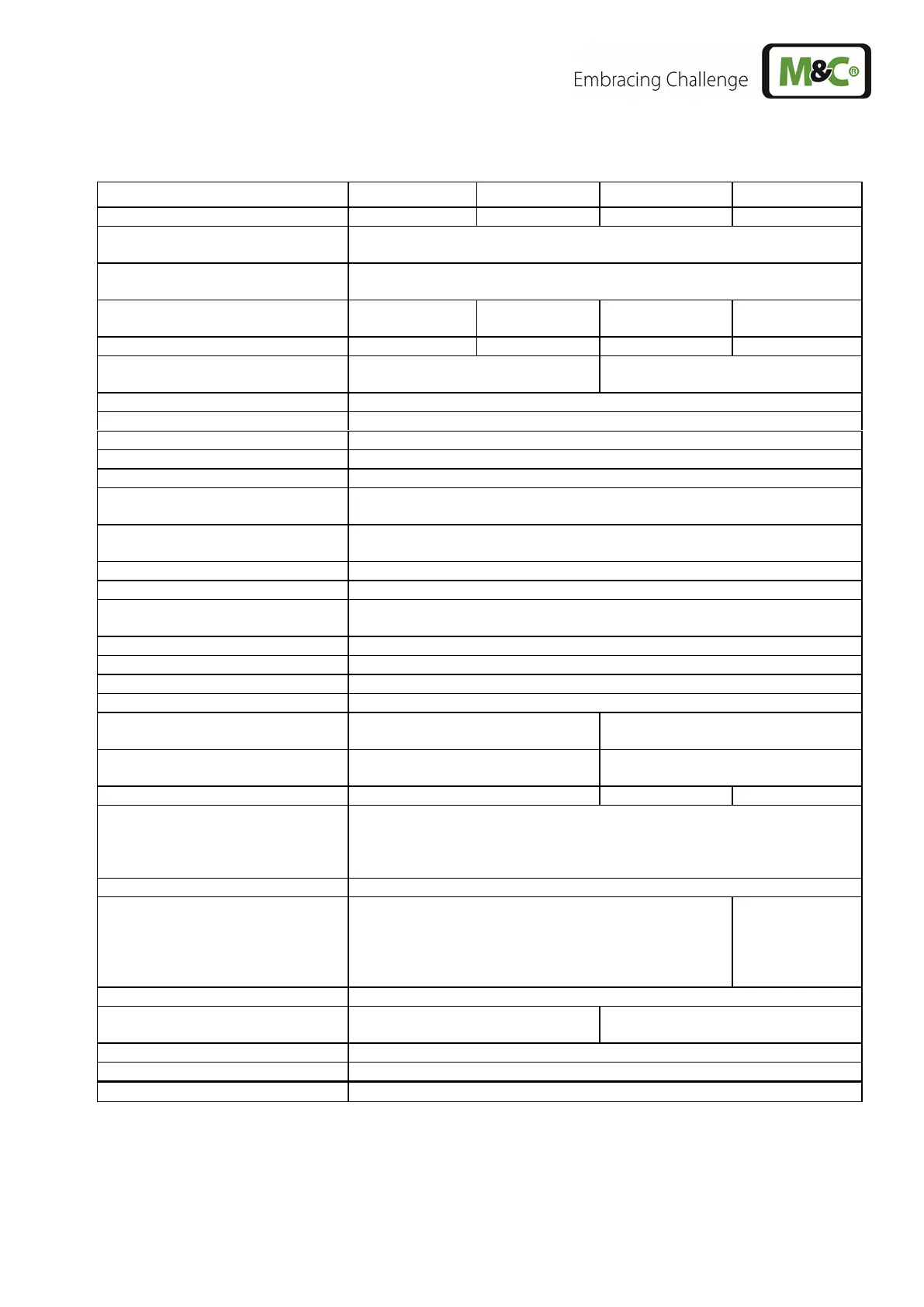
9 TECHNICAL DATA
Part-No.Converter cartridge Type
C Carbon-Molybdenum
Part-No.Converter cartridge Type
SS metallic Filling
Gas inlet and –outlet non-heated
(cold) or heated (hot)
Max. +80 °C [176 °F],
dew point “dry“
Max. +250 °C [482 °F],
dew point <160 °C [320 °F]
Temperature range, adjustable
30 to 60 Nl/h, max. 90 Nl/h
Max. 2 bar abs. (pressure deviations only with max. 0.1 bar/min)
Volume of the converter cartridge
Operating temp. converter car-
tridge type C
Min. 320 °C [608 °F] typ. 350 °C [662 °F] max. 380 °C [716 °F]
Operating temp. converter car-
tridge type SS
Min. 620 °C [1148 °F] typ. 660 °C [1220 °F] max. 680 °C [1256 °F]
200 ppm (type C), 2000 ppm (type SS) at new catalyst
Conversion rate NO
2
in NO
Effectiveness > 95 % for a new catalyst
Service life of the NO
2
/NO catalyst
Change as a preventive measure every 6 months for type C**
Change as a preventive measure every 12 months for type SS**
< 20-60 mbar depending on type
+10 to +50 °C [50 to 122 °F]
-25 to +65 °C [-13 to 149 °F]
Connection sample gas inlet and
outlet
PVDF-fitting G1/4 i DIN 228/1
ø6 mm tube fitting, 1.4571*(316Ti*)
230 V 48-62 Hz
or 115 V 48-62 Hz (a)
230 V 48-62 Hz
or 115 V 48-62 Hz (a)
Mains power plug connector incl. 2 fine fuses 5 x 20 mm,
230 V / 3.15 A
TT
or 115 V / 6.3 A
T
,
2 m [approx. 6.56 ft] cable with shockproof plug.
Alarm- and control signals 9 pin Sub-D-connector
Status signals for temperature
1 Contact potential free, max. contact rating 24 V,
1 A
Material of sample contacting parts
Stainl. Steel SS316Ti, PTFE, FPM, PVDF
Stainl. Steel
SS316Ti, PTFE,
FPM, PVDF, alu-
minium hard-
coated
19" rack mounting,
3U, depth 350 mm [13.78”]
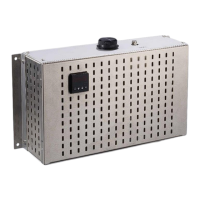
Wall mounting,
height 350 mm [13.78”], depth 3U
Electrical equipment standard
Option for CG-2 and CG-2M
Mounting bracket, 3U – 84HP, Part No.: 50A3000
* Standard ø 6 mm connection, optional ø ¼“ – please indicate with order.
** The indicated service life of 6 respectively 12 months is the minimum service live of the catalyst material under
normal conditions and in not highly corrosive, reducing or oxidizing atmospheres. The operator is responsible for
checking and, if necessary, adjusting the life cycles.



 To Next Page