1-25
G IH
C - Prelevare un carico in alto su
pneumatici.
È tassativamente vietato prelevare un
carico se il carrello elevatore non è in
piano (Vedi paragrafo : G -
ORIZZONTALITÀ DEL CARRELLO ELEVATO-
RE nel capitolo : MOVIMENTAZIONE DI UN
CARICO).
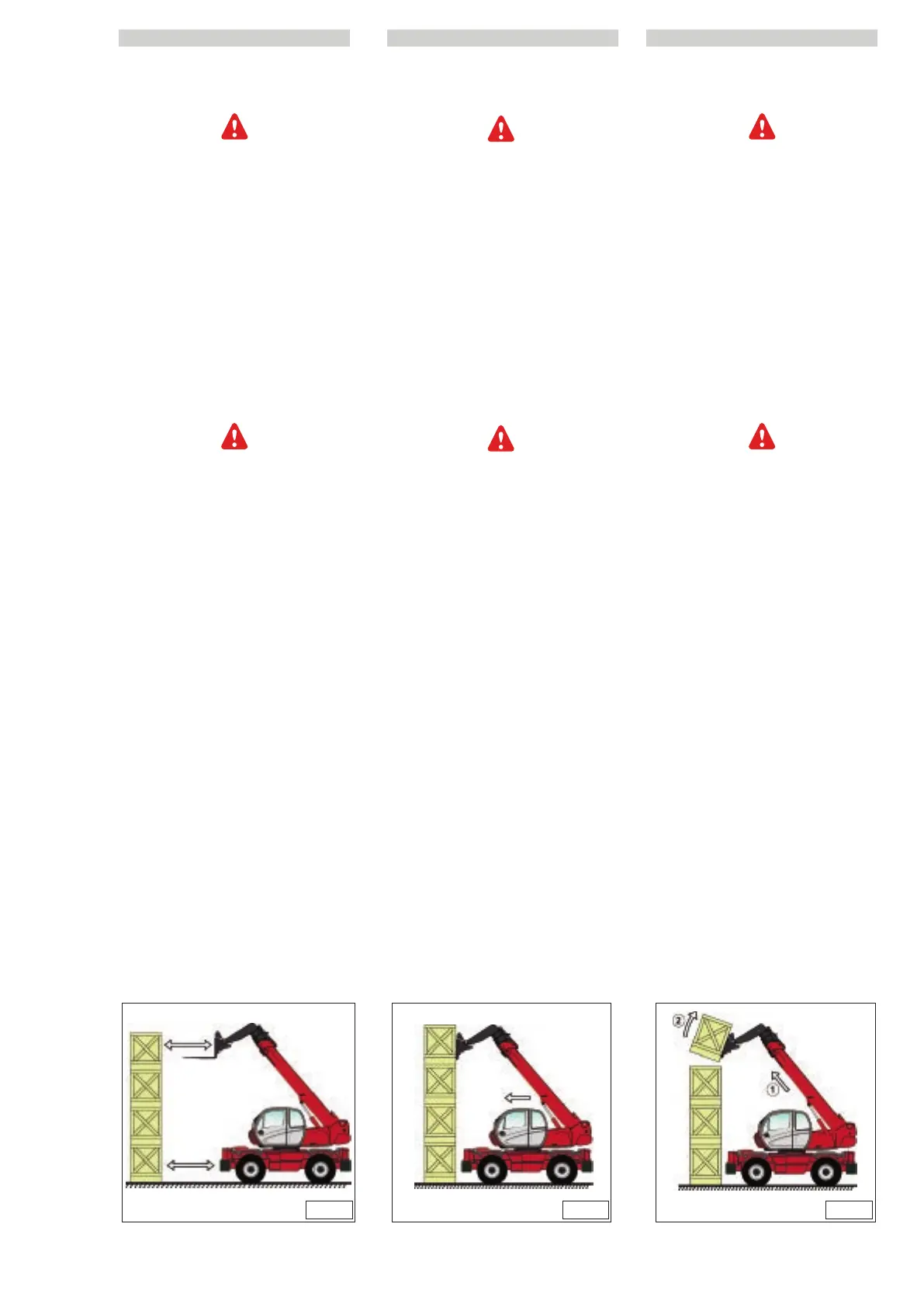
- Verificare che le forche passino
facilmente sotto il carico.
- Avvicinare il carrello elevatore
perpendicolarmente al carico con le
forche orizzontali (Fig. G), manovrando
dolcemente e con prudenza (Vedi
paragrafo : E - VISIBILITÀ nel capitolo :
ISTRUZIONI PER LA MOVIMENTAZIONE
relativo alla visibilità sul percorso).
Ricordandosi di mantenere sempre la
distanza necessaria per inserire le forche
sotto il carico, tra la pila e il carrello eleva-
tore (Fig. G), utilizzando la lunghezza mini-
ma possibile del braccio.
- Portare le forche contro il carico (Fig. H).
Tirare il freno di stazionamento e mettere
la leva dell'invertitore di marcia in folle.
- Sollevare leggermente il carico (1) e
inclinare il portaforche (2) indietro per
stabilizzare il carico (Fig. I).
it
C
- Taking up a high load on tyres.
Under no circumstances should you pick
up a load if the lift truck is not in a hori-
zontal position. (See paragraph : G - HORI-
ZONTAL POSITION OF THE LIFT TRUCK in
the chapter : LOAD HANDLING).
- Ensure that the forks will easily pass
under the load.
- Position the lift truck perpendicular to the
load with the forks in a horizontal
position (Fig. G) manoeuvring gently and
carefully (See paragraph : E - VISIBILITY
in the chapter : HANDLING
INSTRUCTIONS for visibility of the road).
Always think about keeping the distance
necessary to fit the forks under the load,
between the pile and the lift truck (Fig. G)
and use the shortest possible
length of jib.
- Stop with the forks in front of the load
(Fig. H). Apply the parking brake and
place the forward/reverse lever in
neutral.
- Slightly lift the load (1) and incline the
forks carriage (2) backwards to stabilize
the load (Fig. I).
en
C - Pobieranie na oponach ładunku
znajdującego się wysoko
Kategorycznie zabrania się pobierania
ładunku, jeśli wózek podnośnikowy nie
jest ustawiony poziomo (zobacz punkt G -
USTAWIENIE WÓZKA PODNOŚNIKOWEGO
W POZIOMIE w rozdziale OPEROWANIE
ŁADUNKIEM).
- Sprawdzić, czy widły przejdą pod
ładunkiem.
- Podjechać wózkiem podnośnikowym
prostopadle do ładunku, z widłami
ustawionymi poziomo (Rys. G), operując
powoli i ostrożnie (patrz punkt: E -
WIDOCZNOŚĆ w rozdziale : INSTRUKCJE
NA TEMAT MANEWROWANIA, dotyczący
widoczności drogi).
Pamiętać o zachowaniu odległości
niezbędnej do wsunięcia wideł pod
ładunek, między sztaplem a wózkiem
podnośnikowym (Rys. G), wykorzystując
jak najkrótszą długość wysięgnika.
- Widły ustawić naprzeciw ładunku (Rys. H).
Zaciągnąć hamulec postojowy, a
następnie ustawić dźwignię zmiany
kierunku jazdy w położeniu jałowym.
- Lekko unieść ładunek (1) i przechylić
karetkę (2) do tyłu, w celu
ustabilizowania ładunku (Rys. I).
pl
648870 IT-EN-PL (04/05/2015)







 To Next Page