EasyManua.ls Logo

Marantz 2240 - Suggestions for AM Tuner Trouble Shooting

Marantz 2240
43 pages
Print Icon
To Next Page IconTo Next Page
To Previous Page IconTo Previous Page
Loading...
The
DC
component
of
the
detected
IF
signal
is
used
as
a
AGC
voltage
to
control
emitter
current
of
RF
amplifier
through
the
AGC
amplifier
incorporated
in
the
IC.
A
part
of
the
DC
component
is
also
applied
to
the
signal
strength
indication
amplifier
H154.
The
output
appears
at
the
collector
of
H154
and
is
level
adjusted
by
R178,
indicated
on
the
signal
strength
meter
MO04.
2.1
Suggestions
for
AM
Tuner
Trouble
Shooting
Check
for
broken
AM
bar
antenna,
next
try
to
tune
station
by
rotating
fly-wheel
tuning
knob
slowly
and
observe
the
AM
signal
strength
meter
whether
it
deflects
or
not.
If
the
signal
strength
meter
gives
a
deflection
at
serveral
frequencies
received,
no
failure
may
exist
in
the
stages
at
least
preceding
the
detector
circuit.
Next
connect
a
oscilloscope
to
the
test
point
B
or
J161
and
check
for
audio
signals
with
the
tuning
meter
deflected.
If
the
signal
strength
meter
does
not
deflect,
check
the
local
oscillator
circuit.
Normal
oscillating
voltage
at
the
hot
end
of
the
oscillator
tuning
capacitor
is
about
1.5
or
3
volts,
varying
with
tuning
capacitor
position.
When
measuring
oscillating
voltage
use
a
RF
VTVM,
no
circuit
tester
gives
correct
indication.
If
the
local
oscillator
voltage
is
normal,
check
all
voltage
distribution
in
the
AM
circuits
by
using
a
DC
VTVM
and
compare
the
measured
values
with
those
given
in
the
schematic
diagram.
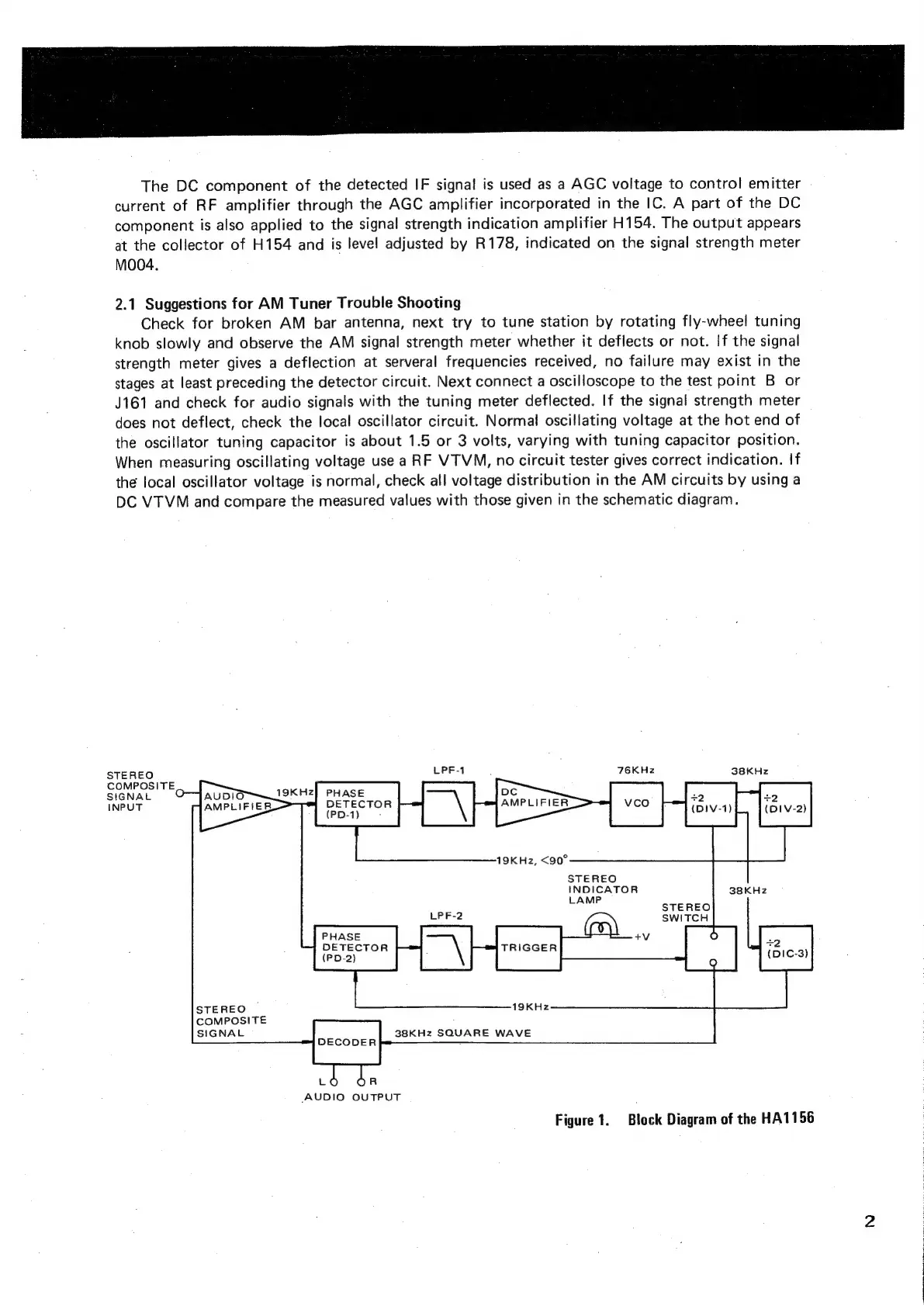
STEREO
LPF-1
76KHz
38KHz
COMPOSITE,
SIGNAL
PHASE
INPUT
DETECTOR
(PD-1)
:
AUDIO
19KHz
AMPLIFIER
STEREO
INDICATOR
LAMP
STEREO
SWITCH
PHASE
DETECTOR
(PD-2)
STEREO
|
19KHz
COMPOSITE
SIGNAL
38KHz
SQUARE
WAVE
AUDIO
OUTPUT
Figure
1.
Block
Diagram
of
the
HA1156

Other manuals for Marantz 2240

Related product manuals